Snapshots in History: November 4-5: Remembering the Kitchen Accord and the Constitution
On November 4-5 and
beyond, Canadians may want to reflect on the events of November 4-5, 1981 that
led to the patriation of Canada’s constitution from the
United Kingdom and the subsequent ratification of the Constitution Act (1982)
and the Canadian Charter of Rights and Freedoms by Canada’s federal government
and a majority of the provincial governments. However, the outcome was far from
perfect and harmonious as the then-separatist Parti Québécois (PQ) government of
Québec under Premier René Lévesque refused to go along with the
federal government and some of the other provincial governments who disagreed
on issues such as an amending formula, the proposed Charter of Rights (which
some provinces saw as encroaching on their jurisdiction and powers), and the
provincial right to opt out of federal programs in exchange for compensation. Initially,
the provinces of Ontario and New Brunswick sided with the government of Canada
against the other eight provincial governments including Québec (referred to as
the “Gang of Eight”). At the constitutional meetings of November 1981, the
matter was turned on its head when Lévesque agreed with Prime Minister Pierre Trudeau on the
provisional idea of patriating the constitution without amending it, followed
by the possibility of a national referendum in several years time. Other
provincial premiers were concerned that this course of events, if followed
through, would lead to a diminution of provincial powers. So began the push to
make a deal…
On the evening of
November 4, 1981, then-federal Justice Minister Jean Chrétien met with then-Ontario
Attorney-General Roy
McMurtry, and
then-Saskatchewan Attorney-General Roy Romanow in the kitchen of the Government
Conference Centre in Ottawa, thereby being dubbed The Kitchen Cabinet.
The Premiers agreed to remove the “opt-out” clause off the table, while the
federal government agreed reluctantly to include the notwithstanding clause that would allow provincial
governments to override certain sections of the Canadian Charter of Rights and
Freedoms. Prime Minister Pierre Trudeau agreed and The Kitchen Accord
was born. Québec Premier René Lévesque learned of this deal on the morning of
November 5, 1981 at breakfast, felt a sense of betrayal, and announced that his
government would not support the deal and left the meeting. Québec announced
its intention to veto the agreement but subsequent rulings by the Québec Court
of Appeal and the Supreme Court of Canada stated that the province did not possess
veto powers, even though previous administrations had argued for the right of Québec
to have a veto in constitutional negotiations.
For those who are interested in this aspect of
Canadian constitutional history, consider the following titles for loan from
Toronto Public Library collections:
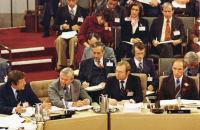
Canada’s
constitutional revolution / Barry L. Strayer, 2013. Book. Adult
Non-Fiction. 342.71029 STR
The now-retired Hon. Dr. Barry L. Strayer, who served
on the Federal Court of Canada and the Court Martial Appeal Court of Canada,
was also a constitutional adviser to the federal government who was influential
in designing the Canadian Charter of Rights and Freedoms. In this work, Dr.
Strayer shares his experiences as an important legal advisor. He discusses the
constitutional discourses of the 1960s and the influence of Pierre Trudeau and
constitutional expert F. R.
Scott on the Charter of Rights file. Strayer also lays out the negotiations
before and after the 1980 Québec referendum, the ensuing federal-provincial
conflict, and the eventual conclusion of the patriation process.
The Canadian constitution / Adam Dodek, 2013. Book. Adult
Non-Fiction. 342.71029 DOD
The author, a law
professor at the University of Ottawa, provides an up-to-date overview of
Canada’s constitutional history, including a brief overall history, an
examination of the Constitution Acts of 1867 and 1982, the importance of the
Supreme Court of Canada and its Justices, key constitutional cases, and
important dates in Canadian constitutional history.
Also available as an eBook.
The
last act: Pierre Trudeau, the gang of eight, and the fight for Canada
/ Ron Graham, 2011. Book. Adult Non-Fiction. 342.71029 GRA
Journalist Ron Graham offers the reader a good
accounting of what happened that fateful November in 1981 with the negotiations
to fully bring Canada’s constitution home from the United Kingdom. Watch the
shifts in position between the opposing camps on the constitutional front that
led to the “Kitchen Accord”. Lévesque expresses anger at what he sees as a
betrayal of Québec and likens it to “The Night of the Long Knives” (which
usually refers to Hitler’s purge of the Nazi Party in 1934) although it is
doubtful whether the PQ government would have agreed to anything. Trudeau sees
the patriation process as legal but also as mean. However, he also the Canadian
Charter of Rights and Freedoms come to fruition but later regretted agreeing to
the notwithstanding clause. Read Andrew Cohen’s review of this book in the
Globe and Mail here.
Also available as an eBook.

Memoirs
and reflections / R. Roy McMurtry, 2013. Book. Adult
Non-Fiction. 340.092 MACM MACM
The former “Red Tory” Progressive Conservative
attorney-general of Ontario (and member of provincial parliament) offers
insights into a varied and exceptional career that also included time as a
reformist defense lawyer, Canadian high commissioner to the United Kingdom, and
chief justice in Ontario. In addition to being in the midst of constitutional
discussions while provincial attorney-general, McMurtry also discusses legal
cases mired in controversy, including the police raids on Toronto bathhouses,
and a nurse wrongly accused of and charged with murdering babies.
The
patriation minutes / Howard A. Leeson, 2011. Book. Adult
Non-Fiction. 342.71029 LEE
See the developing constitutional negotiations in
early November 1981 through the lens of Dr. Howard A. Leeson, a political
science professor then serving as Saskatchewan’s Deputy Minister of
Intergovernmental Affairs. Leeson has made public his primary sources: notes and minutes taken at meetings of the
First Ministers as well as in-depth memos of meetings taking place away from
the Government Conference Centre.
If you want to delve a little further back, try the
following title as well:
Canada–
notwithstanding : the making of the constitution, 1976-1982 / Roy J. Romanow,
Howard A. Leeson, and John D. Whyte, 1984. Book. Adult Non-Fiction. Find copies
under: 342.71029 R / 342.029 ROM
The authors offer an
inside account of the process leading to the patriation of the constitution and
the beginning of the Canadian Charter of Rights and Freedoms. They acknowledge
that the process and outcomes can be criticized but achieving full independence
and constitutional reform are symbolic of Canadians’ resolve to sustain their
country.
Comments