I Tried Knitting “Field Comforts” from a WWI Pamphlet
Toronto Public Library's Digital Archive is a great way to explore books from the past. In previous posts, I looked at Canada's first cookbook and a 19th-century book on learning how to draw. For Remembrance Day, I decided to move forward in time to the First World War.
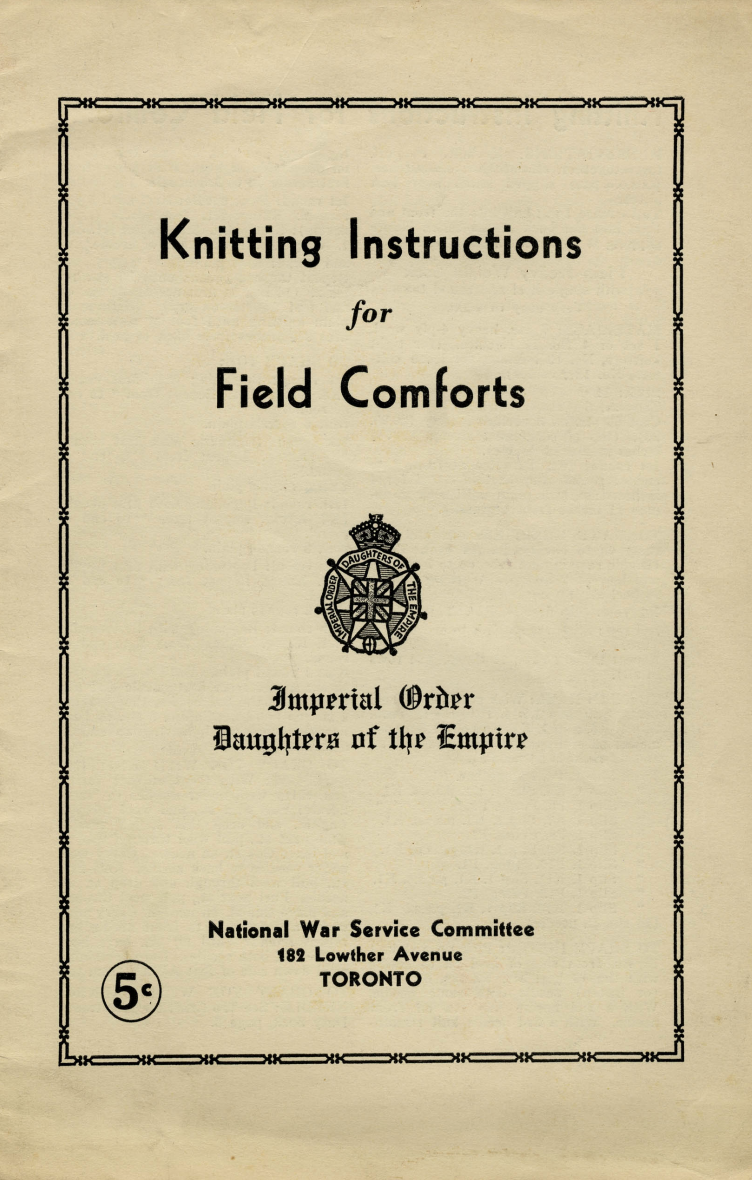
I found this book: Knitting Instructions for Field Comforts. It's a 1914 pamphlet published in Toronto by the Imperial Order Daughters of the Empire. It has 11 patterns for knitted garments to send to soldiers on the WWI battlefields. To immerse myself in the history, I set out to make some of these patterns.
WWI and knitting
Every war has its horrors. Some of the most lasting images from WWI are those of young soldiers fighting both the elements and the enemy in the freezing trenches of the European battlefields.
The knitting pamphlet refers to field "comforts". You can imagine that it would have truly been a comfort to receive a gift of a warm knitted item, especially one hand-made by a loved one.
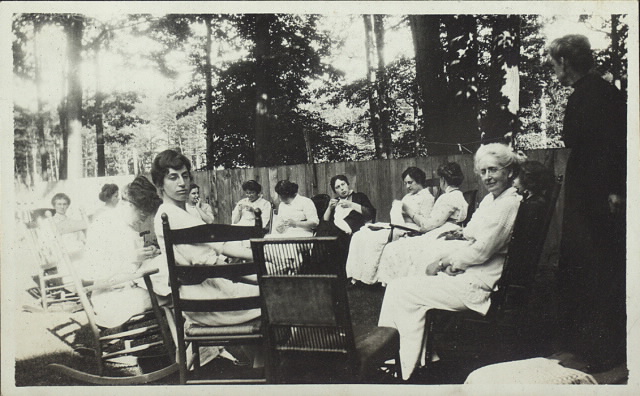
Items in demand included scarves, mitts, pullovers, caps, balaclavas and especially socks. Socks were essential for keeping feet warm and dry in the muddy ditches where soldiers spent so much of their time. Knitting was considered to be an important aspect of support on the home front. Gatherings for that purpose, such as the one seen in the photo below, were fairly common.
The instructions
I approached the pamphlet with a certain amount of trepidation, thinking that these instructions written over a hundred years ago might be difficult to work from.
However, this was not the case at all. The instructions were very approachable, although they'd certainly be a mystery to someone who'd never seen a knitting pattern at all. Especially since there were no illustrations or diagrams. But they used the same abbreviations and jargon used by modern patterns, so I think any experienced knitter would be able to work from them.
As an example, here are the full instructions for "Service Scarves":
FOR THE NAVY—
MATERIALS: 4-ply Beehive Fingering or 4-ply Miss Canada Fingering. 11 ozs. Navy. Two No. 10 Knitting Needles.
MEASUREMENTS: Length 66 to 72 ins. Width 14 ins.
Tension: 7 1/2 sts.=1 inch.
Cast on 96 sts. Knit 66 inches in plain knitting (Garter st.). Cast off.
FOR THE ARMY—
MEASUREMENTS: Length 46 ins. Width 12 ins.
Cast on 76 sts. Knit 46 inches in plain knitting (Garter st.). Cast off.
Picking the yarn
Previous adventures in testing the rare books in our Special Collections for a modern readers have been solo. But this time I had backup. Shortly after I decided on this project, I mentioned it to my colleague Pam. "Knitting?" she said, her face suddenly suffused with a look of keen attention, "Do you need any help?"
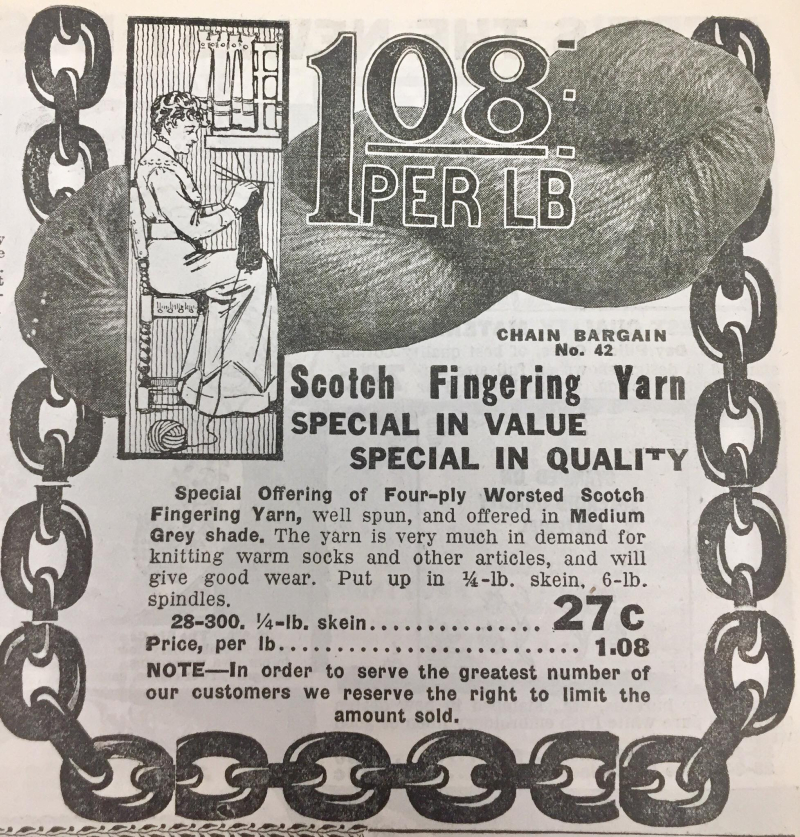
She held good on her offer and even found some information about the exact kind of yarn that would have been used for these patterns in a 1916 Eaton's catalogue available on our Digital Archive. A medium grey shade was favored for war knitting. Since that offer of $1.08 for a pound of yarn had expired long ago, Pam instead chose a somewhat military shade of green for her "Gunner's Half Mitts".
The results
Two knitters meant the chance to try two different patterns. The one that intrigued me the most was the one for "Rifle Mitts." This pattern is like that of a standard pair of mitts. However, the index finger on the dominant hand is knitted as separate, like for a glove. This keeps the hands warmer than a set of fingerless gloves would, but still leaves the trigger finger free.
Aside from having to work with double-pointed needles (the bane of glove and sock-makers), the pattern was easy to follow. Here's a pictures of the work in progress (featuring my crafty helper Dahlia) and the finished right hand mitt.

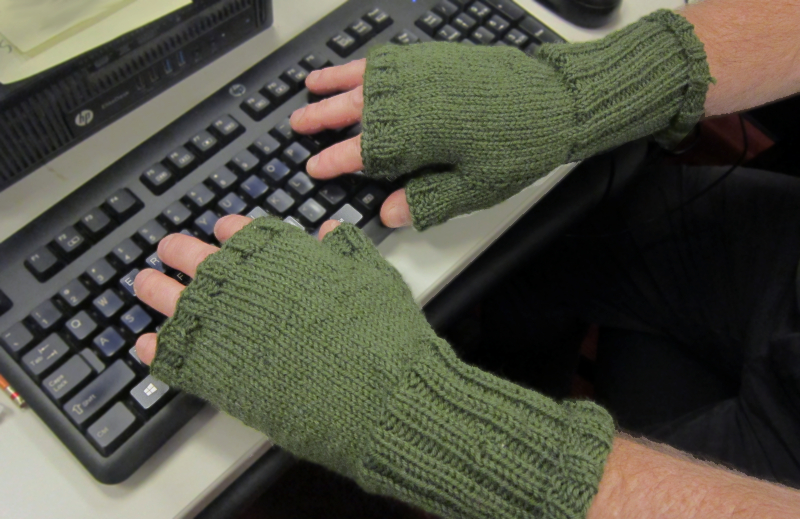
My colleague finished the "Gunner's Half Mitts" in record time. You can see them below modeled by another one of our coworkers. These mitts provide less warmth than the rifle mitts but allow for free movement of all the fingers.
Knitting Instructions for Field Comforts turned out to be a useful source of basic patterns that would make good gifts for modern soldiers or other loved ones.
Not a knitter? Our Digital Archive has many more resources related to both WWI and WWII, and we invite you to browse the archive for books, photos and more — including WWI posters and WWII posters from Canada.
Or explore some related posts from Toronto Public Library:
- Riveting Rosies: Ephemera and Photographs of Canadian Women in the Second World War
- World War II Posters: 5 Things They Told Canadians To Do
- We Asked Toronto to Remix Wartime Posters for the Current Moment
18 thoughts on “I Tried Knitting “Field Comforts” from a WWI Pamphlet”
Very creative!
Thank you for your excellent and fascinating blog about knitting and World War I, Peggy. I love the Eaton’s ad! Good for you for actually knitting rifle mitts, and your colleague for knitting gunner’s half mitts.
These are great! 😍 I think combining the thumb and index finger of a half mitt with the rifle mitt would be quite useful these days for using a smartphone!
I did that very thing for mitts to use this winter! (But it didn’t feel appropriate to include my pampered texting mitts in this blog post. 🙂)
Thank you! I’m glad you enjoyed it!
Thank you!
OMG, that’s amazing! I am working on a 1916 cardigan to top my WW1 nurse’s uniform (I reenact as a member of the Canadian Army Medical Corps) and I think some of these will have to be next!
How fun!
That’s very interesting, Victoria! As a librarian, I can appreciate a professional woman in a cardigan. 😉 I hope you get some use out of the patterns.
Amazing idea. It is wonderful to see history come to life.
Great blog Peggy! Knitters might also be interested to know that you can still knit for the merchant seamen using the 1898 hat pattern. It’s on Ravelry and there’s a helpful YouTube video showing how to knit the brim. It’s an excellent pattern and it’s also a free one.
https://www.ravelry.com/patterns/library/1898-hat
Bonus pattern! Thanks, Anne.
So interesting. I’m part of a group that knits hats etc for the homeless and school children. We’ve been knitting outside up until last week.
That’s a wonderful initiative, MP. Gathering outdoor to knit warm garments for those in need sounds very much in the spirit of the women’s knitting circle shown in the blog.
What a great idea for a blog post! You really got into the spirit of it.
What a fun and interesting blog! I recently came across a poem, by Canadian poet Katherine Hale, that is quite fitting. It is from her book Grey Knitting and other poems published in 1914.
A tiny click of little wooden needles,
Elfin amid the gianthood of war;
Whispers of women, tireless and patient,
Who weave the web afar.
Thank you for sharing the poem, Fiona! It’s perfect.
Great blog! I love that you included the yarn ad and scarf patterns. I wasn’t aware of gunner’s mitts, so thanks for teaching me something new today.