Young Voices is old!
 Young Voices magazine turns 50 this year!!
The first issue came out in December of 1965 and was introduced by a note "From the Editor to the Contributors" that began:
"Young Voices" is a young people's magazine published by North York Public Library. All contributions are by students of high school or junior high school age… Over 60 contributions were received, some of outstanding quality, but all of great interest or originality.
Young Voices has grown over the years — for the 2014 issue of the magazine we received over 650 submissions — but the goal of the magazine remains the same: to publish great writing and visual art created by teens living in Toronto.
Jack Burman, who was 16 years old in 1965 and attended Downsview Secondary School, had his story "The Funeral" published in the first issue of Young Voices.
Jack went on to become a professional photographer, who, according to the CBC in their review of Jack's book The Dead, "brings to his photographs a strong literary sensibility."
Jack was kind enough to provide TPL teens with one of his photos, which he describes as "a kind of shaman's mask from a 19th century Kongo-region tribe. The idea of the mask — in particular the mirrored/coated eyes — was to enable vision into the next world, the world of the Ancestors and Spirits/Gods." Adds Jack, in reference to his Young Voices story, "I haven't managed to get too far in 50 years from the crossing represented by a funeral!"
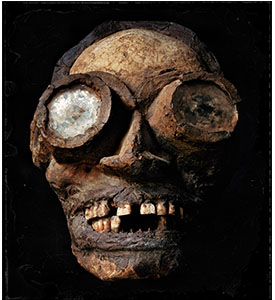
Here's Jack's story from Young Voices 1965:
The Funeral
A mid-April morning; out of a house stepped a young boy, who was greeted by a raw, gusting wind that made his clothes, apparen'tly warm and heavy, feel thin and insufficient. On this day he was quite generous with his attention, and now gave it freely to the sky, which seemed decidedly unnatural. Rows of clouds spread neatly to the horizon, a horizon pricked by the odd thread-thin column of smoke, and the not-so-odd office or apartment building. The clouds were uniformly shadowed by the brush of an unimaginative painter, so that their grey darkened very gradually down towards their bottoms. Their positioning was particularly singular; a stiff regimentation, like pupils of some austere master. But, inevitably, the sky's oddity was soon forgotten, and the boy's mind returned to the event at hand: a funeral.
The young boy (a friend of the deceased's son) entered the family car, and was presently on his way to the distant funeral chapel. Rather than focus his thoughts on recent occurrences, he stared determinedly out the car window, and was easily diverted by a number of passing sights. He counted the points on the maple leaves that adorned each new Canadian flag he saw, for he had read somewhere that the official number of points was eleven — not thirteen as some flags had. He noticed with curiosity the signs on the store windows, carelessly printed in Italian or Ukrainian. As the car rumbled over the streetcar tracks and the cobbled section of the main street, he was afforded the odd view down a street with old, old houses packed together on each side. Even in this bleak weather, some children scampered here and there among the scrub lawns and dirt driveways, and enjoyed themselves mightily. Presently the chapel, flanked by a car-lot and a row of stores, met the youth's wandering eye, and the car lurched to a stop down a nearby side street.
Inside the chapel, the lights were justly dim. The rabbi was not yet present, and the people spoke in whispers and low tones:
"How did you know him, Sam?"
"A quiet man, such a quiet man…"
"He worked for me a while back — a darn good fellow."
"A hear attack! And so young, poor man…"
Now the rabbi stumbled slowly down the centre aisle, and all became quiet. His white beard grew rather haphazardly, and he clutched a memorial prayer book under his arm. After reaching an oft-used lectern, he turned towards those assembled in an awkward, faltering way, and opened the prayer book. He was the very model of an orthodox, Old Country Jewish rabbi — the beard, the gait, the wrinkled face and soft, wise eyes, the long ancient, matte black robe — all were so characteristic and symbolic!
His words did not seem inspired. They did not soar freely and majestically, and lift the soul to dizzy heights. No, they were mumbled, so as to be barely understandable. They were directed only at the family of mourners sitting in the front rows, so as to be virtually inaudible at the rear of the chapel. They were spoken in a very… a very human way, that's all.
The hard wooden bench offered the young boy no comfort. This was not the first funeral he had attended, and, as at others, he struggled to prevent himself from thinking the irreverent thoughts that plagued him on such occasions. He actually taunted the good that was in him by bringing it face to face with the evil that he — that everyone — could so easily produce.
This conflict was periodically interrupted by some person's late arrival. The heavy chapel door would open, and the roar of clanging streetcars, of honking autos — of normal city life would swoop in and bury the rabbi's prayers under a mass of heathen noise.
But when the door closed, silence magically returned and the service continued. Despite several such interruptions, the rabbi managed to complete the memorial prayers, and those gathered left for the long drive to the cemetery.
***
The setting was one that would quicken the pulse of any poet or writer. It was perfect — the place of burial was removed from other graves, being on the summit of a windswept hill. Tall pine trees graced the scene, and provided a gentle song of mourning when their branches swished in the swirling breeze. All was very idealistic — like a vague image of perfection that had somehow escaped from the mind and settled unseen on this small plot of land. The result was a diminutive landscape that achieved what the rabbi had not: the young boy, and surely many around him, basked in fleeting seconds in a timelessness where pure thought shone everywhere — in an infinity of honest thought (be that thought virtuous or corrupt by the world's standards). Truth, with its varying shades of good and evil, prevailed. Nowhere was there shallow, man-made irreverent thought to torture or test the good in a person. The young boy did not stop to realize this latter fact, nor did any around him. It would have been inhuman to wilfully analyze this state of mind. Only after this mental elevation has lived a full life, and come to a quiet end, does the conscious mind, which has waited patiently far, far below, regain its position of prominence, and resume guiding the body through the series of sensuous manoeuvres referred to by some as Life. The conscious mind had no place in this state of suspended animation, nor did irreverent thought, which is spawned in the conscious mind. After such a holy experience, the youth felt a vacuum, a void, an emptiness, lodged uncomfortably within him, so that he knew he had missed a golden chance, a rare opportunity. Bur for what? A golden chance for what? This he could not begin to answer at his stage of development — perhaps at any stage of development.
***
The pitiful sobbing of many around him returned the boy to… to what? Reality? Oh, that will do, but there is just as strong a reality in the forementioned uplifting and suspension of the soul. The boy returned to… to earthly reality — that's better. As the crowd of mourners swept him along back to the parking lot, the young boy glanced back at the memorable site of his transitory elevation. But he looked back on what was now, oddly enough, a very ordinary scene. A lonely rectangle of freshly turned sod marked the top of a small hill. The pine trees were now quite short, and their branches hung limply in the sudden calm afternoon air.
Comments