[Original] Journey to Freedom Day
Today we celebrate the Journey to Freedom Day, remembering the massive wave of Boat People who fled from Vietnam to Canada in late 1970s. Among them were a significant number of ethnic Chinese, some of whom had lived in Vietnam for generations.
China and Vietnam are known to have close geographical and historical connections for centuries. Major waves of Chinese immigration to Vietnam go back as early as the 1400s. Prior to 1976 approximately 1.2 million Chinese were living in Vietnam. During the century leading to 1975 Chinese played a leading role in Vietnam’s private business sector; they made up high percentage of well-established middle class and upper class ethnic group. When tension increased between China and Vietnam after the Vietnam War, both ethnic Chinese and native Vietnamese fled the country as boat people between 1975 and 1979 due to political and economic changes. In commemorating the Vietnamese refugees’ endeavors for freedom, we acknowledge the part that ethnic Chinese took in the massive migration.
The Chinese Canadian Archive at the Toronto Public Library has fortunately collected numerous documents and photos of Chinese who joined the exodus and chose Toronto as the final destination of their journey.
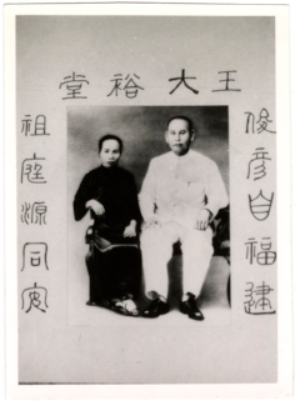
One such collection is that of the Vuong family, who originated from Tong’an of Fujian Sheng in China (福建省同安縣) and moved to Vietnam in early 1900s. The above photo is of Vuong Jin Sha (王金沙) and Hong Yu Man(洪玉滿), the patriarch and matriarch of the family. The image was kept in family shrine and was paid tribute to by later generations at family events and holidays.
On June 9, 1978, seven members of the family, including a three-year-old boy, fled Saigon. The group escaped from one place to another, passed border inspections, were detained in refugee camps, packed into junk ships, floated on the ocean, and eventually reached Canada in August 1979. During the 14-month journey, numerous letters and photos were mailed home, narrating daily happenings.
This is the first letter from the group one week after they escaped:
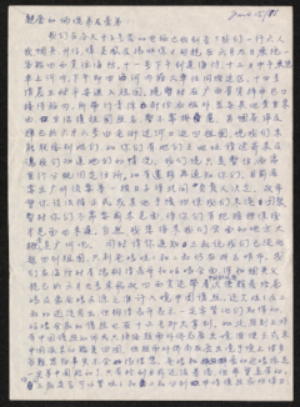

“We left Saigon via United passenger ship June 9th and arrived the coast border inspection on the afternoon of the 11th. On the 13th we arrived at the City of Hanoi on a bus and then took a train to the border area of Tongdeng. 5 o’clock in the morning of the 14th, we entered China safely…”
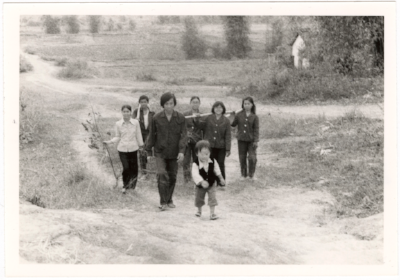
This photo was taken of the group at Yingde Tea Plantation in Guangdong Province of China (廣東英德茶廠) in November 1978, one of the refugee camps they were detained at for a few months. The precious picture was captured illegally because photography was prohibited in the camp.
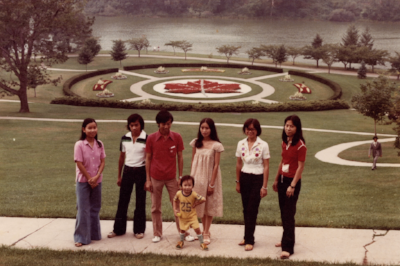
They finally arrived in Toronto in August. One of the very first family outings was to have their photo taken in High Park with the maple-leaf flowerbed as background, to commemorate the new-found start of life.
The group felt safe and welcomed in Canada. They quickly settled and established new lives. They attended English classes, searched for employment, built businesses and grew their families.
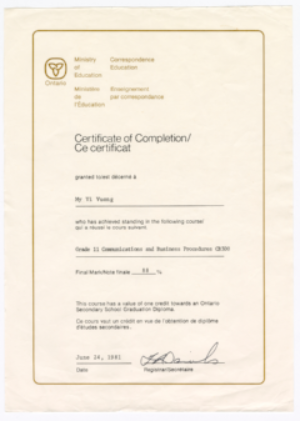
This document certifies My Vi Vuong’s completion of Communication and Business Procedure class offered by Ontario Ministry of Education in 1981.
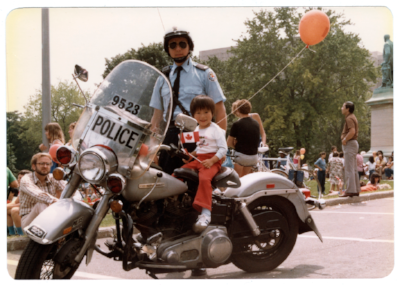
Living in Toronto, the family’s peace and enjoyment of life was restored. Their annual family event is to celebrate Canada Day at Queen’s Park. This photo of Sing, the three-year-old boy in the fleeing group, was taken July 1, 1980, the year following their arrival in Canada. From then to 2000, they took a family photo every July 1 at the same location; all of these are now preserved at the Chinese Canadian Archive of the Toronto Public Library.
Forty years have now passed since the exodus; the family’s experiences have formed a brave and encouraging history for younger generations to learn from. They left a war-torn country behind looking for a new home, surviving border inspections, diseases, starvation, ocean storms and pirate robberies. In remembering the refugees’ journey to Canada, we also recognize the Chinese people’s involvement, because it’s not only family history but also a nation’s history that should be always remembered and valued.
If you have inquiries about the Chinese Canadian Archive, please contact us at afan@torontopubliclibrary.ca. Comments, questions and donations are always welcomed.
Comments