Five Ways to Discover the Art of Cartography: Free Exhibit Opens August 13!
Our new exhibit, The Art of Cartography, opens this Saturday, August 13 in the TD Gallery at the Toronto Reference Library. The exhibit features magnificent maps and atlases from the library's Special Collections dating from the 16th to the 19th century. As always, admission is free and the gallery is open to the public during regular library hours.

Map of Palma from Civitates Orbis Terrarum, Georg Braun (1541-1622), Frans Hogenberg (1535-1590), 1593
Cartography –- the practice of making maps –- is both an art and a science. Throughout history, maps have been created for practical purposes, telling us where we are in the world and helping us find where we are going. We have used maps to chart the land, sea and skies and to understand our place in the world. Maps can be functional and informative, but they can also be decorative, imaginative and beautiful.
Septentrionalium terrarum descriptio Gerard Mercator (1512-1594), 1613
This exhibit focuses on the artistry of maps, the techniques and decorative flourishes employed by (largely) European mapmakers, during what has been called the "Golden Age of Cartography." The changes in how maps look can'tell us many things: when, how and why they were made, how they were printed and shared, what was known and unknown at the time. Each map reveals something about the values and ideas about the world at the time. Maps can have a profound impact on how we understand the world around us. As Smithsonian curator Lucy Fellowes once put it, "Every map is someone's way of getting you to look at the world his or her way."
Map of America from Theatrvm orbis terrarvm, Abraham Ortelius (1527-1598), 1592
The Art of Cartography showcases maps and atlases by some of the most prominent and influential mapmakers and publishers of the Age of Discovery. See the first printed map of the North Pole, complete with a giant magnetic rock, whirlpools and an island inhabited by "pygmies." You'll find maps featuring persistent cartographic errors, like those which depict California as an island, or ones that feature details of "phantom islands" which never really existed. The exhibit features a range of materials, including remarkable early maps of North America, still largely terra incognita ("unknown lands"), star charts, 19th century map games, city plans, and miniature maps and atlases.
Figure 34 of Beschreibung des Gantzen Welt-Kreysses, Allain Manneson Mallet (1630-1706), 685
Don't miss the touch screen interactives that let you learn more about some of the most bizarre maps on display, or try your hand at completing a "dissected map" from the 19th century — the original jigsaw puzzles.
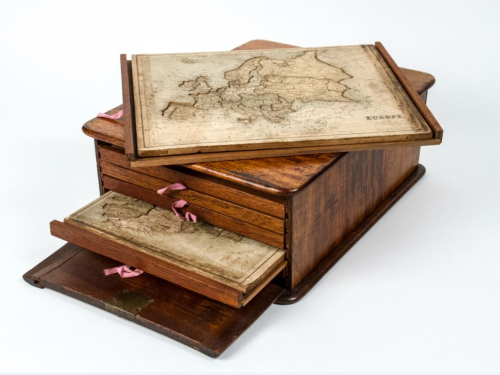
Eslick's patent puzzles, Steven Joseph Eslick (1851-1904), ca. 1880. Osborne Collection of Early Children's Books
Intrigued? Here are five great ways to satisfy your cartographic curiosity.
1. Hear from artists and cartographers making maps today
You might assume that cartography is a dead art. Today, you can instantly access satellite images and maps from the other side of the planet with a few touches on your phone — so what is left for mapmakers to do? Join us for a free talk on October 3 with Chris Brackley (cartographer for The Royal Canadian Geographical Society and Canadian Geographic Magazine, and owner of As the Crow Flies cARTography) who will talk about how the work of cartographers has changed and why it is still important today.
Maps continue to be both a source of inspiration and a provocative medium for visual artists, illustrators and storytellers. On September 22, don't miss a fascinating panel discussion about mapping the city with Daniel Rotsztain, Flavio Trevisan and Marlena Zuber in conversation with Shawn Micallef.
2. Discover why small is beautiful
The Art of Cartography features some charming miniature maps and pocket atlases — more portable versions of the lavish atlases that were popularized in the 16th and 17th century. To learn more about these mini-maps, join collector Alec Parley on October 6 for Cartography in Miniature, an illustrated talk about the history and beauty of miniature maps.
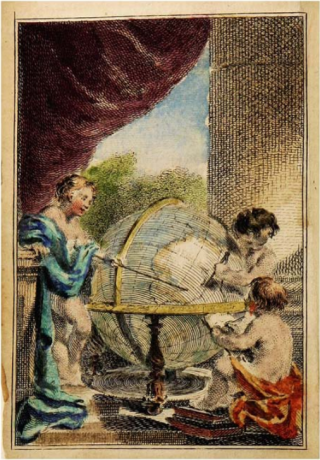
Frontispiece from Atlas minimus, John Gibson, (1750-1792), 1785
3. Become an Geocaching explorer!
Inspired by the explorers and mapmakers who set out to chart unknown lands? Why not try exploring Toronto Public Library branches in search of hidden geocaches? Find out more about the Geocaching Scavenger Hunt here.
4. Read up the maps and mapmakers who have our shaped view of the world
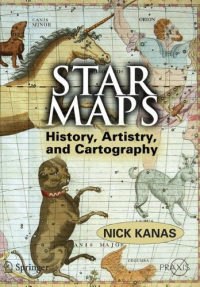
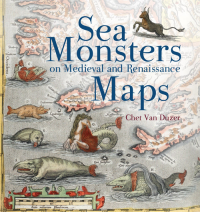
For those interested in digging deeper into the art and history of cartography, Toronto Public Library offers an incredible range of books and resources. Here is just a small sample of recommended reads.




5. Visit the exhibit and join a guided tour!
Of course, the best way to appreciate The Art of Cartography is to visit the exhibit in person and get up close to these remarkable works of art. There are free guided tours every Tuesday at 2 pm. The Art of Cartography runs until October 16.
2 thoughts on “Five Ways to Discover the Art of Cartography: Free Exhibit Opens August 13!”
very true ,cartography is a skill,with the software,this has been made easier , but for someone to appreciate it well at least he or she need to have some basic in simple arts.
very true ,cartography is a skill,with the software,this has been made easier , but for someone to appreciate it well at least he or she need to have some basic in simple arts.