Toronto Reference Library at 40: The Evolution of Its Site. Part 1. Site and Street Name Changes
As the Toronto Reference Library celebrates its 40th anniversary on November 2, we take a backward glance at the changes to the site as the area evolved from dense forest to suburban village to downtown neighbourhood.
The present library is bound by Yonge Street on the west, Asquith Avenue on the south, Collier Street on the north and Sherlock Holmes Walk on the east. In 1972, Metropolitan Toronto Council approved providing $7 million to acquire the block for a new Metropolitan Toronto Central Library.
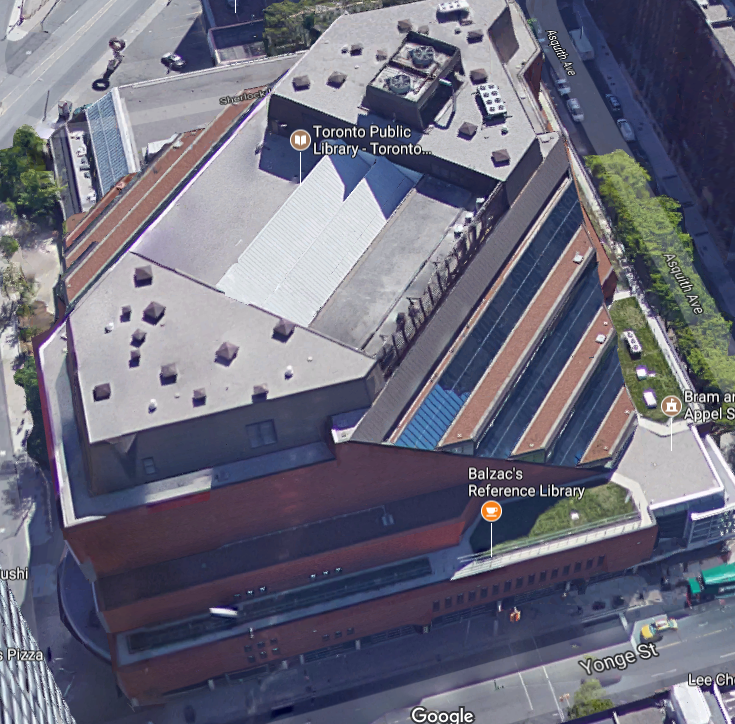
The library is only the most recent occupant of the site. In a series of three blogs, the history of the property will be traced from its early days until the $30 million library was constructed in the 1970s.
Using materials in the library’s collections and online resources, we will document changes in the site and the names of its bordering streets (part 1) and show some of the buildings that stood along its frontages on Yonge Street (part 2) and Asquith Avenue (part 3), which disappeared before the Reference Library opened in 1977. Unfortunately no images of previous buildings on the Collier Street frontage were found to warrant a separate post for it.
The Area in 1802
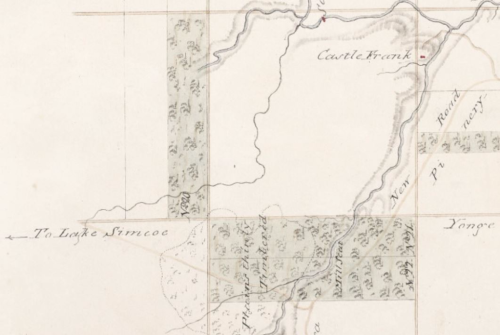
The Toronto Reference Library was constructed on a small section of Lot 20, Concession Two from the Bay, visible in the upper left portion of this 1802 map. (Lot and concession numbers are still used in legal descriptions of properties.) The 200-acre farm lot was located on the east side of Yonge Street and bordered today's Bloor Street for its entire length. The land was part of a huge tract that the British bought from the Mississauga in 1787 and 1805, the so-called Toronto purchase. It was subdivided for settlement shortly after Upper Canada (Ontario) became a province in 1791.
For thousands of years, indigenous peoples had been on the land. They placed their camps along the springs and streams which flowed through the area as they travelled on a portage trail that extended between what became known as the Don and the Humber rivers, and partly was located along modern Rosedale Valley Road and Davenport Road.
The 1802 map shows "Yonge Street", which John Graves Simcoe, the first lieutenant-governor of the province, ordered built in 1793 to replace native trails leading from the capital at York (Toronto) to Lake Simcoe and its water links with the upper Great Lakes. Yonge is the only one of the three city streets bordering the Toronto Reference Library to retain its early name (for Sir George Yonge, British Secretary of War). Asquith and Collier have been known by several different names over the years.
The Area in 1852
This 1852 map of Yorkville shows Yonge Street and the earliest names of Asquith Avenue, then called Jarvis Street, and Collier Street, then known as James Street. The site of the future Reference Library had been subdivided into 13 lots by this time, probably by Joseph Bloor, a brewer (who perhaps named James Street for his father James Bloor), and Sheriff William Botsford Jarvis of Rosedale (for whom this Jarvis Street was named), who laid out the village of Yorkville on their combined lands in about 1836.
Lot owners are identified on this map. Two of the lots facing Yonge Street were held by James Wallis, a blacksmith (H) and a Mr. Smith (I). Joseph Bloor owned the property at the northeast corner of Yonge and Jarvis Street (J) and another pair along Jarvis itself (R, Q). The three other Jarvis Street lots belonged to a Methodist Chapel (K), David Crown, a boot and shoemaker (P) and a Mr. Crown, either William or his father Elias, both builders (O). Matthew Hutchinson, a carriage maker, held three lots in the vicinity of the southeast corner of Yonge and James streets (G, F and L/R). The other two lots on James Street belonged to Sheriff Jarvis (M) and Thomas Atkinson, a brick manufacturer (N).
The Area in 1884
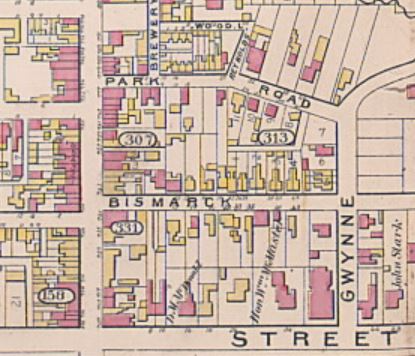
Yorkville was an independent municipality for 30 years from its incorporation on January 1, 1853 until it was annexed to Toronto on February 1, 1883. About six weeks after annexation, a city bylaw changed the names of several Yorkville streets to avoid confusion with Toronto streets of identical names. These included Jarvis Street which was renamed Bismarck Avenue (in honour of German Chancellor Otto Von Bismarck) and James Street that became known as Park Road, since it connected Park Road in Rosedale to Yonge Street.
The Area in 1924


This 1924 map shows the two side streets that now border the Toronto Reference Library with both their historic names and their current designations. In 1896, Gwynne Street was renamed Park Road since it connected the earlier Park Road in Rosedale with Bloor Street. The section of what had been Park Road between Yonge Street and the former Gwynne Street was renamed Collier Street, since it was a western continuation of the existing Collier Street, which had been laid out in 1886 on a subdivision of the property of the late William Henry Draper and probably had been named for his son, Francis Collier Draper.
At the request of local residents, the name of Bismarck Avenue was changed to Asquith Avenue in August 1915 because of heightened anti-German sentiment following the sinking of the Lusitania during the First World War. The new name honoured H. H. (Herbert Henry) Asquith, 1st Earl of Oxford and Asquith (1852-1928), who served as the Liberal Prime Minister of the United Kingdom from 1908 to 1916.
The area in 1965
A detailed view of the site in May 1965 is available on Insurance Plan of the City of Toronto (vol. 5, plate 557), but it cannot be reproduced here for copyright reasons. Much of the block was vacant. The only buildings standing were those on Yonge Street near the intersections of Asquith Avenue (nos. 775 to 783) and Collier Street (nos. 799 to 805), as well as 2 to 10 Asquith Avenue and 41 Collier Street. All of these buildings would be demolished in the early 1970s to make way for the Toronto Reference Library.
Construction and opening of the library, 1975-1977
After years of planning – and replanning and redrawing – the ground breaking ceremony for the new Metropolitan Toronto Central Library took place on a blustery day in late February 1975. The library officially opened almost three years later on November 2, 1977.
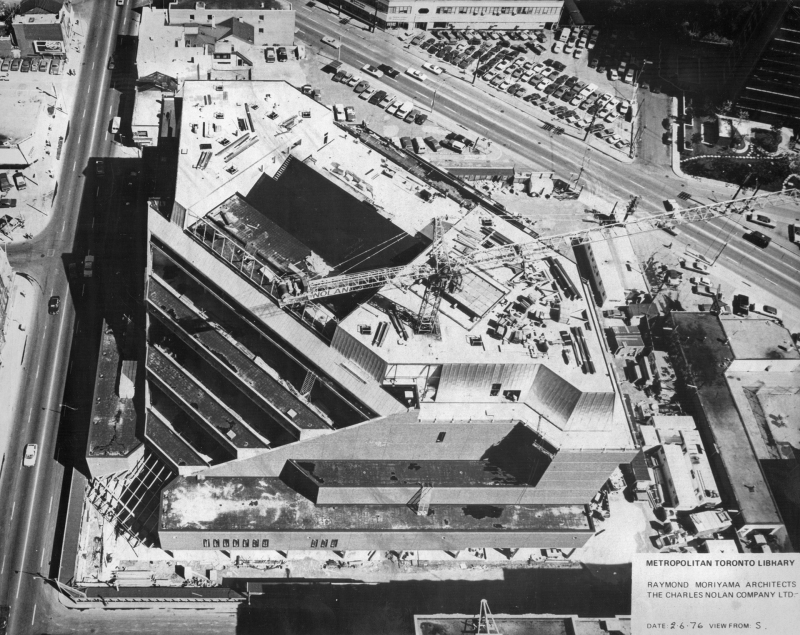
Aerial view of Metropolitan Toronto Library construction, view from south, June 2, 1976. Toronto Public Library Archives
Find out more
To see originals of many of the items featured in the blog post, join me for a Discover Special Collections talk on Wednesday November 1.
Everyone is welcome to the public celebration of the 40th anniversary on Thursday November 2 at 2 p.m. in the Atrium of the Toronto Reference Library.
More Toronto Public Library resources about Yorkville are available through our Toronto neighbourhoods map.
Much of the information on the blog post is derived from Stephanie Hutcheson's book, Yorkville in Pictures, or my unpublished revision and expansion of it.
Related posts
Toronto Reference Library at 40: The Evolution of its Site. Part 2. Yonge Street Frontage
Toronto Reference Library at 40: The Evolution of its Site. Part 3. Asquith Avenue Frontage
24 thoughts on “Toronto Reference Library at 40: The Evolution of Its Site. Part 1. Site and Street Name Changes”
Thank you for your blog about the history of the land on which Toronto Reference Library now stands. It is interesting to find out who streets are named after, as well – I am looking forward to your upcoming blogs!
Thank you for your blog about the history of the land on which Toronto Reference Library now stands. It is interesting to find out who streets are named after, as well – I am looking forward to your upcoming blogs!
Thank you for your blog about the history of the land on which Toronto Reference Library now stands. It is interesting to find out who streets are named after, as well – I am looking forward to your upcoming blogs!
I’m enthralled with how often street and town names are changed for immediate “partisan” reasons. Thank you for this concise and informative blog. The maps are great reference. Looking forward to the next instalment.
I’m enthralled with how often street and town names are changed for immediate “partisan” reasons. Thank you for this concise and informative blog. The maps are great reference. Looking forward to the next instalment.
I’m enthralled with how often street and town names are changed for immediate “partisan” reasons. Thank you for this concise and informative blog. The maps are great reference. Looking forward to the next instalment.
Hi Marie
Like you, I am fascinated by the origin of local street names. My unpublished revision of Yorkville in Pictures has a major section about “Yorkville Place Names” that includes almost all of the local streets, listed alphabetically by their present name. Where applicable, former name(s) also are included, presented chronologically by the dates when they were first shown on registered subdivision plans, maps or directories. Of course, the origin of the names is provided.
Barb
Hi Marie
Like you, I am fascinated by the origin of local street names. My unpublished revision of Yorkville in Pictures has a major section about “Yorkville Place Names” that includes almost all of the local streets, listed alphabetically by their present name. Where applicable, former name(s) also are included, presented chronologically by the dates when they were first shown on registered subdivision plans, maps or directories. Of course, the origin of the names is provided.
Barb
Hi Marie
Like you, I am fascinated by the origin of local street names. My unpublished revision of Yorkville in Pictures has a major section about “Yorkville Place Names” that includes almost all of the local streets, listed alphabetically by their present name. Where applicable, former name(s) also are included, presented chronologically by the dates when they were first shown on registered subdivision plans, maps or directories. Of course, the origin of the names is provided.
Barb
Hi Muriel
I too my fascinated by street names, and have included a section about them in most of the local history books that I have prepared for Toronto Public Library. Hope you have enjoyed the next two blogs about this historic site.
Barb
Hi Muriel
I too my fascinated by street names, and have included a section about them in most of the local history books that I have prepared for Toronto Public Library. Hope you have enjoyed the next two blogs about this historic site.
Barb
Hi Muriel
I too my fascinated by street names, and have included a section about them in most of the local history books that I have prepared for Toronto Public Library. Hope you have enjoyed the next two blogs about this historic site.
Barb
Just ran into this article. Interested to learn that my two times Great Grandfather James Wallis’ (1807-1885) Blacksmith shop stood on the present site of the Toronto Public Library. James was born in Alston, Cumberland England. Cumberland street Toronto was named in his honour (www.thestar.com/life/2012/12/06/cumberland_st_named_for_coun cillors_birthplace_street_name.html). John Maguire, Goderich ON
Just ran into this article. Interested to learn that my two times Great Grandfather James Wallis’ (1807-1885) Blacksmith shop stood on the present site of the Toronto Public Library. James was born in Alston, Cumberland England. Cumberland street Toronto was named in his honour (www.thestar.com/life/2012/12/06/cumberland_st_named_for_coun cillors_birthplace_street_name.html). John Maguire, Goderich ON
Just ran into this article. Interested to learn that my two times Great Grandfather James Wallis’ (1807-1885) Blacksmith shop stood on the present site of the Toronto Public Library. James was born in Alston, Cumberland England. Cumberland street Toronto was named in his honour (www.thestar.com/life/2012/12/06/cumberland_st_named_for_coun cillors_birthplace_street_name.html). John Maguire, Goderich ON
Hi John
Thanks for sharing the information about your ancestor, James Wallis, who was a prominent early resident of Yorkville – documented as living there as early as 1837.
Wallis served on Yorkville’s first municipal council in 1853, and, like the other four councillors, he was commemorated on the Yorkville coat of arms with his initial (the letter “W”) and a symbol of his trade (an anvil for blacksmith). The coat of arms was originally on the Yorkville Town Hall, and now can still be seen on the façade of the Yorkville Fire Hall at 34 Yorkville Avenue. After Wallis left the council he served as Yorkville’s treasurer for several years.
The green in front of Wallis’s smithy on the east side of Yonge Street (approximately where the Toronto Reference Library is now located) was the spot where Yorkville‘s annual celebrations for Queen Victoria’s birthday started for many years. One oldtimer recalled: “Promptly at sunrise … village notables would assemble around one of Wallis’ big anvils that had been brought out of the shop for the occasion and solemnly fire off twenty-one rounds.”
As you mentioned, the name of Cumberland Street commemorates the birthplace of James Wallis. Originally known as Sydenham Street, it was renamed Cumberland after Yorkville was annexed to Toronto in 1883, by City of Toronto Bylaw 1319.
Barbara Myrvold
Hi John
Thanks for sharing the information about your ancestor, James Wallis, who was a prominent early resident of Yorkville – documented as living there as early as 1837.
Wallis served on Yorkville’s first municipal council in 1853, and, like the other four councillors, he was commemorated on the Yorkville coat of arms with his initial (the letter “W”) and a symbol of his trade (an anvil for blacksmith). The coat of arms was originally on the Yorkville Town Hall, and now can still be seen on the façade of the Yorkville Fire Hall at 34 Yorkville Avenue. After Wallis left the council he served as Yorkville’s treasurer for several years.
The green in front of Wallis’s smithy on the east side of Yonge Street (approximately where the Toronto Reference Library is now located) was the spot where Yorkville‘s annual celebrations for Queen Victoria’s birthday started for many years. One oldtimer recalled: “Promptly at sunrise … village notables would assemble around one of Wallis’ big anvils that had been brought out of the shop for the occasion and solemnly fire off twenty-one rounds.”
As you mentioned, the name of Cumberland Street commemorates the birthplace of James Wallis. Originally known as Sydenham Street, it was renamed Cumberland after Yorkville was annexed to Toronto in 1883, by City of Toronto Bylaw 1319.
Barbara Myrvold
Hi John
Thanks for sharing the information about your ancestor, James Wallis, who was a prominent early resident of Yorkville – documented as living there as early as 1837.
Wallis served on Yorkville’s first municipal council in 1853, and, like the other four councillors, he was commemorated on the Yorkville coat of arms with his initial (the letter “W”) and a symbol of his trade (an anvil for blacksmith). The coat of arms was originally on the Yorkville Town Hall, and now can still be seen on the façade of the Yorkville Fire Hall at 34 Yorkville Avenue. After Wallis left the council he served as Yorkville’s treasurer for several years.
The green in front of Wallis’s smithy on the east side of Yonge Street (approximately where the Toronto Reference Library is now located) was the spot where Yorkville‘s annual celebrations for Queen Victoria’s birthday started for many years. One oldtimer recalled: “Promptly at sunrise … village notables would assemble around one of Wallis’ big anvils that had been brought out of the shop for the occasion and solemnly fire off twenty-one rounds.”
As you mentioned, the name of Cumberland Street commemorates the birthplace of James Wallis. Originally known as Sydenham Street, it was renamed Cumberland after Yorkville was annexed to Toronto in 1883, by City of Toronto Bylaw 1319.
Barbara Myrvold
Hi there – I noticed that you mentioned the 1954 and 1965 Insurance Plans of Toronto that are available in the Special Collections room are copyright. I’m curious, 1) why are they copyright (all the earlier Goad’s Fire Insurance Maps are not) and 2) I assume it’s okay to recreate a hand-drawn rendering of the map that can be published, say on a blog?
I’d appreciate your advice on this.
Kristine Morris
Hi there – I noticed that you mentioned the 1954 and 1965 Insurance Plans of Toronto that are available in the Special Collections room are copyright. I’m curious, 1) why are they copyright (all the earlier Goad’s Fire Insurance Maps are not) and 2) I assume it’s okay to recreate a hand-drawn rendering of the map that can be published, say on a blog?
I’d appreciate your advice on this.
Kristine Morris
Hi there – I noticed that you mentioned the 1954 and 1965 Insurance Plans of Toronto that are available in the Special Collections room are copyright. I’m curious, 1) why are they copyright (all the earlier Goad’s Fire Insurance Maps are not) and 2) I assume it’s okay to recreate a hand-drawn rendering of the map that can be published, say on a blog?
I’d appreciate your advice on this.
Kristine Morris
Re 1) Copyright is held for 90 years so materials published after 1928 are still in copyright 2) I do not have expertise in copyright law so couldn’t advise you on this.
Barbara Myrvold
Local History Senior Services Specialist
Toronto Public Library
Special Collections Department, Toronto Reference Library
789 Yonge Street, Toronto M4W 2G8
Tel: 416-395-5516
Re 1) Copyright is held for 90 years so materials published after 1928 are still in copyright 2) I do not have expertise in copyright law so couldn’t advise you on this.
Barbara Myrvold
Local History Senior Services Specialist
Toronto Public Library
Special Collections Department, Toronto Reference Library
789 Yonge Street, Toronto M4W 2G8
Tel: 416-395-5516
Re 1) Copyright is held for 90 years so materials published after 1928 are still in copyright 2) I do not have expertise in copyright law so couldn’t advise you on this.
Barbara Myrvold
Local History Senior Services Specialist
Toronto Public Library
Special Collections Department, Toronto Reference Library
789 Yonge Street, Toronto M4W 2G8
Tel: 416-395-5516