
This post reproduces parts of the exhibit, You, Me, Us: Outstanding Books For and About Young People with Disabilities.
Below is the main wall-panel text from the exhibit, a small sample of exhibit items and one of the exhibit videos.
You can also listen to a described audio tour on the main exhibit page.
The exhibit is on display in TD Gallery at the Toronto Reference Library from November 16, 2019 to January 26, 2020.
You, Me, Us: Outstanding Books For and About Young People with Disabilities
The books in this exhibit are for everyone: you, me, us. They are from the IBBY Collection for Young People with Disabilities. This unique reference collection is located at our North York Central Library. It contains over 4,000 books published around the world in English and many other languages.
Some of the books were made especially for young people with disabilities such as vision loss, autism, Down syndrome and more.
Other books feature stories about characters with disabilities. Reading these books will help people without disabilities understand what it means to live with one.
All of these books are considered outstanding. They have been chosen for their insightful approach, informative content, and exceptional design. They have been enjoyed by readers around the globe and now they are here for you to discover, too.
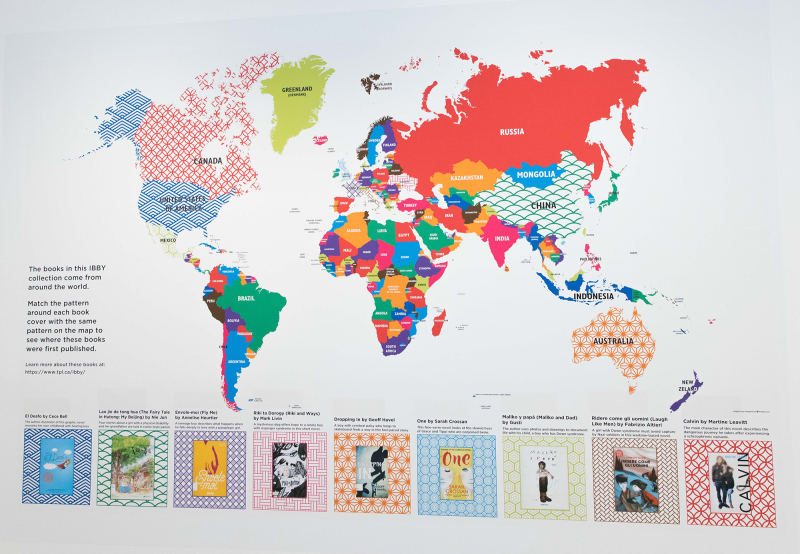
Main wall text: The books in this IBBY collection come from around the world. Match the pattern around each book cover with the same pattern on the map to see where these books were first published. Learn more about this books at
tpl.ca/ibby
What is IBBY?
The International Board on Books for Young People – IBBY – is a non-profit organization that was founded in Switzerland in 1953. IBBY members around the world have a passionate commitment to bring books and children together.
IBBY initiates and administers numerous book awards and projects. The most prestigious international award for children’s literature is IBBY’s Hans Christian Andersen Award. Significant projects include the IBBY Children in Crisis Fund, established to help children affected by natural disasters, civil disorder or war.
IBBY has also established several unique collections of children’s books. The largest one is the IBBY Collection for Young People with Disabilities. at our North York Central Library.
Selection of exhibit items

El basal del rei Olaf, written by Mar Pavón and illustrated by Maria Girón Sant Felui de Guíxols. Spain: Traumuntana Editorial, 2018.
This illustration accompanies a story for children published in Spain. They show Olaf, a young boy with Down syndrome, and his family. Olaf's disability will not be apparen't to many readers. The book's creators seem to say that this is the best way for everyone to view him. The highly realistic and expressive faces of all the characters underscore the happiness and loving kindness that runs throughout this story.
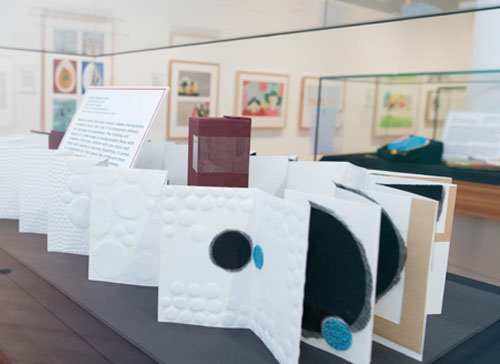
Le petit Chaperon rouge (Little Red Riding Hood), Warja Lavater (design), Myriam Colin (tactile adaptation). Talant, France: Les Doigts Qui Rêvent, 2008.
Here is a book that uses colours, shapes and textures to retell a classic fairy tale. It is completely without text and easy to understand. This retelling will appeal to a wide range of young people: those with complete vision loss, children with low vision; and others with reading or learning disabilities. It comes in a handmade box that opens like a treasure chest to reveal its wonderful accordion-style contents.

Moa åker på lager, written by Ann Gomér and illustrated by Cecilia Höglund Häljarp. Sweden: Landskrona vision AB, 2013.
Fifteen-year-old Moa likes guys, dancing and being with friends. She also has Down syndrome — but that doesn't stop her from being a cool girl with pink hair. Using sign language and Swedish text, Moa Goes to Camp recounts the first time Moa attends camp with her friends. The striking graphic illustrations capture Moa's zest for living and her strong connection to the world at large. Teens and adults with disabilities will find Moa both relatable and inspiring.
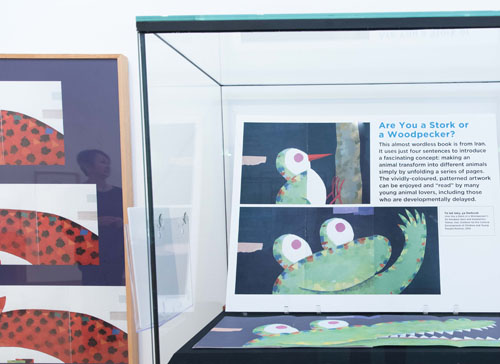
To lak laky, ya Darkoub (Are You a Stork or a Woodpecker?), by Ali Khodaee (text and illustration). Tehran, Iran: Institute for the Cultural Development of Children and Young People/Kanoon, 2012.
This almost wordless book is from Iran. It uses just four sentences to introduce a fascinating concept: making an animal transform into different animals simply by unfolding a series of pages. The vividly-coloured, patterned artwork can be enjoyed and "read" by many young animal lovers, including those who are developmentally delayed.
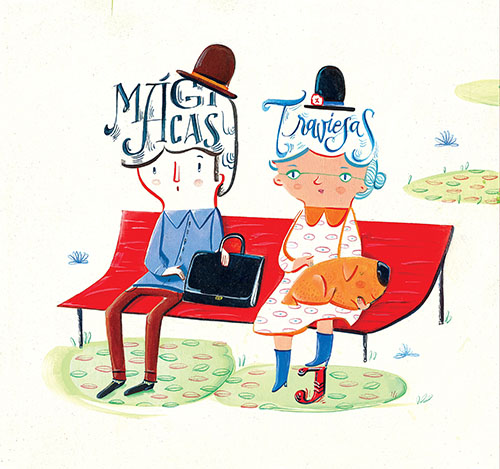
Mríaa, Marai, María, written by Clara M. Granara and illustrated by Ana Sanfelippo. Buenos Aires, Argentina: Quipu, 2015.
What does it mean to be someone with dyslexia? How do words look to someone who has reading difficulties? This story from Argentina answers these questions beginning with its title, which reworks the name "maria" as someone with dyslexia might read it. The warm, playful artwork includes letters, words and sentences as they would appear to someone who has difficulties reading print. This highly visual approach will help readers come away with a better understanding of dyslexia.

Une livre (A Book) by Hervé Tullet; Talant, France: Les Doigts Qui Rêvent, 2016. Press Here by Hervé Tullet; San Francisco, CA, USA: Handprint Books, 2019
One basic shape — a circle — along with three colours and textures are almost all that is needed to bring this book to life in a ny child's hands. The simple, French-language text is in both Braille and print. It addressed readers directly and encourages them to touch and interact with the book in a variety of ways.
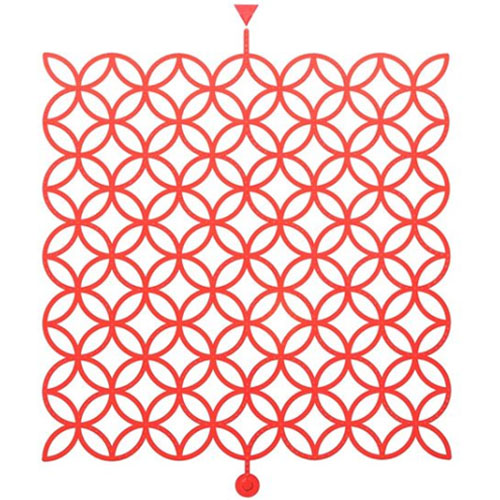
Tenji Tsuki sawaru ehon: Sawaru meiro (Touch Picture Book with Braille: Mazes by Touch) by Junko Murayama (design). Tokyo, Japan: Shogakukan, Inc., 2013.
The mazes in these unusual books are made up of lines of Braille. They will appeal to a wide range of puzzle players, including children with vision loss who are already familiar with Braille. Children who are just starting to use and read Braille will also enjoy the mazes. Puzzle players without any vision loss can learn what it is like to read Braille by running their fingers over the raised dots (of the wall maze in the exhibit).
All of the mazes in this book have been printed on one large piece of cardstock. When the book is completely unfolded, several children can enjoy using it at once.
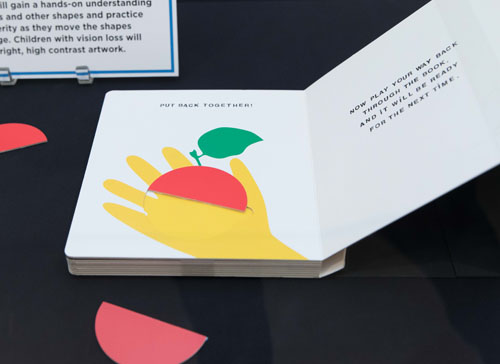
Give & Take by Lucie Félix. Somerville, MA, USA: Candlewick Studio, 2016.
This playful book will appeal to many readers, especially those who want to learn about basic concepts. They will gain a hands-on understanding of circles, squares and other shapes and practice their finger dexterity as they move the shapes from page to page. Children with vision loss will appreciate the bright, high, contrast artwork.
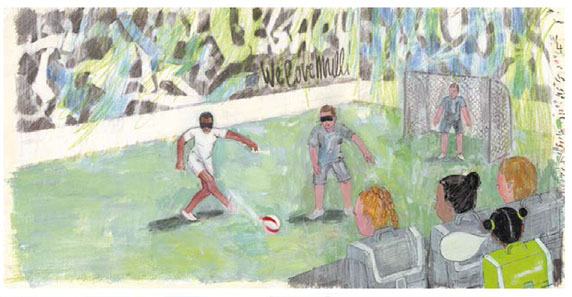
Mulgheta: Ein Tag im Leben eines Blinden Fuβballspielers (Mulgheta: A Day in the Life of a Blind Footballer) by Patricia Thoma (text and illustration). Berlin, Germany: Jacoby & Stuart, 2017.
Real-life athlete Mulgheta Russom is one of the best blind football players in Germany. He fled war-torn Eritrea as a child and lost his eyesight as the result of a car accident when he was 20 years old. In this inspiring picture book published in Germany, Mulgheta demonstrates how he navigates the world as a bling person. The vivid illustrations capture his outgoing nature and his outstanding athletic skills.
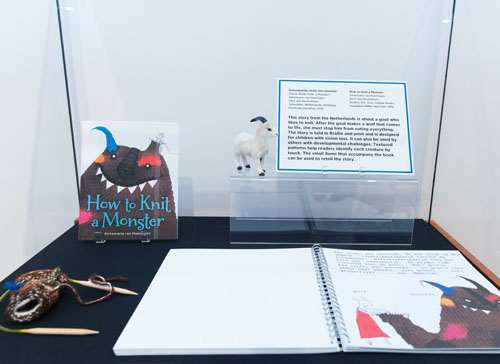
Bottom-right: Sneeuwwitje breit een monster (Snow White Knits a Monster) by Annemarie van Haeringen (text and illustration); Terheijden, Netherlands: Stichting PrentenboekenPlus, 2016. Top-left: How to Knit a Monster by Annemarie van Haeringen (text and illustration); Boston, MA, USA: Clarion Books/Houghton Mifflin Harcourt, 2018.
This story from the Netherlands is about a goat who likes to knit. After the goat makes a wolf that comes to life, she must stop him from eating everything. The story is told in Braille and print and is designed for children with vision loss. It can also be used by others with developmental challenges. Textured patterns help readers identify each creature by touch. The small items that accompany the book can be used to retell the story.
Want to borrow books related to this exhibit? Go to the reading list.

Comments