The Blood of June and the Conspiracy of October
This happened in a democratic, law-abiding nation.
The scene is an early evening street parade to celebrate a popular holiday. On one side of the street, stands have been erected to welcome political dignitaries and official guests. On the other side of the street, where a large park begins, crowds have been amassing since the late afternoon. Police officers in a row protect the honorary stand, line the edge of the street where the parade will pass, and operate as undercover agents in the crowd. Secret service agents watch from the stands. Something is about to happen.

At the edge of the park, approximately 30 protesters are manifesting. They are protesting what they consider to be the defiant appearance of the country's leader at this parade. The leader of the protests is hoisted onto the shoulders of his comrades, and they begin to shout slogans. Some hand out flyers in the crowd.
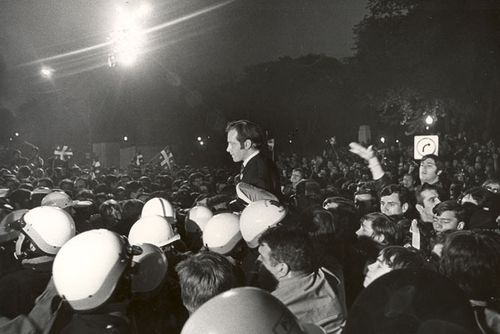
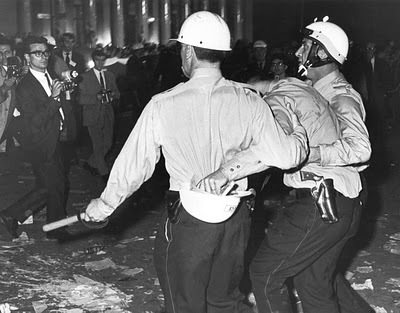
Within minutes, helmeted police surround the group. Before the protest leader has a chance to move towards the stands, he is dragged down by police and forcefully taken to a van by the side of the road, tossed within. The parade has yet to begin in earnest. Police on motorbikes zoom through the street, through the crowd. Some of the protesters try to rescue their leader, only to be beaten by police wielding truncheons.
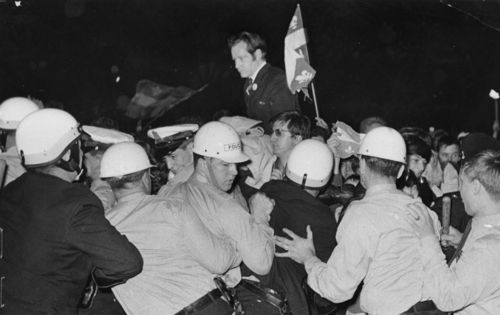
An officer grabs the protesters' flag and rips it up in front of them. As they yell in outrage, a roar goes through the crowd gathered in the park, along the street's edge. It appears that police reinforcements have been called and are moving south, through the park, towards the street. Thinking they are dealing with a massive protest, they swoop down on the crowd, using their truncheons to randomly hit anything in their way. This causes a stampede towards the street, right in the path of the parade.

Truncheons rise and fall on any unlucky enough to be near: men, women, pregnant women, children, seniors. The pain of being hit with a wooden truncheon is compared to an electric discharge, the sense that bones are being smashed within you, that your nerves are being squeezed in a merciless vice.
People in the crowd are running in all directions, scared of being trapped and hit by the police. Their only defense, their only means of retaliation, is to throw bottles. Bottles are thrown towards the stands, towards those held responsible for this chaos.
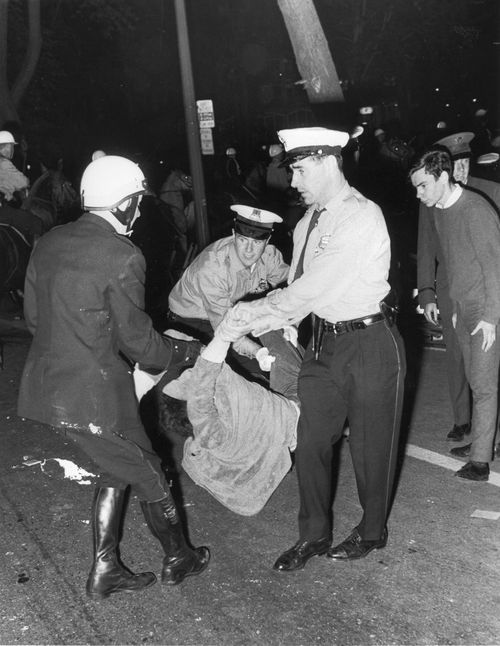
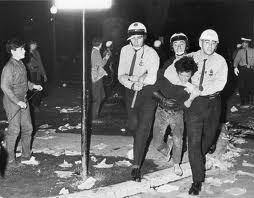
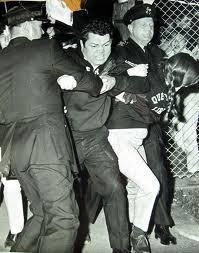
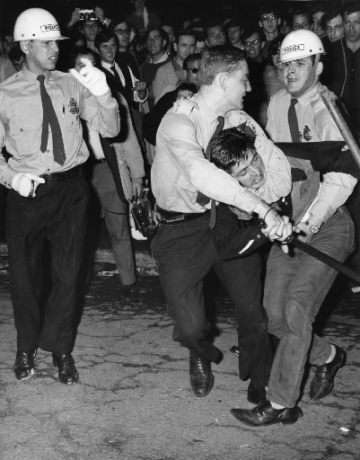
Whoever looks young, hippie-ish, countercultural, is grabbed by the police, thrown to the ground, beaten with batons even on the ground. Three or four officers grab arms and legs and drag the person through glass-strewn streets to a police van, all the while clubbing the person as they go.
Scenes from Taire des hommes (1968)
Others are hit in the head with truncheons. This is enough to make them lose consciousness, collapse on the pavement. They wake up to officers twisting their limbs, choking them in a headlock, beating them in the groin and stomach, swearing at them, telling them that they're good-for-nothing.

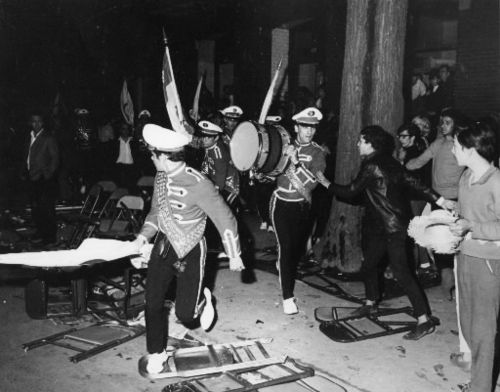
The police chase people right into the parade, right amidst the marching bands and costumed participants. The street echoes with screams, horns, breaking glass, slogans, curses, sirens.
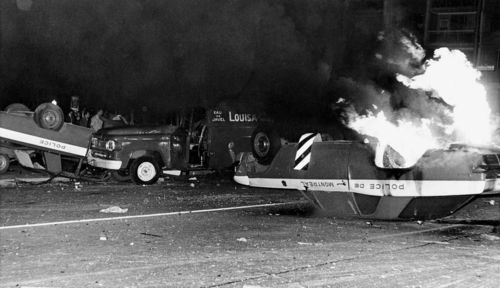
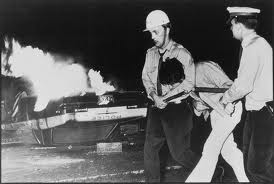
Fires are set in the park. Smoke spreads through the area due to quickly improvised Molotov cocktails. A police car is overturned and torched by the outraged crowd, followed by two more.
Police officers beat a young man to the ground, continue to beat him until he doesn't move anymore. They hit him in the face, legs, and groin. Blood flows from his head. Stop it, someone shouts. He's a bottle thrower, one of the officers says, shaking his bloody baton. As the crowd moves closer to rescue the young man, the police quickly drag him away.
Even journalists are not exempt from the violence. The police yell at them to stop paying attention to the arrests and to focus on the parade, and anybody who disobeys has their equipment confiscated, is pushed to the ground and arrested, or simply hit with a baton.
Suddenly, from the depths of the park, the mounted police make their appearance, six horses in a row, the officers equipped with thick wooden sticks four feet long. They charge on the crowd, stamping on women, children, and seniors. They strike shoulders, backs, crack skulls without remorse. People are trampled as they try to run away, break their nose, teeth, and jaw as they fall flat to the pavement. A frenzied officer yells, charge the French Canadians!
A child, scared out of his mind, frozen in fear, cries out, mommy, mommy! A mounted police officer rides too close and smacks him in the face with his baton. The child collapses to the ground. The officer stops his horse, nudges the child with his baton, makes sure he's alive, and then rides on to pursue others in the crowd.
A young man, cornered between a police car and a mounted officer, receives a vicious beating. The officer hits him so hard that he breaks his baton, but continues to pound him with the broken edge. His horse suddenly rears up, his hooves fall on the young man, crushing him.
Bottles fly through the sky, trying to reach the stand where the prime minister is defiantly sitting, smiling at the unfolding scene. When security manages to convince him to leave, the line of police in front of the stands are now free to join in suppressing the crowd, and they move in aggressively with their batons. Damn separatist, one yells as he smacks a man in the stomach.

The beat people senseless and then throw them, unconscious, bleeding, in extreme pain, into the tight holding space of a police van. They are crowded in, 15 to 20 in a space designed for 10, some standing, sitting, lying down. It is hot like an oven, with very little airflow. They have cuts, broken bones, broken ribs, broken noses, fractured elbows, swollen faces, black and blue bruises.
In the vans, those arrested try to help the injured as best as they can: improvised tourniquets, ripped-shirt compresses, moral support. When they ask the officers for water through the small square airflow window, they are told, die!
In one of the vans, a person lies unconscious, his skull fractured. Fearing for his safety, the others beg the officers to get him medical attention. Let him die like a dog!, is the response.
The vans are driven to various police stations. Upon arrival, the van doors are open and those arrested face a gauntlet of twenty police officers leading to the entrance of the station. The officers are laughing, yelling insults, waiting to hit. What's going on, one of the arrested says with a cracking voice. Don't fall, a courageous person affirms, don't give them the pleasure of falling.
A journalist covering the parade for the national broadcaster describes the evening as the Monday of the Truncheon. His managers accuse him of being non-objective in his reporting and suspend him. His colleagues respond by refusing to cover the national election of the following night.
All in all, 292 people are arrested, including 81 minors. 123 people are gravely injured, including 42 police officers.
It is June 24, 1968. Montreal, PQ. La belle province.
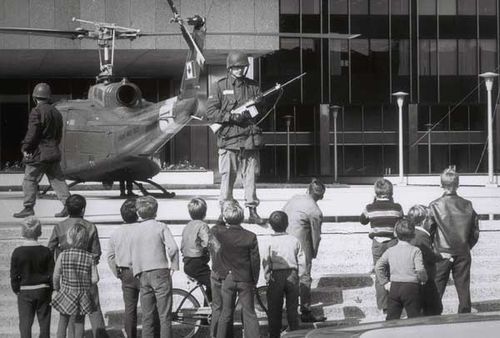
Two years later, on October 5, begins what has become known as the October Crisis, with the kidnapping of a British diplomat, James Cross. Acting under the War Measures Act, 497 Quebeckers will be arrested and detained without a warrant, without bail, without rights.

To understand the roots of the crisis, we must revisit this June evening of 1968. Of the 292 people beaten and arrested that evening, two were eventual members of the Chénier cell, the group that kidnapped and assassinated the Minister of Labour, Pierre Laporte.
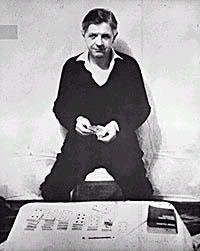
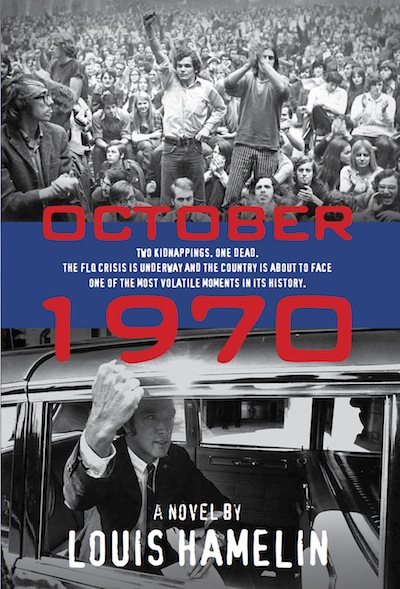
The water is muddied, as Louis Hamelin reveals in his fascinating, prize-winning (Prix Littéraire des Collégiens 2010, Grand Prix littéraire de la Presse québécoise 2011, Prix Ringuet 2011), Giller Prize-nominated novel, October 1970.
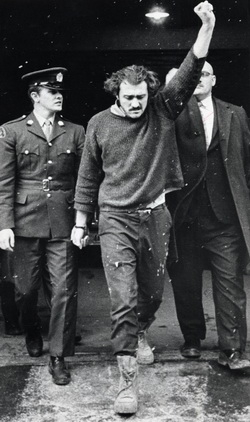

No less great a political figure than Quebec Premier Robert Bourassa, in power during the crisis, would have stated: the October Crisis is our JFK assassination.

Conspiracy, cover-up? One thing is certain: the truth is not the official version.
/L
"Depuis l'automne". Si on avait besoin d'un cinquième saison (1975) / Harmonium
Comments