Snapshots in History: April 16: Remembering Blakeney, Franklin, King, and Quintanilla-Pérez
On April 16, let us take some time to reflect on
some historical snapshots into the past as we remember Allan Blakeney, Rosalind Franklin, Martin Luther King
Jr., and Selena Quintanilla-Pérez (aka Selena). Toronto Public Library
collections offer a means of exploring the worlds of individuals from the past
through biographies, autobiographies, memoirs and other works as well as
materials in various formats.
Allan Blakeney (1925-2011),
who died on April 16, 2011, was Premier of Saskatchewan from 1971-1982 and his
government introduced state intervention in the economy (for the purpose of
economic diversification in a mainly agrarian province) with the creation of the
Potash Corporation of Saskatchewan and Saskoil, and advocated for provincial
ownership of natural resources in the Canadian constitutional battles of the
late 1970s/early 1980s. He had previously served in the Saskatchewan government
in the early 1960s as Minister of Health, playing a pivotal role as the
province introduced the inaugural medicare plan in Canada in 1962. Prior to his
political career, Blakeney studied law, earned a Rhodes scholarship, and worked
in the Saskatchewan civil service. Consider the following titles authored by
Allan Blakeney:
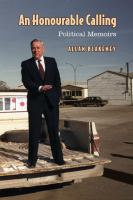
An
honourable calling: political memoirs / Allan Blakeney, 2008. Book.
The former Saskatchewan premier offers
commentary on many issues that he experienced over his 38 years as a civil
servant, cabinet minister, Premier and Opposition Leader. He discussed the 1962
Medicare Crisis, the province’s control over its resources including potash and
uranium, and the constitutional battles of the early 1980s.
Political
management in Canada [2nd ed.] / Allan
Blakeney and Sandford F. Borins, 1998. Book.
This
book dealt with the meshing of politics and government administration.
Co-author Blakeney approached this from his background as both a civil servant
and as an elected politician.
Rosalind Franklin (1920-1958), who died on April
16, 1958 from ovarian cancer, was a British biophysicist and X-Ray crystallographer
whose work on the X-ray diffraction images of DNA has not always received the
attention that it deserved but actually paved the way for the discovery of the
DNA double helix by Francis Crick and James A. Watson without her initial
approval or knowledge. Consider the following biographies about Rosalind
Franklin:
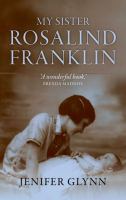
My
sister Rosalind Franklin / Jenifer Glynn, 2012. Book.
The untimely death of Rosalind Franklin in 1958
prevented her from becoming a Nobel Prize laureate but her contribution of
X-ray diffraction images led to the identification of DNA by Francis Crick and
James D. Watson and should not be downplayed.
(This review also appeared in Salute
to International Women’s Day! Selected Biographies and Memoirs of Women on
the Albert Campbell District Blog.)
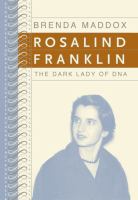
Rosalind
Franklin: the dark lady of DNA / Brenda Maddox, 2002. Book.
Also available as an eBook.
Please refer to the review
provided by the Book
Buzz blog on this title.
Why remember Rev. Dr. Martin Luther King Jr.
(1929-1968) on April 16th? Fifty (50) years ago today, on April 16,
1963, Dr. King wrote the famous “Letter from Birmingham Jail” (format: HTML,
PDF)
in Alabama while he was incarcerated for
a thirteenth (13th) time during his lengthy, nonviolent struggle (in
the spirit of Mohandas K. Gandhi) supporting civil rights and opposing racism. Dr.
King was responding to criticism from clergymen under the “Call to Unity” banner
who argued that the battle against racial segregation in the United States of
America should be contested only within law courts and not on streets in
communities. Those supporting “Call to Unity” also suggested that Dr. King was
an outsider, an appellation to which he took exception, and argued that
communities and states were interrelated in the overall struggle for civil
rights. In 1964, Dr. King received the Nobel Peace Prize for his leadership
role in nonviolent opposition to racism in the United States. Consider the
following titles for borrowing from Toronto Public Library collections:
Dreams
and nightmares: Martin Luther King, Jr., Malcolm X, and the struggle for Black
equality in America / Britta Waldschmidt-Nelson, 2012. Book.
Academic
Waldschmidt-Nelson compared and contrasted Martin Luther King Jr. and Malcolm X
as two iconic leaders of the civil rights movement in the United States. While
Dr. King and Malcolm X were both sons of Baptist ministers, their solutions
diverged in that King advocated integration of African-Americans in society
while Malcolm X advocated separation but subsequently broke from the Nation of
Islam in 1964, while still advocating the self-determination of
African-Americans.

Ethics:
the essential writings / Gordon Daniel Marino (ed.), 2010. Book.
This book included Dr. King’s Letter from
Birmingham Jail amongst other essays written by well-known individuals such as Aristotle,
Plato, Immanuel Kant, Søren Kierkegaard, John Stuart Mill, Friedrich Nietzsche, Jean-Paul Sartre and others.
Gospel
of Freedom: Martin Luther King, Jr.'s Letter from Birmingham Jail and the
Struggle That Changed a Nation / Jonathan Rieder, 2013. Book.
Sociologist Rieder set the scene for Dr. King’s
clarion call for universal social justice and proceeded to analyze King’s
Letter from Birmingham Jail in great detail with special attention paid to
covert and overt changes in Dr. King’s intent and tone. The author demonstrated
in-depth knowledge of Dr. King’s works, including the famous “I Have a Dream”
speech delivered some four months later in Washington D.C. on August 28, 1963.
Letter
from the Birmingham jail [1st
ed.] / Martin Luther King Jr., 1994. Book.
Dr. King’s Letter from Birmingham Jail is presented
here under cover in book format.
Martin
Luther King Jr.: history maker [1st
ed.] / Richard S. Reddie, 2011. Book.
For those new to the subject, Reddie provided a
chronological, readable biography of Dr. King, complete with significant events
including his imprisonment in Birmingham, Alabama, the March on Washington, and
eventually his assassination in 1968. This book was the first one written about
Dr. King since Barack Obama became American President. The author considered
whether Obama’s election constituted the achievement of Dr. King’s dream.
Why we
can’t wait / Martin Luther King Jr., 1964. Book.
This landmark work by Dr. King included his Letter
from Birmingham Jail (with some editorial changes) and discussed the launch of
the “Negro Revolution” in 1963 on account of several reasons: disenchantment
with the slow pace of educational desegregation; lack of confidence in
governments and political figures in dealing with discrimination in housing and
minimal support in supporting African-American voting rights in the southern
states; the spread of decolonization in African and Asian states; the centenary
of the 1863 Emancipation Proclamation coupled with the economic and political
poverty of African-Americans; and, an increase in support for the direct
nonviolent action approach.
Selena Quintanilla-Pérez
(1971-1995), or more popularly known as Selena, was born on April 16, 1971 in
Texas to Mexican-American and half-Cherokee Native American paren'tage. As a
popular singer-songwriter, Billboard
declared Selena to be the top Latin artist of the 1990s and the best selling
Latin artist of the decade on account of her fourteen (14) top ten singles in
the top Latin song charts, including seven (7) number one hits. She was Female
Vocalist of the Year at the 1987 Tejano Music Awards. Her popularity increased
during the early 1990s, both in Spanish-speaking and English-speaking countries
as she had begun to sing in English as well as Spanish. Her untimely death on
March 31, 1995 at the hands of the former president of her fan club deprived
fans all over the world of her talent. Consider what Toronto Public Library collections
have to offer:
Dreaming
of you [CD] / Selena, 1995.
Selena
live the last concert [DVD] / Selena, 2003.
Selena’s last concert was
filmed in Houston, Texas.
Selena
performances live [DVD] / Johnny Canales and Selena, [2011].
Selena:
the original motion picture soundtrack [CD] / Selena, 1997.

To
Selena, with love / Chris Perez, 2012. Book.
Husband and widower Chris Perez authored this sympathetic
biography of his murdered 23-year old wife Selena. Perez delved into personal
details of their friendship, relationship, and marriage and his sense of loss
following Selena’s passing.
Comments