Snapshots in History: September 10: Remembering Mary Wollstonecraft (1759-1797)

(Source: Wikipedia – URL: http://en.wikipedia.org/wiki/File:Wollstonecraft2.JPG
- Plaque of Mary Wollstonecraft at her
last residence, The Polygon, where she died in 1797 – Photographer: Ellaroth (Taken
on 9 January 2011))
On September 10 and beyond, take a moment to
remember author, philosopher, and women’s rights advocate Mary
Wollstonecraft (Born: April 27, 1759; Died: September
10, 1797). Wollstonecraft authored two novels (one complete, one incomplete),
treatises, a travel narrative, a historical account of the French Revolution, a
book of conduct, and a children’s book. More recently, Mary Wollstonecraft is
best known for her polemical, political works A Vindication of the Rights of Woman (1792) ((a
response to Jean-Jacques Rousseau and his work Émile that argued for sufficient education for women to facilitate support
to rational men) in which she argued that women are not
naturally inferior to men but differences could occur, owing to a lack of
education. She saw men and women as being rational with reason being the basis
for any social order.) and A
Vindication of the Rights of Men (written
anonymously in 1790 as a response to Edmund Burke’s reflections on the French
Revolution that argued for the status quo as human nature
could not undertake too much change. Mary Wollstonecraft was already immersed
in the milieu of the Enlightenment and its desire for progress.)
Her travel narrative (with elements of an
autobiographical memoir), Letters Written During a
Short Residence in Sweden, Norway, and Denmark
(1796), provided sociological analysis of the Scandinavian countries and their
peoples as well as dealing with philosophical questions regarding identity. Initially,
Mary Wollstonecraft undertook the journey on behalf of her lover Gilbert Imlay
(and the father of her first daughter, Fanny Imlay) to recover a stolen treasure
ship. Wollstonecraft hoped that undertaking this mission would help to repair
her strained relationship with Imlay. Unfortunately, the relationship remained
in ruins and some of the letters by Mary Wollstonecraft reflected her sadness
and anger at what she viewed as Imlay’s betrayal. (Wollstonecraft attempted suicide
twice.) This work, the last of her writings published during her life, attracted
the admiration and attention of William Godwin with whom she was already
acquainted. Godwin and Wollstonecraft began a relationship that became
passionate over time with Mary expecting another child. Godwin and
Wollstonecraft married so that their child (her second child), Mary Wollstonecraft
Godwin (later to become author Mary Shelley of
Frankenstein fame), would be born legitimate in societal eyes. Godwin was
criticized by some friends for going against his previous advocacy of the
abolition of marriage but went ahead anyways with Mary and William residing in
adjoining houses for the purpose of retaining some degree of independence. Unfortunately,
on August 30, 1797, during the birth of their daughter Mary, the placenta broke
apart and infection ensued with Mary Wollstonecraft dying of sepsis on
September 10, 1797.
Godwin was devastated at Mary Wollstonecraft’s
death; in January 1798, Godwin published his book Memoirs of the Author of A Vindication of the
Rights of Woman as a
tribute. (Click here to
access the eBook version of William Godwin’s work available on Project
Gutenberg.) Consider the following titles by and about Mary Wollstonecraft for loan
from Toronto Public Library collections:
Collected
letters of Mary Wollstonecraft / Mary Wollstonecraft; edited by Ralph M.
Wardle, 1979. Book. Adult Non-Fiction. 921 WOL / 828 WOLLSTONECRAFT
Letters
on Sweden, Norway, and Denmark [online resource] / Mary Wollstonecraft; Project Gutenberg, 2002. eBook.
Adult Non-Fiction.
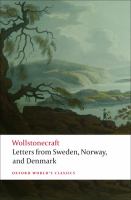
Letters
written during a short residence in Sweden, Norway, and Denmark / Mary
Wollstonecraft; edited by Tone Brekke and Jon Mee, 2009. Book. Adult
Non-Fiction. 828.609
WOL

Mary,
a fiction and The wrongs of woman, or, Maria / Mary Wollstonecraft; edited
by Michelle Faubert, 2012. Book. Adult Fiction (catalogued as Adult
Non-Fiction). 823.6 WOL
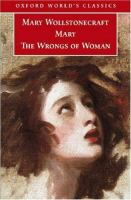
Mary;
and, The wrongs of woman [Rev. and corrected., rev. ed.] / Mary
Wollstonecraft; edited by Gary Kelly, 2007. Adult Fiction. FICTION WOL
Maria,
or the Wrongs of woman [online resource] / Mary Wollstonecraft / Mary
Wollstonecraft; Project Gutenberg,
2006. eBook. Adult Fiction.
(In Mary: a
fiction (1788), a self-taught, rational heroine was compelled into a loveless
marriage for economic reasons but entered into two romantic relationships, one
with a man and one with a woman. Maria, or,
The Wrongs of Woman (published posthumously in 1798) was intended to be a
fictional sequel to her polemic A Vindication of the Rights of Woman. The character Maria is imprisoned by her husband in an insane asylum
but is befriended by Jemima, who is charged with watching over Maria in the
asylum.)
A
most extraordinary pair: Mary Wollstonecraft and William Godwin [1st ed.]/
Jean Detre, 1975. Book. Adult Non-Fiction. 828 GOD DET
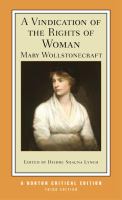
A vindication
of the rights of woman: an authoritative text backgrounds and contexts
criticism [3rd ed.] / Mary Wollstonecraft; edited by Deidre Shauna Lynch, 2009. Book.
Adult Non-Fiction. 305.42094
WOL
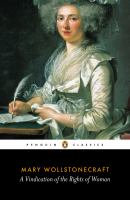
A
vindication of the rights of woman [Rev.
ed.] / Mary Wollstonecraft, 2004. Book. Adult Non-Fiction. 305.42 WOL

A vindication of the rights of men, in a letter to the right honourable Edmund
Burke; occasioned by his reflections on the revolution in France and ; A
vindication of the rights of woman with strictures on political and moral
subjects / Mary Wollstonecraft; edited
by D.L. Macdonald and Kathleen Scherf, 1997. Book.
Adult Non-Fiction. 323 WOL
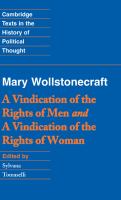
A
vindication of the rights of men; with, A vindication of the rights of woman,
and Hints / Mary Wollstonecraft; edited by
Sylvana Tomaselli, 1995. Book. Adult Non-Fiction. 323 WOL
Comments