Snapshots in History: January 17: Remembering Raoul Wallenberg
(Credit: YouTube – Raoul Wallenberg Documentary Trailer – Published August 8, 2013)
(Credit: Vimeo – Rescuing Raoul Wallenberg Extended Presentation – “This is a sampling of footage collected between 2006 and 2011 during the pre-production and research phase of the feature
documentary film "Rescuing Raoul Wallenberg".)
(Credit: YouTube – Nina Lagergren, Raoul Wallenberg's sister, unveiled the commemorative
plaque – Published May 15, 2012)
(Credit: CBC News – Ernest Mason on commemorating Raoul Wallenberg – December 5, 2012 – 1:06)
(Credit: YouTube – Raoul Wallenberg Remembered – Published November 27, 2012)
(Credit: YouTube – Raoul Wallenberg Remembered – Published November 27, 2012)
(Credit: YouTube – Working with Raoul Wallenberg: Righteous Among the Nations: Per Anger's testimony – Uploaded on July 7, 2010)
On January 17 and beyond, take a moment to remember Swedish diplomat Raoul Wallenberg (Born: August 4, 1912 in Lidingö Municipality, Sweden; Died: Death date is in dispute – Soviet/Russian sources suggest July 17, 1947) who saved thousands upon thousands of Hungarian Jewish people from the Nazi Holocaust during World War 2. Working with fellow Swedish diplomat Per Anger and others, Wallenberg issued passport documents (“Schutzpass”) that offered protection to Jews as well as hiding 35,000 Jews in buildings designed for less than 5,000 people designated as Swedish territory, using techniques learned from an architecture course in which he was enrolled at the University of Michigan. The Schutzpass concept saved 20,000 Hungarian Jews. Wallenberg is also credited with saving the remaining 115,000 residents of Budapest’s Jewish ghetto in 1945 by threatening Nazi officers with trial as war criminals if they carried out a massacre. On January 17, 1945, during the siege of Budapest by the Soviet Red Army, Wallenberg was ostensibly seized by Soviet troops on suspicion of spying and vanished from public view. Not everyone accepted the subsequent official Soviet view that Wallenberg died in Soviet custody at the Lubyanka prison in Moscow on July 17, 1947. Some people believed that Raoul Wallenberg was still alive in the 1950s and 1960s and perhaps even beyond that. In a January 16, 2014 article in the National Post, a Liberal Party of Canada MP, Irwin Cotler, argued that the current Russian government has “a moral imperative and a historic responsibility” to uncover the truth about what happened to Raoul Wallenberg.
Canada named Raoul Wallenberg as its first honorary Canadian citizen in 1985 with a variety of monuments and parks dedicated to him since 1987. Since then, five other extraordinary individuals joined Raoul Wallenberg as honorary Canadian citizens, namely: Nelson Mandela, Tenzin Gyatso (14th Dalai Lama), Aung Sang Suu Kyi, The Aga Khan, and Malala Yousafzai. Wallenberg is also an honorary citizen of the United States of America, Hungary, Australia, and Israel. Israel also honoured Wallenberg as one of the select group of Righteous among the Nations, a designation for non-Jews who risked their lives to save Jewish people during the Holocaust.
|
|
|
On June 5, 2001, the Minister of Canadian Heritage, the Hon. Sheila Copps, announced that January 17 would be designated as Raoul Wallenberg Day beginning in 2002. Canada has maintained this commitment with the current Minister of Multiculturalism, the Hon, Jason Kenney, issuing a statement on Raoul Wallenberg Day on January 17, 2014.
Consider the selective reading list of titles about Raoul Wallenberg available for borrowing from Toronto Public Library collections:
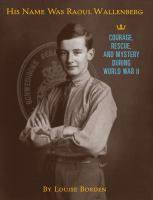
His name was Raoul Wallenberg: courage, rescue, and mystery during World War II / Louise Borden, 2012. Book. Children’s Non-Fiction. J 940.5318 WAL BOR
The author undertook detailed research including conducting interviews and accessing archival sources to produce a readable biography of Raoul Wallenberg for school children and above.

The envoy: the epic rescue of the last Jews of Europe in the desperate closing months of World War II / Alex Kershaw, 2010. Book. Adult Non-Fiction. 940.53183 WAR KER
Historian Kershaw had access to recently released Russian archival materials while writing this book. Wallenberg valiantly worked to save Jews in Hungary from extermination, including raising money to buy the freedom of some Jewish people from notorious Nazis such as Adolf Eichmann who was later captured, brought to justice, and executed. Kershaw also delved into the subject of Wallenberg’s disappearance.
Also available in eBook and Large Print formats.
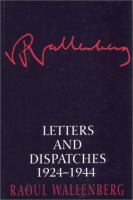
Letters and dispatches, 1924-1944 [1st ed.] / Raoul Wallenberg; translated from the Swedish by Kjersti Board, 1995. Book. Adult Non-Fiction. 940.54779 WAL / 921 WALLENBERG
Read the correspondence of an individual from a wealthy Swedish family who lost his father at an early age. His grandfather encouraged Raoul Wallenberg to gain experience in the world, including studying at the University of Michigan, and spending time in Mexico, South Africa, and Palestine. The letters to his grandfather and mother reveal a decent person but offer no obvious signs that this individual would undertake heroic measures in the future to save thousands of lives, save for a willingness to confront authority when necessary.
With Raoul Wallenberg in Budapest: memories of the war years in Hungary / Per Anger; preface by Elie Wiesel; translated from the Swedish by David Mel Paul and Margareta Paul, c1981. Book. Adult Non-Fiction. 943.9 A
Wallenberg’s colleague Per Anger reflected on his time in Hungary working with Raoul Wallenberg to save thousands of Jewish people from the Nazi Holocaust.
This title is also available in the original Swedish language as:
Med Raoul Wallenberg i Budapest: minnen från krigsåren i Ungern / Per Anger, 1979. Book. Swedish language. Adult Non-Fiction. 921 WAL \B SWE
(Credit: Global TV Morning News Saskatoon – Raoul Wallenberg tribute – January 15, 2014 – 3:40- “Wed, Jan 15 – A tribute will be held in Saskatoon on Wednesday to honour the legacy of Raoul Wallenberg and his successful efforts to rescue thousands of Jews during WWII.”)
Comments