Snapshots in History: February 25: Remembering John Graves Simcoe

(Credit: Government of Ontario Art Collection, 694156 – Portrait of Colonel John Graves Simcoe, [ca. 1881] – Lieutenant Governor of Upper Canada, 1791-96 – George Theodore Berthon (1806-1892) – Oil on canvas – 109.2 x 83.8 cm (43" x 33") – This image is in the public domain. URL: http://en.wikipedia.org/wiki/File:ColonelSimcoe.jpg )
On February 25 and beyond, take a moment to remember the life of John Graves Simcoe (Born: February 25, 1752 in Cotterstock, England; Died: October 26, 1806 in Exeter, England) who served as the first Lieutenant-Governor of Upper Canada from 1791-1796. Simcoe served with British forces during the American War of Independence, being invalided home to England before the surrender of Yorktown in 1781. During the war, Simcoe had been promoted from lieutenant to lieutenant-colonel and became one of the more successful regimental commanders and demonstrated his penchant for tactics with the publication of his Journal of the Operations of the Queen’s Rangers. During his convalescence, he resided at the home of his godfather Admiral Samuel Graves in Exeter, England. There, Simcoe met and married Admiral Graves’ ward Elizabeth Posthuma Gwillim (“Mrs. Simcoe”) who was an heiress in her own right, owning a 5,000-acre estate in Devon, England.
Simcoe briefly served as a Member of Parliament in the British House of Commons in 1790 before being promised and appointed to the position of Lieutenant-Governor of Upper Canada in September 1791. Upper Canada, as it was then known, was comprised of southern Ontario and the watersheds of Lake Superior and Georgian Bay. Under Simcoe’s stewardship, Upper Canada’s bicameral legislature founded York in 1793 (previously Fort Toronto (French) and afterwards Toronto as of 1834) which became the capital on February 1, 1796 (as Newark (now Niagara-on-the-Lake) was too prone to American attack) and introduced elements of the British legal system into Upper Canadian society, including English common law, trial by jury, and freehold land tenure. Upper Canada also abolished slavery with the passage of the Act Against Slavery on July 9, 1793, resulting in no slaves present by 1810 which predated the British Empire as a whole by 23 years.
Ill-health cut short Simcoe’s time in service in Upper Canada as he left in 1796 and resigned as Lieutenant-Governor in 1798 after a brief stint serving as British force commander in 1797. Simcoe also commanded the Western District in Britain subsequently but died in 1806 before taking up his new post as commander-in-chief in India to succeed Charles Cornwallis who had also died after shortly assuming the post himself.
Consider the following titles for borrowing from Toronto Public Library collections:
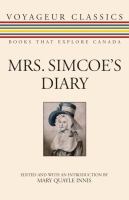
Mrs. Simcoe’s diary / Elizabeth Simcoe; edited by Mary Quayle Innis; foreword by Michael Ganrowski, 2007, [1965]. Book. Adult Non-Fiction. 971.30209 SIM SIM (Series: Voyageur classics)
Elizabeth Simcoe’s diary offers those interested in Canadian history a primary source snapshot of the 1791-1796 time period. She met aboriginal Mohawk Chief Joseph Brant and explorer Alexander Mackenzie. She was interested in the First Nations peoples as well as the fauna and flora and the developing social customs of the British settlers in Upper Canada. Follow Elizabeth Simcoe’s journey (and that of her husband) from September 17, 1791 to October 16, 1796.
See also: copies of the 1965 edition (971.302 SIMCOE). Or, consider the following version:
The diary of Mrs. John Graves Simcoe: wife of the first lieutenant-governor of the province of Upper Canada, 1792-6 / Elizabeth Simcoe; with notes and a biography by J. Ross Robertson, and two hundred and thirty-seven illustrations, including ninety reproductions of interesting sketches made by Mrs. Simcoe, 1973, [c1911]. Book. Adult Non-Fiction. 971.302 SIM
Consider this edition of Elizabeth Simcoe’s diary edited in 1911 by journalist and publisher John Ross Robertson.
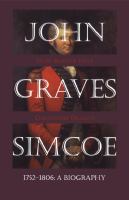
John Graves Simcoe, 1752-1806: a biography / Mary Beacock Fryer and Christopher Draycott, 1998. Book. Adult Non-Fiction. 921 SIMCOE / 971.302 SIM / 971.30209 SIM FRY
Follow the military career of John Graves Simcoe from his time as commander of the Queen’s Rangers during the American Revolution through to his appointment as the first Lieutenant-Governor of Upper Canada and founder of York (now present-day Toronto), followed by his ill-health, additional military appointments and eventual death.
Also available in eBook format (Access Online).
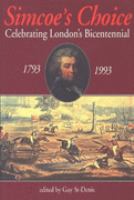
Simcoe's choice: celebrating London's bicentennial, 1793-1993 / Edited by Guy St-Denis, 1992. Book. Adult Non-Fiction. 971.326 SIM
John Graves Simcoe wanted present-day London, Ontario to be the capital of Upper Canada in 1793 but was overruled by Guy Carleton, Lord Dorchester, who agreed to Simcoe’s second-place choice of York. However, this historical development did not stop London from becoming the largest municipality in southwestern Ontario and a centre of higher learning with the University of Western Ontario and Fanshawe College.
Infant Toronto as Simcoe’s folly / John Andre, 1971. Book. Adult Non-Fiction. 971.354 A / 971.3541 A.
Read about the role of German artist and settler William Berczy (founder of Markham, Ontario) in the founding of York (predecessor to Toronto) in co-operation with John Graves Simcoe.
Click here for more copies (971.3541 A).
Governor Simcoe and his lady / Marcus Van Steen, [1968]. Book. Adult Non-Fiction. 921 SIMCOE / 921 SIM VAN
This biography of the Simcoes recounts the death of John and Elizabeth Simcoe’s infant daughter Katherine (January 16, 1793 to April 19, 1794) and her burial in the old military burial ground at Victoria Memorial Park (now Square) at Portland and Niagara Streets, several blocks northeast of Fort York.
Toronto stories from the life of a city, Part 1: York [1 videocassette] / Lynx Images Inc., 1994. VHS. Documentary. Adult Non-Fiction. VIDEO 58790
Learn about the early history of York (Toronto) from 1793 to 1834 through quotations attributed to early inhabitants and through the narration of a facsimile of “Mrs. John Graves Simcoe”.
Click here to view digitized images associated with John Graves Simcoe (including pictures and photographs and posters and printed ephemera) in Toronto Public Library collections.
Comments