Snapshots in History: February 13 and 15: Remembering Galileo Galilei and his Trial
(Credit: Biography.com – Galileo Galilei)

(Credit: Galileo facing the Roman Inquisition. Painted in 1857 by Cristiano Banti)
Let us remember the contributions of the multi-faceted Galileo Galilei (Born: February 15, 1564 in Pisa, Florence, Italy; Died: January 8, 1642 in Arcetri, Tuscany, Italy), a major contributor to the Scientific Revolution in the Renaissance with work in mathematics, physics, astronomy (including improvements to the telescope and support for Nicolaus Copernicus’ contention that the planets including the Earth revolve around the Sun and not the other way around), and philosophy. Galileo’s trial for heresy began on February 13, 1633 for supporting heliocentrism (revolution around the Sun by planetary and other bodies). He was found “vehemently suspect of heresy” on June 22, 1633 and subjected to house arrest for the remainder of his life. His work Dialogue Concerning the Two Chief World Systems, (contrasting the heliocentric view of Nicolaus Copernicus with that of Ptolemy in which the Earth was the centre of the universe) published in 1632 and a bestseller at the time, was banned and added to the Index of Forbidden Books, known in Latin as the Index Librorum Prohibitorum, only to be removed in 1835 (along with Copernicus’ On the Revolutions of the Heavenly Spheres) as the Catholic Church’s opposition to heliocentrism waned over time.
Consider the following titles for borrowing from Toronto Public Library collections:
Books:
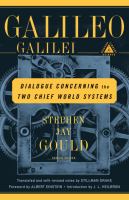
Dialogue concerning the two chief world systems, Ptolemaic and Copernican / Galileo Galilei, 2001. Book.
In this 1632 work, Galileo offers proof for the Copernican'theory that the Earth and other heavenly bodies revolve around the Sun, in stark contrast to the Ptolemaic view upheld by the Church that the Sun and other celestial bodies revolve around the Earth. Despite being a popular work, the Church used Dialogue… against Galileo in his 1633 trial.

Selected writings / Galileo Galilei; translated by William R. Shea and Mark Davie; with an introduction and notes by William R. Shea, 2012. Book.
All of Galileo’s writings on science and religion are included in this book as well as important documents from his trial before the 1633 Inquisition.
Contents: A sidereal message — Letters on the sunspots. First letter; From the Third letter — Science and religion. Letter to Don Benedetto Castelli; Letter to the Grand Duchess Christina; Letter from Cardinal Bellarmine to Paolo Antonio Foscarini; Observations on the Copernican Theory — From The assayer — Dialogue on the two chief world systems. First day; From the Second day; From the Third day; Fourth day — The trial — Two new sciences. From the First day — From the Third day.
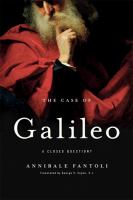
The case of Galileo: a closed question? / Annibale Fantoli; translated by George V. Coyne, 2012. Book.
University of Victoria (B.C.) philosophy professor Annibale Fantoli offers readers a distilled but focused account of years of painstaking research into the Church’s 1616 ban on Copernicanism, as well as Galileo Galilei’s support of Copernicus and his work On the Revolutions of the Heavenly Spheres that led to his own trial in 1633. Fantoli, a renowned Galileo scholar, criticizes the responses of Cardinal Poupard and Pope John Paul 2 to the 1992 reports of the Commission for the Study of the Galileo Case.
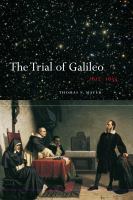
The trial of Galileo, 1612-1633 / edited by Thomas F. Mayer, 2012. Book.
Mayer, a scholarly expert on Galileo’s trial, offers the reader an examination of the trial as a legal event, translating correspondence, transcripts, legal documents, and sections of Galileo’s works to provide the reader with the opportunity to critically analyze primary sources related to the trial.
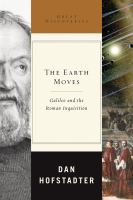
The Earth moves: Galileo and the Roman Inquisition / Dan Hofstadter, 2009. Book.
The stage is set: Pit two former friends (Galileo Galilei and Pope Urban VIII) against one another as Galileo’s 1633 trial takes place within the context of scientific and political change, including Galileo’s improved telescope, against the backdrop of a 1616 Church edict against heliocentrism intended to dissuade laypeople from challenging the Scripture and church doctrine.
Galileo goes to jail: and other myths about science and religion / edited by Ronald L. Numbers, 2009. Book.
This book sets straight some of the myths that have found their way into the religion versus science debate, such as Galileo being imprisoned and tortured for supporting Copernicanism (rather, Galileo was subjected to house arrest) and Islam’s supposed opposition to science (See Ehsan Masood’s 2009 book Science & Islam: a history (also available in eBook format) that points out that the invention of algebra, the crank, the camshaft, and the reciprocating piston occurred in the Islamic world.)
DVDs:
400 years of the telescope a journey of science, technology and thought [1 videodisc] / PBS, An Interstellar Studios Production, 2009. DVD. Documentary. 57 Minutes.
This PBS documentary draws on interviews with leading astrophysicists and cosmologists from renowned universities and observatories who explain a variety of concepts, including Galileo’s use of a simple telescope to explore the cosmos.
Galileo’s battle for the heavens [1 videodisc] / Simon Callow et al.; WGBH/Boston in association with Channel 4, 2006. DVD. Documentary. Dramatization. 120 Minutes.
This Nova production dramatizes Galileo Galilei’s life, explores his scientific accomplishments and his defense of the once controversial view that the earth rotated around the sun (which ran counter to official beliefs in the 1500s and 1600s. The documentary draws on correspondence from Maria Celeste, Galileo’s illegitimate daughter, which places Galileo’s scientific discoveries and his heresy trial into context.
Science and religion [2 videodiscs] / Lawrence Principe; Teaching Company, 2006. DVD. Lectures. 360 Minutes.
This DVD set includes twelve (12) lectures of thirty minutes each in duration by Professor Lawrence M. Principe, Professor of the History of Science and Technology, and of Chemistry at Johns Hopkins University. Contents include: Lecture 5. Church, Copernicus, and Galileo; and, Lecture 6. Galileo's trial.

Galileo [1 videodisc] / Kultur; produced and directed by Ruth Wood; narrated by Kate Harper, 2001. DVD. Documentary. Dramatization. About 50 Minutes.
This documentary tells the story of the preeminent Italian astronomer and mathematician Galileo Galilei who challenged the accepted teachings of his day which brought him into conflict with Church authority. Galileo had to contend with the Inquisition, a trial, and his later years under house arrest. Dramatizations are used to show Galileo’s life and work. Historians Les Prince and Joel Roderick offer commentary and analysis to the viewer.
See also: Snapshots in History: February 19: Remembering Nicolaus Copernicus (1473-1543).
Comments