Snapshots in History: July 16: Remembering Alex Colville
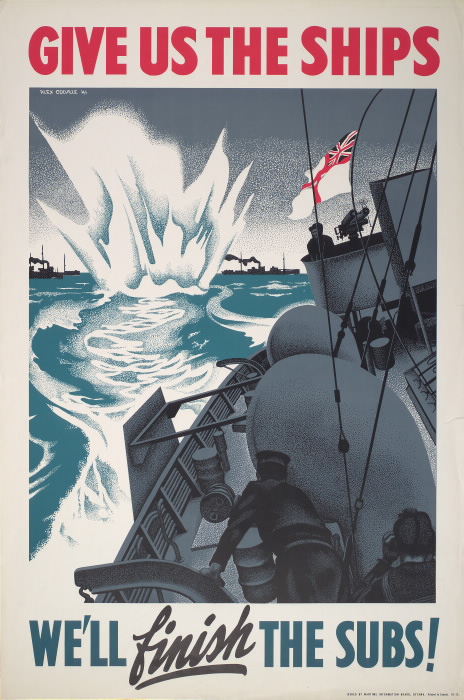
(Credit: Canada. Wartime Information Board, 1941.
Contributor: Alex Colville)
|
(Digitization of Poster at: Toronto Reference Library, |
Baldwin Room |
-
Call Number/Accession Number: 1939-45. Industrial production.
Item 10. L)
On July 16 and beyond, take a moment to reflect upon
the contribution of David Alexander
“Alex” Colville (Born: August 24, 1920 in Toronto, Ontario; Died: July 16,
2013 in Wolfville, Nova Scotia). The official website of Alex Colville noted
that his paintings “bear more affinity to the
American Precisionists of the 1930s than to photo-realism”, supported by
many sketches and studies which helped to create an abstract, geometric base
before the actual drawings were created from a live model and proportioned
according to plan. After this, a painstaking and laborious painting process
would commence with the application of thinned paint to a primed wooden panel.
At the conclusion of the painting process, transparen't lacquer would be applied
to seal the opaque surface.
During World War 2, Colville enlisted in the
Canadian Army under the auspices of the War Artist Program, served in the
European theatre of war, and established himself as an important war artist.
Colville’s work is exhibited in a variety of locations including the National
Gallery of Canada, the Art Gallery of Nova Scotia, the Cape Breton University
Art Gallery, New York’s Museum of Modern Art, the Musée National d'Art Moderne
and the Centre National d'Art et de Culture Georges Pompidou in Paris, France, the
Wallraf-Richartz Museum in Cologne, Germany and the Kestnergesellschaft in
Hanover, Germany.
Consider the following titles for loan from Toronto
Public Library collections about Alex Colville and his work:
Alex
Colville: diary of a war artist / Alex Colville; Cheryl Lean and Graham
Metson (compilers), 1981. Book. Adult Non-Fiction. For additional copies to
borrow, click here.
Those interested in the importance of Canadian war
art in World War 2 and Alex Colville’s connection thereto should consider examining
this book. In 1982, Mr.
Colville donated his remaining wartime drawings and sketches to the Canadian
War Museum to join the museum’s War Art Collection. To view online representations
of some of Mr. Colville’s war art, click here.
Alex
Colville – return / Tom Smart and Alex Colville, 2004. Book. Adult
Non-Fiction.
Art curator Smart focused on Colville’s work for the
preceding 10-year period, highlighting 18 paintings, print, and selected
preliminary drawings. Smart offered the reader a biographical sketch of the
artist’s influence and life and emphasized Colville’s practice of magic
realism. This book paid attention to favourite subjects, composition,
technique, and recurring themes of doubling, ordering, longing, and morality. Smart
did not hide differences of opinion that he had with Mr. Colville.
Alex
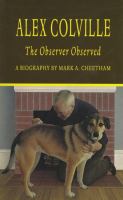
Colville: the observer observed / Mark A. Cheetham, 1994. Book. Adult
Non-Fiction. (Series: Canadian
biography series.)
Cheetham offered the reader a look at Alex
Colville’s political conservatism that included criticism of government support
for the arts through the Canada Council for the Arts that the author argued
indirectly aided Colville by supporting Canadian public art galleries in which
his artwork is displayed. Colville was known for critiquing other contemporary
artists and their work.
Colville
/ Alex Colville; David G. Burnett and Art Gallery of Ontario, 1983. Book. Adult
Non-Fiction. For more copies to borrow, click here.
The Art Gallery of Ontario produced this 1983
exhibition catalogue of Alex Colville’s work displayed at the AGO.
One thought on “Snapshots in History: July 16: Remembering Alex Colville”
Thank you so much for such an interesting blog
about such an outstanding Canadian artist!