Toronto Book Award Nominee – The ordinary is extraordinary with Suzanne Robertson’s Paramita, Little Black
The winner of Toronto Book Awards will be announced on October 11, 2012. Paramitia, Little Black by Suzanne Robertson is one of the five finalists.
It’s been a long time since I’ve read a collection of poetry – especially by one poet. 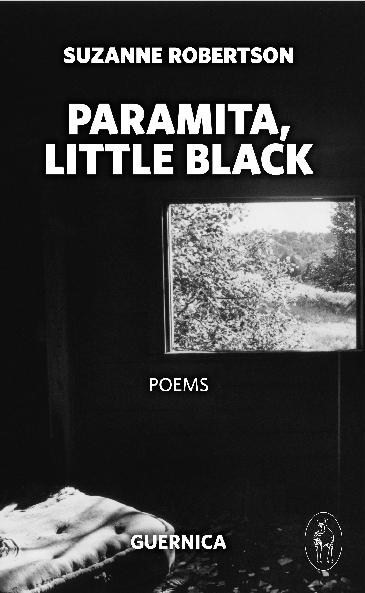
I usually only read one poem and would ruminate on its form, style, and theme and come away with a definite feeling. But with Paramitia, Little Black by Suzanne Robertson, a collection of fifteen different poems, I am taken into various states of consciousness to feel the different threads of connection within each poem. In To the Point, I’m in the here and now, but the simple word ‘to’ at the beginning of each sentence flies me dizzyingly back and forth between nature (lake, trees, wind, sky, rock), to human (man, woman, boy), to animal (tigers growling, dogs jonesin’, geese walking).
I am used to poetry with a definite rhythm and rhyming scheme, so it took me awhile to be comfortable with Robertson’s unique style. She ranges from a traditional poetic form in Sibling of the Air to prose poetry like Fear of Death Confounds Me and The Move. I find that I can miss Robertson’s way with words and must re-read her poems a few times and stop to contemplate the images conveyed as in “the way longing hangs like a woman’s stocking” or “Children slept side by side in the hallway like vibrations of light” (p. 12) or “The dishwasher having a fit in the corner” (p. 21). Robertson seems to take ordinary and simple observances and make them extraordinary and meaningful. In Little Black, the longest of the poems, there is the strong connecting thread with nature personified as it begins with “The light on the river appears to be in the act of remembering something important … and the water repeats it back to us” (p. 51). The inanimate is animated in “every room in the house has a pulse” (p. 58).
Despite therefore, finding some of Robertson’s poems confusing, on the whole I did enjoy reading Robertson’s collection of modern poetry.
Comments