What if You Can’t See the Forest Because There are No Trees?
Tomorrow is World Forestry Day, a day dedicated to recognizing those big
beautiful lungs of the earth. But the day is traditionally not only about
acknowledging those impressive plants lining the shores of our lakes and the
paths of our parks, but also about recognizing the huge role they play in
mitigating climate change and about working to protect them.
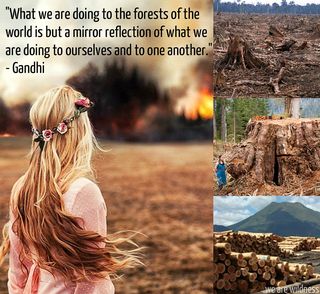
 Although almost a third of the world’s land is covered by forest, each
year more than 32 million acres of forest are destroyed for farmland, fuel, construction,
furniture and other purposes. Of course as forests are removed, all the plants
and animals within are also destroyed, inevitably causing extinction for some. About half of the world’s
rain forests had been destroyed by 2011, the majority in the preceding 50
years. More than half of the world’s animal and plant species live in rain
forests.
For
example, The Wildlife Conservation Society says that poachers for the illegal ivory trade have killed 62 percent of
Africa's forest elephants in the last decade. The demand for elephant ivory (tusks)
originates mainly from China and Thailand (the latter ironically the host of
this year's CITES or Convention on International Trade in Endangered Species of Wild Fauna and Flora meeting). Minkebe National Park has had 11,100 forest
elephants (Loxodon'ta cyclotis) killed in the last eight years and Okapi
Faunal Reserve has lost 75 percent of its elephants in 15 years. Elephants are
key seed dispersers for tropical trees, so when they vanish, the health of the entire
plant and animal community suffers.
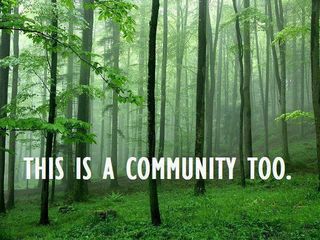
Forests are actually complex communities of interdependent
plants and animals. Even the soil on the forest floor is home to a huge variety
of invertebrates, fungi and bacteria, each of whom play important roles in
cycling nutrients and supporting the rest of the forest. It’s alleged that trees actually communicate when they share
carbon and
nitrogen via fungi in a process not unlike the way our brains work.
 Renowned Canadian
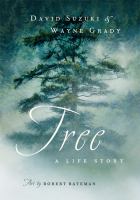
scientific authors, David Suzuki and Wayne Grady, teamed up to write Tree: A Life Story (also available in talking book),
the story of a single tree. They outline how the tree grows and receives
nourishment and what role the tree plays in the forest throughout its life. Tree
also looks at the community of organisms that share its ecosystem, and
the tree is placed within the context of the events going on in the larger
world during the tree's lifetime.
Trees have so many
challenges from logging to disease to alien pests transported accidentally in
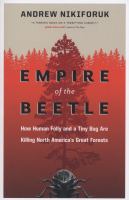
our world of international commerce. Andrew Nikiforuk’s book Empire of the Beetle: How Human Folly and A Tiny Bug are Killing North America's Great Forests (also available in ebook)
suggests that the pine beetle infestation currently
destroying pine and spruce trees from Alaska to New Mexico is the result of
misguided science, out-of-control logging, bad public policy and
a hundred years of fire suppression.
Want to check out our some of our local trees
before they’re all gone? Toronto, the city of parks, is home to hundreds of
species. Check out this list of Toronto guide books
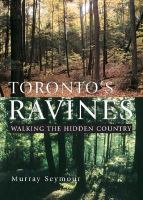
and borrow one of our pedometers to start exploring. Start with Toronto's Ravines: Walking the Hidden Country
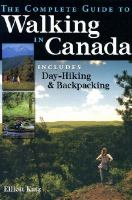
or take on the whole country with The Complete Guide to Walking in Canada.
You can do more to support trees. If there's a city-owned street
allowance at the front of your residential property, you may be able to get a free
tree planted by Toronto Urban Forestry Services. Choose from a list of trees (many
of which are native, which will adapt more easily than their exotic cousins),
although the city will weigh in based on species availability and the
appropriateness of your lawn. Visit www.toronto.ca/trees/index.htm
or call (416) 338-TREE (8733) for more information.
Want one in the backyard too? LEAF (Local Enhancement and Appreciation
of Forests) is a not-for-profit organization that offers subsidized planting of
native trees and shrubs to property owners in Toronto, Markham, Vaughan and
Richmond Hill. An expert from the Backyard Tree Planting Program will visit
your home to offer advice and assess growing conditions before making a plant recommendation.
LEAF will do the planting and then provide information on how to care for your new
tree. Prices range between $50 to $200 depending on the species and the season;
visit yourleaf.org or call
(416) 413-9244 for more information.
 Live in an
apartment or want to do even more? Help reforest our beautiful city and meet
our tree canopy goal. Trees Across Toronto is the city of Toronto’s native tree and shrub planting
program that that takes place each year on the last Saturday in April; this
year, the tree planting event is on April 27 from 10 am to 12 pm at Milliken Park and Windfields Park. More
than 1,500 volunteers planted 2,000 trees last year. All materials and tools
will be provided by Urban Forestry staff.
And if by
chance you can’t use all the bounteous harvest from your fruit tree, let
volunteers from Not Far From The Tree
put your excess to good use. The harvest from your tree will be split evenly
between you as the tree owner, the volunteers and local food banks, shelters
and neighbourhood community (more than 12,000 pounds of black walnuts, sweet
cherries, sour cherries, mulberries, serviceberries, apricots, plums, grapes,
crab apples, elderberries, sumac, pears and apples were picked last year). What’s
not to love about healthy food, hands-on action against climate change, and
building community through sharing?
 There’s
more you can do to save trees and our common environment. Destruction of forests
to produce soy (most of which goes to feed cattle), cattle, rice, palm oil and
logging are also principal drivers of deforestation, so eat low on the food
chain (it takes far more energy and resources to produce a pound of meat than
it does to produce a pound of vegetables). Avoid palm oil altogether as major
and important habitat is being destroyed for your fast food and margarine. Use
re-purposed woods or at the very least,
ensure you buy sustainably produced lumber (as certified by the Forest
Stewardship Council). As our global population increases from 7 billion to 9
billion by 2040, and as more people worldwide rise into the middle class, the
demand for all such commodities will continue to rise. The solution lies in the global supply
chain and the message consumers need to send: “If you cut down trees, I won’t buy your
product.”
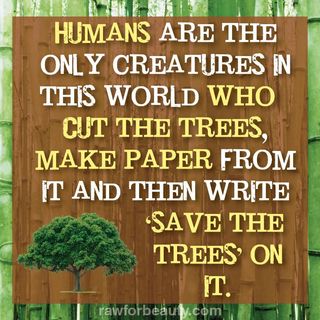
“Trees are poems that earth writes upon the
sky. We fell them down and turn them into paper, that we may record our
emptiness."
– from ’Ode To Trees’, a poem by Kahlil
Gibran
3 thoughts on “What if You Can’t See the Forest Because There are No Trees?”
I just came across this quote today. It seems appropriate:
The Woods are never Solitary—
They are full of Whispering, Beckoning, Friendly Life.
– Lucy Maud Montgomery –
Excellent and very timely. Thought provoking.
Thanks Book Buzz and Cynthia. I came across this article on the weekend which suggests that bushmeat hunting, or the hunting of gorillas and other non-human primates for food may also be transforming the rain forests in Africa as these primates are crucial to dispersing the seeds of some fruit- and nut-bearing trees. See: http://www.mnn.com/earth-matters/wilderness-resources/stories/bushmeat-trade-is-transforming-rain-forest So sad.