Harper Lee, 1926-2016
"Atticus told me to delete the adjectives and I'd have the facts."
Harper Lee, To Kill a Mockingbird
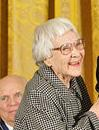
When a writer as beloved as Harper Lee dies, it is hard to leave out the adjectives — words like beautiful, powerful and important are commonly used. Her novel To Kill a Mockingbird had a tremendous impact on the literary world and upon readers. The book tells the story of a young girl Scout Finch and her observations of her Alabama town and its citizens over a three-year period in the 1930s. The novel was so beloved that she received the Presidential Medal of Freedom in 2007 and the National Medal of Arts in 2010, although she had only published this single book. In 2015, her second novel Go Set a Watchman was released amid controversy. Lee had been unwell after suffering a stroke in 2007 and was partially blind and deaf, suffering from memory loss when the book was published and it is unclear whether she had given genuine approval for the publication. For many years she was adamant that she would not release another novel because she found the success of her first book "frightening".
Born in April 1926, Harper Lee's childhood is similar to Scout's in To Kill a Mockingbird. Named after her grandmother, Ellen, Lee is known to family and friends as Nelle. Her father was a lawyer and legislator; there is speculation that her mother Frances may have been bipolar. She rarely left the house. Two events in her childhood particularly resonated with Lee and inspired the novel. When she was five, nine black men in Scottsboro, Alabama were charged with the rape of a white woman. Despite evidence that the rape never happened, the men were convicted. In addition, her father A.C. Lee once defended two black men accused of killing a white shopkeeper. The men were found guilty and hanged. After attending Huntingdon College and the University of Alabama in Tuscaloosa, Lee moved to New York City where she worked as an airlines booking agent, writing in her spare time. In 1956, friends agreed to support her financially for a year while she wrote. The book Go Set a Watchman was completed in 1957 and through editing and revisions became To Kill a Mockingbird.
Lee continued to write but didn't complete another book. She worked with her childhood friend Truman Capote on his true crime book, In Cold Blood, although she felt that her contributions were not appropriately acknowledged.
Go Set a Watchman was published in 2015 after the manuscript, originally thought lost, was located in a safety deposit box. It is essentially the same book she submitted to publishers in 1957.
Harper Lee died at the age of 89 in her sleep.
(Photograph by Eric Draper, White House Photographer [Public domain], via Wikimedia Commons)
One thought on “Harper Lee, 1926-2016”
For nearly fifty years, since I first read TKM (now eight readings, precipitated by seeing people in the play, screening the film, or helping friends’ children with assignments), this novel has been familiar to me. I cannot see why it is so lauded in North America, and indeed, around the world. There are much stronger Southern novels — Faulkner’s Absalom, Absalom!, Eudora Welty’s The Robber Bridegroom, Lee Smith, for example. Harper Lee a great number of awards for TKM, including the Presidential Medal of Freedom from George W. Bush (!). Many people still object to Pearl Buck having won’the Nobel Prize for Literature in 1938; I think the exorbitant praise for TKM needs examining. Is it because it is sufficiently difficult, but not too much (heaven forbid) for high school students? Would someone out there in TKM Land please elucidate.