A brief history of the automobile industry
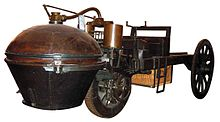
(image courtesy of Wikipedia)
In 1769, French inventor Nicholas-Joseph Cugnot built a three-wheeled steamer (see above image) to help the French army haul artillery pieces. Although his contraption was considered to be too slow and impractical, Cugnot is still regarded as the creator of the first motorized road vehicle. In 1805, Oliver Evans, who built an incredibly slow machine designed to work on both land and in water for the City of Philadelphia Department of Health, is considered to be the first American'to create a motorized road vehicle. Commercial production of automobiles began in 1896 in the United States, ten years after Karl Benz received a German patent for his invention of the first automobile powered by an internal combustion engine. Along with his wife, Bertha, he founded the German automobile manufacturer Mercedes-Benz.
The early 1900s boomed with various types of motorized vehicles being developed around the world. In the United States Ransom E. Olds and his Olds Motor Vehicle Company (later known as Oldsmobile) dominated this era of automobile production. As a result of superior promotional and marketing efforts, sales of the Oldsmobile approached 5,000 in 1904 which, at the time, was unheard of in the industry. The Thomas B. Jeffrey Company developed the world's second mass-produced automobile called the Rambler. In 1902, 1,500 Ramblers were built and sold, and by 1904 production reached 2,342 units.
Perhaps the most famous car of all time is Henry Ford's Model T. In order to keep costs low, Ford focused efforts on improving production methods. His moving assembly line began operation in 1913-1914 making it possible to lower the cost of the Model T and, as a result, increase sales and potential customers. In response to consumer demands manufacturers have reinvented the automobile numerous times over.
From the development of anti-lock braking systems, to hybrid vehicles, to the first highway-capable all electric vehicle, the automobile industry continues to create, innovate and transform the way we live. To read more about this fascinating industry, take a look at these books, ebooks and DVDs:








Comments