Business Beach Reads

(image courtesy of http://www.freeimages.com)
Summer is finally here, and as we pack our things for the cottage and the beach, why not bring along a business book? Now, if you think that finding a great business book to read while away on vacation is too difficult, think again! The business book genre offers unique opportunities in summer reading. The following is a list of easy and entertaining reads that will hold your interest all vacation long.
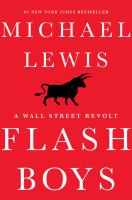 Flash Boys is about a small group of Wall Street guys who figure out that the US stock market has been rigged for the benefit of insiders and that, post-financial crisis, the markets have become not more free but less, and more controlled by the big Wall Street banks. Working at different firms, they come to this realization separately; but after they discover one another, the Flash Boys band together and set out to reform the financial markets. This they do by creating an exchange in which high-frequency trading — the source of the most intractable problems — will have no advantage whatsoever. The characters in Flash Boys are fabulous, each completely different from what you think of when you think "Wall Street guy." Several have walked away from jobs in the financial sector that paid them millions of dollars a year. From their new vantage point they investigate the big banks, the world's stock exchanges and high-frequency trading firms as they have never been investigated, and expose the many strange new ways that Wall Street generates profits.The light that Lewis shines into the darkest corners of the financial world may not be good for your blood pressure, because if you have any contact with the market, even a retirement account, this story is happening to you. But in the end, Flash Boys is an uplifting read. Here are people who have somehow preserved a moral sense in an environment where you don't get paid for that; they have perceived an institutionalized injustice and are willing to go to war to fix it.
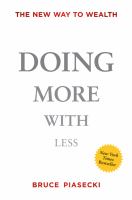 After the last set of business scandals and financial busts, many powerful interests and many influential people are asking questions about doing more with less, from governments to multinational corporations; they are seeking this realignment in hopes of regaining their balance. Doing More with Less is an actionable call to arms, with global insights that are of immediate application to professionals in any industry into new ways to better align money, people and rules. Author Bruce Piaceski convincingly lays out the case for a return to frugality, providing relevant examples from his 30 years of experience as a management consultant and change agent. Piaceski deftly explains how this approach to competition is relevant, and provides readers with the framework to look at what's next without tottering toward failure.
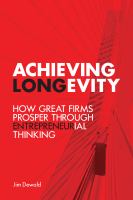 Starting a business is hard, but keeping an established company going can be equally challenging. In the long run, every business will need to adapt to changing market conditions, technologies, and competitive environments. Achieving Longevity explains how to manage those changes through entrepreneurial thinking.
As Jim Dewald shows, the most successful companies thrive by establishing decision-making processes that constantly engage new opportunities, enabling the firm to quickly adapt to disruptive technologies and business models. They allow for tinkering and experimentation and strive to both exploit their competitive advantage today and explore new ideas that will give them an edge tomorrow.
Achieving Longevity provides a framework for introducing the tools and culture necessary to foster entrepreneurial thinking, as well as advice on how to overcome common obstacles to corporate entrepreneurship. Drawing on Dewald's own experience as an entrepreneur, a successful corporate executive, and a professor of strategy, the book offers numerous examples of how to combine the strengths of an established firm with the innovative, outside the box thinking of a start-up venture.
 The founders of a respected Silicon Valley advisory firm study legendary category-creating companies and reveal a groundbreaking discipline called category design.
Winning today isn’t about beating the competition at the old game. It’s about inventing a whole new game — defining a new market category, developing it, and dominating it over time. You can’t build a legendary company without building a legendary category. If you think that having the best product is all it takes to win, you’re going to lose.
In this farsighted, pioneering guide, the founders of Silicon Valley advisory firm Play Bigger rely on data analysis and interviews to understand the inner workings of “category kings”— companies such as Amazon, Salesforce, Uber, and IKEA — that give us new ways of living, thinking or doing business, often solving problems we didn’t know we had.
In Play Bigger, the authors assemble their findings to introduce the new discipline of category design. By applying category design, companies can create new demand where none existed, conditioning customers’ brains so they change their expectations and buying habits. While this discipline defines the tech industry, it applies to every kind of industry and even to personal careers.
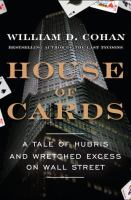 On March 5, 2008, at 10:15 AM, a hedge fund manager in Florida wrote a post on his investing advice web site that included a startling statement about Bear Stearns & Co., the nation’s fifth-largest investment bank: “In my book, they are insolvent.”
This seemed a bold and risky statement. Bear Stearns was about to announce profits of $115 million for the first quarter of 2008, had $17.3 billion in cash on hand, and, as the company incessantly boasted, had been a colossally profitable enterprise in the 85 years since its founding.
Ten days later, Bear Stearns no longer existed, and the calamitous financial meltdown of 2008 had begun.
How this happened –- and why –- is the subject of William D. Cohan’s superb and shocking narrative that chronicles the fall of Bear Stearns and the end of the Second Gilded Age on Wall Street. Bear Stearns serves as the Rosetta Stone to explain how a combination of risky bets, corporate political infighting, lax government regulations and truly bad decision-making wrought havoc on the world financial system.
Cohan’s minute-by-minute account of those ten days in March makes for breathless reading, as the bankers at Bear Stearns struggled to contain the cascading series of events that would doom the firm, and as Treasury Secretary Henry Paulson, New York Federal Reserve Bank President Tim Geithner, and Fed Chairman Ben Bernanke began to realize the dire consequences for the world economy should the company go bankrupt.
 A book that argues that lessons in creativity, innovation, salesmanship, and entrepreneurship can come from surprising places: pirates, bootleggers, counterfeiters, hustlers, and others living and working on the margins of business and society.
Who are the greatest innovators in the world? You're probably thinking Steve Jobs, Thomas Edison, Henry Ford. The usual suspects. This book isn't about them. It's about people you've never heard of. It's about people who are just as innovative, entrepreneurial, and visionary as the Jobses, Edisons, and Fords of the world. They’re in the crowded streets of Shenzhen, the prisons of Somalia, the flooded coastal towns of Thailand. They are pirates, computer hackers, pranksters and former gang leaders. Across the globe, diverse innovators operating in the black, grey and informal economies are developing solutions to a myriad of challenges. Far from being "deviant entrepreneurs" that pose threats to our social and economic stability, these innovators display remarkable ingenuity, pioneering original methods and practices that we can learn from and apply to move formal markets. This book investigates the stories of underground innovation that make up the Misfit Economy. It examines the teeming genius of the underground. It asks: Who are these unknown visionaries? How do they work? How do they organize themselves? How do they catalyze innovation? And ultimately, how can you take these lessons into your own world?
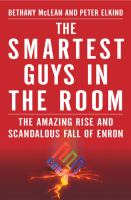 The definitive volume on Enron's amazing rise and scandalous fall, from an award-winning team of Fortune investigative reporters. There were dozens of books about Watergate, but only All the President's Men gave readers the full story, with all the drama and nuance and exclusive reporting. And 30 years later, if you're going to read only one book on Watergate, that's still the one. Today, Enron is the biggest business story of our time, and Fortune senior writers Bethany McLean and Peter Elkind are the new Woodward and Bernstein. Remarkably, it was just two years ago that Enron was thought to epitomize a great New Economy company, with its skyrocketing profits and share price. But that was before Fortune published an article by McLean that asked a seemingly innocent question: How exactly does Enron make money? From that point on, Enron's house of cards began to crumble. Now, McLean and Elkind have investigated much deeper, to offer the definitive book about the Enron scandal and the fascinating people behind it. Meticulously researched and character driven, Smartest Guys in the Room takes the reader deep into Enron's past and behind the closed doors of private meetings. Drawing on a wide range of unique sources, the book follows Enron's rise from obscurity to the top of the business world to its disastrous demise. It reveals as never before major characters such as Ken Lay, Jeff Skilling, and Andy Fastow, as well as lesser known players like Cliff Baxter and Rebecca Mark. Smartest Guys in the Room is a story of greed, arrogance and deceit — a microcosm of all that is wrong with American business today. Above all, it's a fascinating human drama that will prove to be the authoritative account of the Enron scandal.
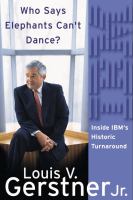 In 1990, IBM had its most profitable year ever. By 1993, the computer industry had changed so rapidly the company was on its way to losing $16 billion and IBM was on a watch list for extinction — victimized by its own lumbering size, an insular corporate culture, and the PC era IBM had itself helped invent.
Then Lou Gerstner was brought in to run IBM. Almost everyone watching the rapid demise of this American icon presumed Gerstner had joined IBM to preside over its continued dissolution into a confederation of autonomous business units. This strategy, well underway when he arrived, would have effectively eliminated the corporation that had invented many of the industry's most important technologies.
Instead, Gerstner took hold of the company and demanded the managers work together to re-establish IBM's mission as a customer-focused provider of computing solutions. Moving ahead of his critics, Gerstner made the hold decision to keep the company together, slash prices on his core product to keep the company competitive, and almost defiantly announced, "The last thing IBM needs right now is a vision."
Who Says Elephants Can't Dance? tells the story of IBM's competitive and cultural transformation. In his own words, Gerstner offers a blow-by-blow account of his arrival at the company and his campaign to rebuild the leadership team and give the workforce a renewed sense of purpose. In the process, Gerstner defined a strategy for the computing giant and remade the ossified culture bred by the company's own success.
The first-hand story of an extraordinary turnaround, a unique case study in managing a crisis, and a thoughtful reflection on the computer industry and the principles of leadership, Who Says Elephants Can't Dance? sums up Gerstner's historic business achievement. Taking readers deep into the world of IBM's CEO, Gerstner recounts the high-level meetings and explains the pressure-filled, no-turning-back decisions that had to be made. He also offers his hard-won conclusions about the essence of what makes a great company run.
Comments