Neil Gaiman on Librarians
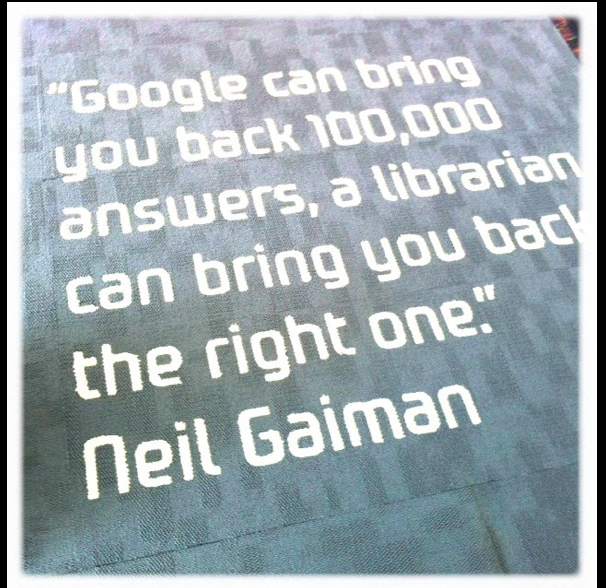
Neil Gaiman writes books for adults and children; he writes graphic novels, picture books and fantasy novels. He also says very wise, timely things including this quote, woven into the carpet at the new Gungahlin Public Library in Canberra, Australia.
6 thoughts on “Neil Gaiman on Librarians”
Neil Gaiman makes reductionist statements, BUT librarians turn these into catchy, yet fundamentally vapid maxims. Google vs. librarians is a false opposition. Between the 4 or 5 great results I can obtain through Google, and the 1 good-enough-at-the-time answer I can get from a librarian, give me Google any day (and honestly, it’s hardly like librarians are immune from the Google addiction).
I think somebody missed the rather blatant “let’s all band together and save our libraries from massive city funding cuts” tone of this piece.
But, in all seriousness, I don’t think you can rightly claim that anyone was attempting to take a statement of Gaiman’s (which in one fell stroke addresses both the information overload Google provides to its end users and the importance of a bibliographic and reference system dedicated to specific and synthesis-oriented information gathering) and reduce it to a “vapid maxim”.
As far as I can’tell, the only person here who has actively approached this rather delightful and piquant witicism of Gaiman’s as “Google vs. librarians” would be you.
I might also take umbridge with your assessment of information provided through librarians (and lumping the entire body of the TPL staff – or heaven forefend a global body of same – into one pool is never a good idea to begin with) as being “1 good-enough-at-the-time answer”. I do not begin to suggest that each and every librarian of the TPL system is a walking encyclopaedia, that being somewhat of a statistical impossibility. However, I find that a living breathing human who can parse English and provide intelligent cross-referencing is far more valuable than a boolean operator search function.
Maybe it’s just me, but I find that Google does not perform well when asked to create multiple cross-referenced results. Nor, given the way Google’s page ranking system (based on internal verification and end user ratings/visits) produces referenced links and results to be terribly useful because the links at the top of the list are the most frequently visited/patronized, not necessarily the most accurate.
Which is rather to the point of what Gaiman was getting at with his quote. Electronic databases are great (you may note the TPL uses one), but they simply do not compare to being able to talk to a living human being who can perform “on the spot” synthesis and cross-referencing. Not to mention that having access to the physical texts that have the answers you’re ideally looking for in the first place there IN the library and/or research collections is far preferable to Google’s ridiculous (and copyright infringing notion) of scanning every book in existence into archived digital form.
But that, right there, is a whole other argument we will not meander into.
Ultimately, I think the question boils down to this:
Would you like Google to tell you which cliff everybody else jumped off of, or would you like a librarian to point you to the bridge?
What is that ol’ Shakespeare wrote in Hamlet (Act III, Scene 2)? “The lady doth protest too much, methinks.”
[Oh, and ironically, I couldn’t remember the exact quotation, so I used Google with a few keywords and found the text in mere seconds–thanks for that book scanning and awesome search engine, Google! Should I have turned to my local library for assistance in finding this exact quotation, I would have had to rely on: a) the librarian behind the desk happening, by sheer luck, to be a Shakespeare scholar, and b) the Shakespeare-scholar-librarian having a good enough memory to remember which play the quotation is from. If that wasn’t the case, in all likelihood, the librarian would have turned the monitor away from me and done a quick Google search with a few select key words to produce the full quotation and its origin… but let’s not get bogged down by actual examples of everyday searches in our efforts to validate the importance of multiple cross-referenced results.]
Does anybody still argue that a horse-drawn carriage is as efficient in getting you to your destination as fast and safely as possible as a car? No, because it is self-evident. The very need to defensively defend a librarian’s worth in light of Google’s ease and efficiency of use is proof that librarians are on the losing end of effectiveness. If the value of using your local librarian’s brain is so obvious, there is no need to feel threatened by Google.
This is not to say that a chat with a librarian isn’t pleasant and useful in other leisurely ways (much in the same way that a ride in a horse-drawn carriage allows for leisurely lingering on the beauty of the scenery). But to get to Point B from Point A in a fast and efficient way, Google is THE vehicle.
You see, it is unfair to claim that Google is simply a popularity arbiter of fashionable places to kill yourself (jump off a cliff), while librarians are superheroes pointing to safety, like Horatio at the bridge. Let me reframe your metaphor: Google, in a democratic fashion, reveals that there are many ways to cross over the dangerous abyss. It may not tell you which bridges are near collapse, or which ones are shaky and narrow, but it does at least let you know of these other bridges and gives you the option to pick. The librarian, traditionally called “gatekeeper of information,” acts not only as a barrier, but as a self-appointed arbiter of what is the “right” information. Given the subjectivity of the librarian, is it surprising that his class, gender, cultural, social, sexual, etc. prejudices shape the information they provide?
I didn’t miss the “let’s all band together and save our libraries from massive city funding cuts” aspect of the piece, but I simply don’t think sticking a picture of a carpet in an Australian library amounts to anything more than thumbing your nose at Ford Nation. You want to band together and save libraries? Then get out there in the arena where you have to face those who disagree with you and stop making faces behind Neil Gaiman quotations.
Both librarians and Google have their uses. Yes, Google can be great. It is great you found a Hamlet quote in 2 seconds (though I would like to add that any librarian could do that, though yes it would take a few seconds longer). However, for more advanced things, Google is only great provided you know how to use it: how to use proper search terms and boolean operators, how to assess the accuracy, currency, and impartiality of the information (contrary to an above statement, Google is not “democratic”). A lot of people do not. I work with at-risk communities, so trust me on that. Libraries can help people learn to use tools like Google. There is a reason that librarians require a masters degree (remember, not every staff member at a library is a librarian – they are usually at the reference desk). However, that is not to say that yes, many people are more than capable of searching Google on their own. It is a great tool. But even many of these people may need help at some point, or could simply find even more (I’m not saying necessarily always better, but more) information in consulting a librarian, and they do. Part of this is only because Google does not have access to everything. There are some specialized databases and types of information that is proprietary and controlled by a publisher and/or university. Often it is available online, but you need a library card. Some things, especially historical works, aren’t even online and need to be tracked down the old fashioned way. There is still a place for librarians.
So what you’re saying sir, is that you require the assistance of a search engine in order to make yourself sound intelligent?
That being the case, it doesn’t surprise me how you claim librarians are “making faces” behind Neil Gaiman, while you sit at your computer arduously “searching” for the answers that plague mankind – stopping to top of your oh-so-witty comments with a splash of Shakespeare.
Your points are mute sir. When was the last time you read about a horse drawn carriage getting in an accident? While not as fast as cars, they seem to be more reliable. In fact, by your own admission Google is a resource that gives many answers but not all of them are correct – and may not even be relevant. In your example of the bridge you state that “Google… reveals that there are many ways to cross over the dangerous abyss. It may not tell you which bridges are near collapse, or which ones are shaky and narrow, but it does at least let you know of these other bridges and gives you the option to pick.” Which means the user of Google must rely on the chance that they’ve found the right information (bridge) rather than the incorrect information (death) based on their knowledge of Boolean, the area they’re navigating, and their grasp of the english language (or relevant language), etc. The so-called “barrier” that a librarian puts up as a “self appointed arbiter of what is the ‘right’ information” is in fact not self appointed. In fact, the information is given to the librarian by a source (a person) and based on that information, they are able to come up with a solution for that source using their own brain as an intermediary to discern the shaky data from that which is sound. Of course, you couldn’t relate to that, being such a seasoned Google user could you?
Yes Google is a great tool, a resource to find many branching answers for what you tell it to search for, and perhaps you’re unable to get past the “addiction” you find yourself in – but perhaps you should first use Google by typing in the word “Librarian.” I believe you will find the first entry quite enlightening, as it outlines various types of librarians, and their roles. Did you know that many librarians don’t just specialize in one discipline? You might find it hard to believe but it’s true. You might also find that when having one of your leisurely chats with a librarian that they are also serving a public relations role and become centers for a community without the means (be it resource or otherwise) to utilize programs such as Google effectively.
My but we seem to have wandered rather far afield. Though I suppose the line of digression that led us to discussing public library systems and Google in terms of modern vs. archaic information delivery systems was an inevitable outcome given the position of your first comment. And while I do not (nor, indeed, did previously) deny that Google holds advantages I was, you may note, not engaging the topic as either/or. I stated my preference for human interaction in the process for, in fact, several reasons.
And while I am more than happy to embrace a broader topic of discussion in this dialogue, I’m just going to briefly address this first:
The comparison of Google (as vehicle) to Librarians (as horse-drawn carriage) is at best an inappropriate analogy in this case. The main reason for that being that people do not obsolesce. We replace ourselves with newer iterations, encompassing variable strains and mutations of the dominant and recessive strains, certainly, but we do not simply go out of style. If you want to talk about the antediluvian structures in which North American libraries chose to, for an ineffably long time, comport themselves then by all means we can’talk about obsolescence and an almost absurdly intractable approach to both natural and imposed evolution in systems management.
And, in light of that point (and to provide us an appropriate segue) we might also look at the line:
“But to get to Point B from Point A in a fast and efficient way, Google is THE vehicle.”
See, there in a nutshell is where your argument fails to address Gaiman’s point (which is why I replied to your original post in the first place), because you’ve not addressed the thesis behind his comment.
Gaiman was talking about the plethora of information available through Google as an overload of information, some inevitably right, some inevitably wrong. He talked about turning to a Librarian not because you need the fastest, easiest answer, but because you need the “right one”.
The “right” answer is the one that encompasses all the aspects of something you need to understand, and seldom, if ever, is the “right” answer going to be meted out to you in a readily available, reductio ad absurdum form. This would be why a _good_ Librarian can provide you with a wealth of research material cross-referenced to address your specific questions and whatever fractally divided or far-flung aspects of a question you need answered, in correlation to one another. This is why I talked about synthesis as being key or crucial to the role Librarians play in information-gathering, because Google and Librarians are not at odds, they are entirely different approaches to information gathering.
Here’s what Google does: Google provides pinpoint searches for those seeking single-string responses. Because of its nature as a simplified query response engine Google is exceptionally capable in terms of producing a return of a single packet or piece of information (as your example of seeking out the section reference for your opening Shakespearian quotation demonstrates), when you need a simplified piece of information to retrieve from its contextual home and to transplant it into something else.
It does not, however, lend itself to cross-referencing or syntehsizing material when you require a compound response or result. That still requires human engagement. So, yes, you can in fact input multiple searches through Google and then correlate the results yourself, accounting for variance in collected data, cultural, societal, and any other applicable viewpoint based factors.
Or, you could deal with a Librarian who works in a given section of a library, who is familiar with not only the subject you are seeking to explore/research, but also the texts available and what they contain and any bias based pitfalls those texts might lead the unwary into. And I might add that there is a simple answer to your “concern” over whether or not a Librarian would remember where the Shakespearian quotation you are trying to put in its proper place belongs (and the broader question of relevancy and ease of subject specific information retrieval): ask a Librarian who works in the appropriate section of the library, like oh, I don’t know, maybe Fiction and Literature? You wouldn’t seriously expect someone in Business or Political Sciences to have that kind of information on hand, would you? And in that instance the onus is on the user (as, I might add, is the case for using any technological system as well) to know how to properly utilize the system they are dealing with.
You know, I actually quite liked your adaptation/expansion of the bridge/chasm analogy right up until the point where we hit “gatekeeper of information”. And here, again, I take exception, because the phrase isn’t “gatekeeper”, it’s “_guardian_” – as in person who protects something so that future generations can also have the benefit of it.
And as regards your assertion that only Librarians (yes, I’m extrapolating from your post) are possessed of bias (of any/all varieties) you have a rather nasty surprise coming. Quite obviously I think, everything that you’re going to be exposed to/filtering from Google, or anywhere else on the internet for that matter, is based on human input. And as such there is no quantifiable “unbiased” input. So while Librarians may be more viscerally or immediately recognizable as being a product of their cultural background/exposure/upbringing/socio-political views, etc., the information provided to you by Google is equally biased, unreliable, slanted, etc.
Does that make Google any less useful? Of course not. But it has a purpose, and when you come right down to it that’s really a rather narrow one. Highly useful for what it can do, yes, but not terribly flexible.
Also, what both interests and confuses me most about this exchange has been the fact that you started out by talking about the notion of “Google vs. librarians [being] a false opposition”, then in your subsequent post relied on the previously denied “opposition” between the two to fuel your argument. You’ve made some good points throughout, and I for one agree with you regarding your final supposition that engaging in debate and voicing an opinion where it will be heard and discussed (hopefully leading to the implementation of change or the maintenance of vital sevices like libraries, and the other by no means less important city services that we really need to keep) is a necessity, but contorting the central support of your original argument to continue the debate is not a sustainable position from which to work.
The root of the issue to hand appears to be that Google and Librarians serve different purposes, and the intrinsic dichotomy between the two is this:
Google is an extraordinarily quick way to search out pinpoint/singular packets of information, but the system lacks the flexibility to provide synthesis and a proper guide to correlative research for those who need it.
Librarians are better suited to providing in-depth, cross-referenced synthesis on a given subject, but (obviously) cannot match the computational speed of an online search engine for dedicated, single-response queries.
And when all is said and done you can pick and choose how (and/or if) you will utilize either service. They are not mutually exclusive options.
P.S. Because it came up (if flippantly) in your response, let me explain my issue with Google’s plan to scan every book in existence into electronic form. My concerns lie in the fact that Google’s proposed plan would violate the International Copyright Treaty by blatantly disregarding the existence of intrinsic intellectual copyright, and the protections that go along with it. This is especially the case as Google chose to present their proposal to the world with an “opt-out” clause, deeming it the copyright holder’s burden to _disallow_ Google the violation of said copyright(s). The position is, at best untenable. The only feasible approach to such an action is the far more sensible “opt-in” clause that Justice Danny Chin ruled would be a viable solution to this issue after rejecting the Google/Author Guild settlement proposal back in March of this year. The idea of enhanced accessibility to the entire store of printed knowledge and material is not a bad idea. just the opposite. But there is a way to do this without violating both international law and personal rights, and Google just isn’t there yet.