Filmmaking 101: Part 1
For the past month, I’ve had the privilege of leading a series of filmmaking workshops in three distinct and vibrant Toronto neighbourhoods. Every Tuesday, I begin my day at The Spot at Jane and Finch. I then drive more than 25 kilometres across the top of the city to The Point, a satellite location of the East Scarborough Storefront in the neighbourhood of Kingston-Galloway. On Fridays, my days are spent at the Victoria Park Hub, where Scarborough and East York meet.
Over the course of six weeks, the participants in my Filmmaking 101 sessions have been working to make their own short films. Each session focuses on a specific phase of the filmmaking process. This blog post will highlight some of the content covered in the first two sessions, Getting Started on Your Film and Planning Your Film.
In Getting Started on Your Film, I encouraged participants to begin thinking up ideas for their short films that would be simple to execute. Together, we identified different film genres and which types of films might be easier for first-time filmmakers. Generally, documentaries are simpler than scripted projects. Films requiring fewer actors, locations, and costumes are simpler than those requiring a huge cast, many locations, and historically accurate costumes. Comedic films and dramas are easier than sci-fi and gangster flicks.
For those who didn’t come to the first session with an idea for a film, we brainstormed where ideas come from. I encouraged participants to remember the famous saying for authors to “write what you know.” The same is true for filmmakers. Your film will be more authentic if you understand your subject matter. It will be simpler for you to execute. But it will also be more valuable to your audience, because your film will serve to share your perspective with them.
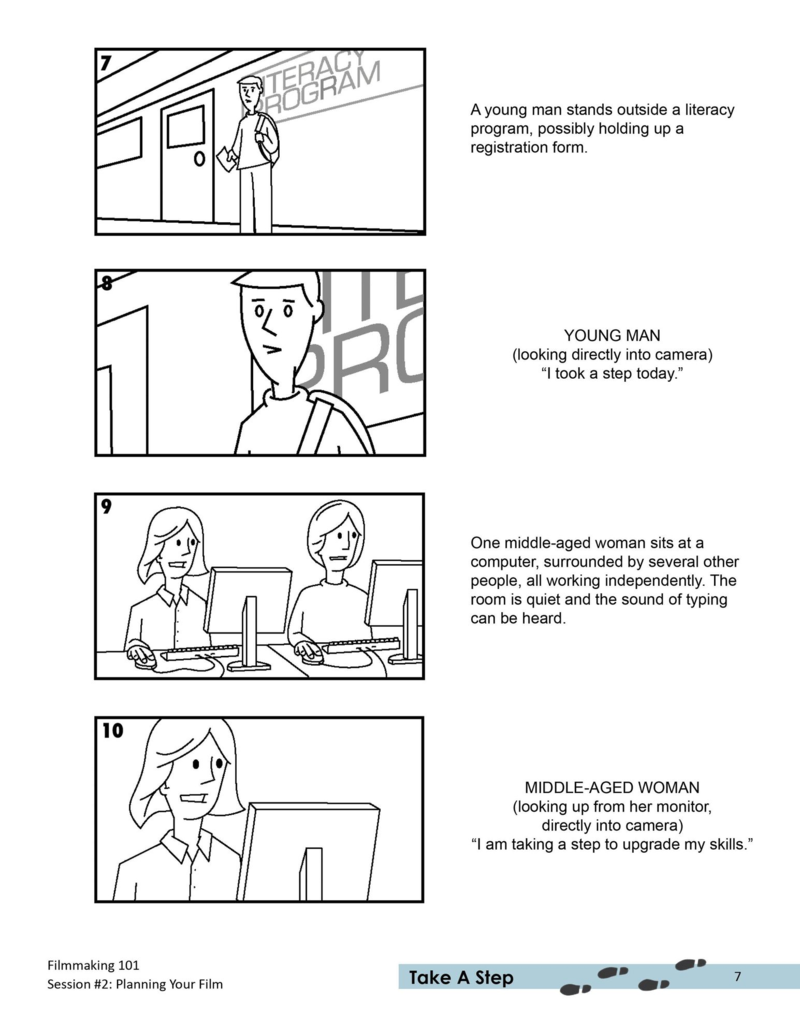
In Planning Your Film, I shared some film writing samples so participants could spend some time fleshing out their ideas on paper. The samples were from a public service announcement I created for the Ontario Literacy Coalition in 2006. The three different format options for writing their films were a treatment, a script, or a series of storyboards.
Participants also shared their film concepts with the group. Each participant was asked to answer the following questions:
- What is your film about? (What’s the idea?)
- What kind of film is it? (What’s the genre?)
- What other film have you seen that your film resembles?
Each concept was workshopped to help participants identify the strengths and challenges of their proposed projects. We asked questions to clarify things that were unclear and we talked about the portions of each participant’s film that excited us.
At the end of the first two sessions, I was jazzed to see how the workshop participants’ films would develop and progress. I was also excited to share some shooting and editing techniques with them in the coming weeks—which I’ll share with you in my next two blog posts on November 26 and 29.
Chanda Chevannes is currently an Innovator in Communities with the Toronto Public Library. She is an award-winning Canadian documentary filmmaker with The People’s Picture Company and an enthusiastic arts educator. Her most recent film is Living Downstream, a feature documentary about the links between synthetic chemicals and cancer.
Comments