Are Robots Coming for Our Jobs? (Part 1)
In short, yes. If someone asked you what code is would you know how to answer them? Is coding some foreign concept to you? What if I told you that you are surrounded by code every day of your life; every red light you pull up to, every text message you send, every alarm you set and every microwave dinner you’ve ever heated up? Code is the language of machines and just like us, they can speak many languages.
The big difference is potential, and the limitations of a human versus a computer. According to Statistics Canada, 17.5% of the population reported speaking two languages at home, meaning 82.5% of us either spoke more than two languages or we just settled on one; my guess is it’s the latter. Those who can speak multiple languages are known as polyglots, and the elite polyglots who master double digits of languages are referred to as hyperpolyglots. Being a hyperpolyglot is extraordinary by our standards, but when compared to your average computer which can gather and interpret information in hundreds of different programming languages, we can see there’s a huge gap in performance.
Where’s the silver lining and how can you prepare yourself? Keep an open mind. People have had it really good from the industrial age up until the beginning of the computer age. If you’d like to cash in on this transition yourself, consider a job in data science. As of today's date, there are currently over 4,000 job postings in Ontario listed on indeed; they’re paying much more than minimum wage and demand is only increasing. Consider reading Think like a Data Scientist by Brian Godsey, Introducing Data Science by Davy Cielen or Data Science for Dummies by Lilian Pierson for more background. You can also perform a blanket search using the terms data science or machine learning on the Toronto Public library website.
We are surrounded by machines that perform myriad of tasks ranging from the most basic duties of keeping the fridge running to Artificially Intelligent (AI) bots that are competing with humans at the highest level of trivia, gaming and more. We are getting to the point where we are in less demand for programmers who can code machines and more in demand for researchers, data scientists and machine learning architects who are fine- tuning how to best feed them more data.
The advent of machine learning and automation have now enabled machines to teach themselves, learn from their mistakes and instantly improve in performance. Where one human might make a mistake, learn from it and vow to not do it again, the rest of that person's coworkers and future coworkers have yet to hit that same stumbling block, likely resulting in future mistakes. If an automated bot, powered by machine learning makes an error, it will correct that part of its code and also share it with every one of its identical task performing robot friends, so none of them will ever make that mistake again.
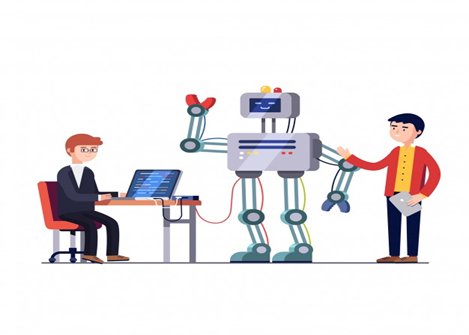
Photo: Created by Iconicbestiary – Freepik.com
There is currently a race going on between the world's biggest tech companies to acquire people who understand AI and who will code the next best automated self-driving car, search engine and fraud detection program. Pretty much everyone is cashing in on AI right now, as it will change the competitive landscape in every business sector. We can see that there is no end in sight for demand of new AI programs and the best that we can do is accept that it is coming. Russia’s president Vladimir Putin has been quoted as saying “the nation that leads in AI will be the ruler of the world” — queue the flight of the Valkyries song now.
I’m going to save the moral and ethical dilemmas of AI for a future post, but I will be the first to say here that there is a lot of good coming with these intelligent machines. Self-driving cars will eliminate the thousands of traffic accidents that occur daily around the globe due to human error. This will make the roads so safe to the point where the only threat becomes human error, thus pushing manual driving to become illegal. Farmers aided by these machines will yield crops more efficiently and at a greater rate than ever before. Banks will know the moment a conman is trying to log into your bank account or purchase something with your information. Transportation routes will be better thought out, quicker and more connected than ever. These are a few examples of thousands where these smart machines will outperform humans to create a better future. The only drawback in this soon to be future is that most human jobs will be the equivalent of the horse and buggy, and the 1908 Ford T model is rolling right around the corner.
To be a part of the discussion or to learn more about artificial intelligence, feel free to sign up for one of our “What is artificial intelligence” programs currently being offered at Downsview Branch. There are also basic coding classes offered at various libraries if you want to try your hand at Adobe Dreamweaver, Robotics, Arduinos and more. If you’re a self learner, the library provides access to Lynda, a database containing over 3,500 video tutorials across a wide range of tech fields including data science, programming and machine learning.
Thanks to Downsview Branch, Digital Innovation Hub | Digital Design Technician: Jorge Guevara
Comments