If It is Too Cheap, Think Twice
Have you ever bought a USB charger and been elated over the good price? The downside is that you may have purchased a device that might damage your phone, laptop or any device that requires a USB.
The potential dangers of a faulty USB charger include the following:
- It could be a fire hazard. Your charger can overheat and cause your device to catch fire.
- Some may have design flaws, or are subject to low quality control during manufacturing. It may be okay but not good enough.
- It may send more power to your device than you need.
A small USB charger contains the following components. All of the components play a vital role in charging your device safely.
Transformer: an apparatus for reducing or increasing the voltage of an alternating current.
Capacitor: a device used to store an electric charge, consisting of one or more pairs of conductors separated by an insulator.
Diode: a semiconductor device with two terminals, typically allowing the flow of current in one direction only.
Resistor: a passive electrical component used to create resistance in the flow of electric current.
Optocoupler: a component that transfers electrical signals between two isolated circuits by using light.
Power transistor: a three terminal semiconductor device used to amplify and switch electronic signals and electrical power.
Figure #1 below is an inexpensive USB charger. All of the components seem fine but look closely at the red wires next to the casing. The red electrical wires have burned out, causing a small explosion. Your next question is probably why did this happen.

What may have happened to the charger
A faulty transformer (purple wrapping in Figure #1) can cause a mini explosion. A transformer is made up of fine copper wire that is wound around a plastic core. There are two types of copper wire: primary wire and secondary wire. The primary and secondary wire never touch one another and each layer of wire needs to be sealed with electrical tape. If the wires come into contact with one another, it can potentially send 120 volts to your device or yourself, small USB chargers should be a maximum of five volts. Figure 2 shows how a transformer looks inside.
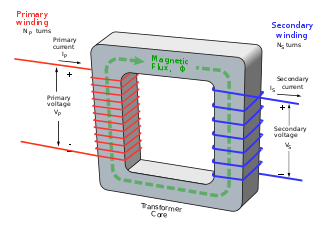
Figure #2 Copyright: Wikipedia
Grounding issue. This is due to a failure of another part, such as components that bridge high voltage to low voltage. Separation between the high and low components can make a difference. This can also cause the case of the charger to carry a voltage thus causing an electric shock.
Components are too close together. Circuit board has small lines of copper that connect various components; this is called tracing, as shown by the dark and light green paint, see Figure #3. If you follow the lines, it will show you how the power flows through the board. On the other side of the circuit board, see Figure #1, the components are placed over the tracing and soldered in place. If the components are placed too close together, it could potentially spark in between, sending high voltage power to the metal casing of the device.
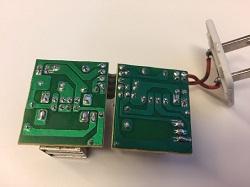
Figure #3
Incorrect voltage labeled on the device. The device is labeled a higher amount of power but the components can only handle half of the amount. An example is if a charger is rated two amps but the components can only handle a fraction of that, the outcome results in overheating. Incorrect voltage can also result in your charger taking too long to charge your device.
Voltage spikes can also be an issue. This is due to the device not having proper filtering for the power. This can cause stress to the device you are charging and damage or reduce the life span of the battery.
What makes a better charger?
Better USB chargers have Control Circuitry (Control IC). Control IC prevents your device from overcharging. They also will have better design and manufacturing that adheres to consumer electrical safety laws such as correct spacing in electric traces, correct filter capacitors, internal fuses, higher quality transformers and many more features.
It is also best to buy what the manufacturer recommends. You may spend more money but the result is safer for both you and the device you want to charge. Always look for the UL symbol on a charger. UL stands for Underwriters Laboratory and it is a certified device.
Be wary of where you are purchasing your device, even for laptop chargers or other inexpensive charging devices. Buy from a reputable source and if the price is too good to be true, then it could be of poor quality.
At the time of writing this blog, Health Canada initiated a recall of USB chargers known to be dangerous.
Resources
New York Times Circuits: How electronic things work
Electronic all-in-one for dummies
Comments