What Are You Making? An Interview with K

Some of the most compelling applications of 3D printing are being developed in the medical community. Researchers such as Semaphore Research Cluster Director Matt Ratto at University of Toronto have used 3D printing to reduce the wait time for much needed prosthetics. Detailed 3D models of organ systems are now used for instruction and practice. It is now possible to print high resolution simulations of the cardio-vascular system for instance, potentially preparing surgeons for complicated procedures and providing practical educational tools. Printing using hydrogels and resins containing growing cells takes it a step further into practical medicine, presenting immediate physical solutions (bioprinting) (3D Printed Mini Heart, Functional 3D printed heart tissue). 3D printed models allow for a more tangible understanding of the human body compared to only using computer software such as those offered by Autodesk.
On a quiet morning in October at the Toronto Reference Library’s Digital Innovation Hub, a new customer came in to 3D print a file they had designed. We started discussing their design, a curvilinear arc with a cylindrical base and connecting piece.
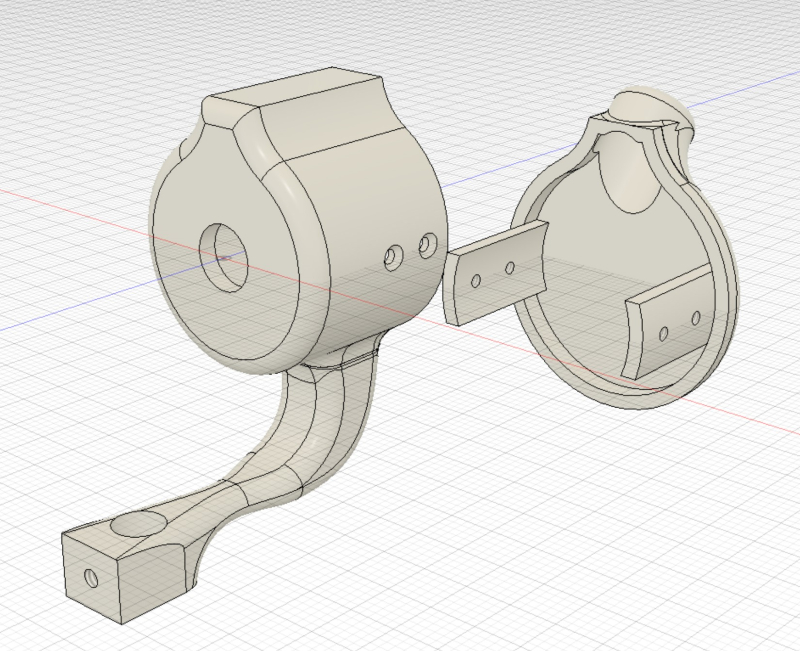
The customer introduced themself as “K”, and then told me the story of why such a customized tool was needed for their work.
K recounted a long and winding academic career. They had started majoring in biology at the University of Waterloo, through the Science and Business program, and then shifted into zoology and animal physiology and explored astrophysics, quantum mechanics and general engineering (using the resources one would only find in such a setting). While completing their undergraduate degree, they had the opportunity to instruct photography, and then worked for the department of mechanical engineering for the new Multi-Scale Additive Manufacturing Lab (MSAM) as a developer and designer. For graduate school, K attended OCADU's (Ontario College of Art and Design University) new medical design program, “Design for Health”.
K had hoped that pursuing an education in medical design would balance an interest in visual arts and science, but also cover that academic gap for helping others. During this time at OCADU, K explored a variety of design projects including improving accessible animal prosthetics (inspired by time spent as a veterinary tech.), designing medical applicators for biogels, and testing HASMAT suiting procedures used for treating Ebola.
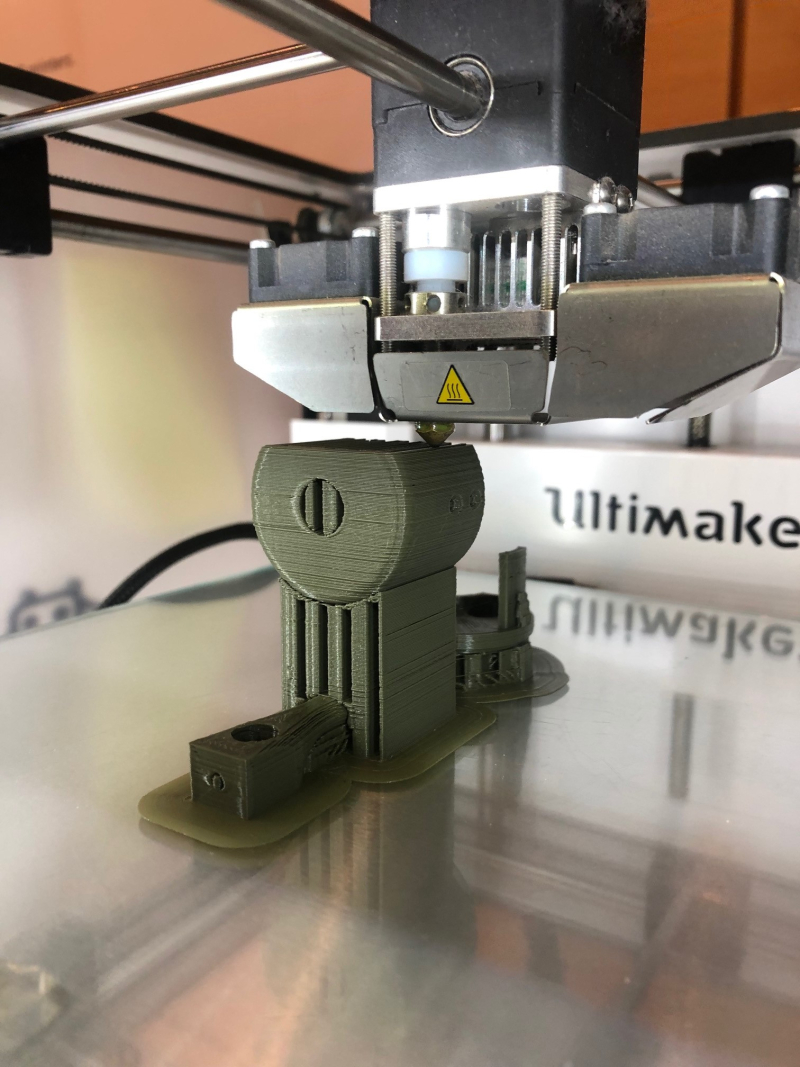
Currently, K applies their knowledge of physiology and art by tattooing. They told me “I’m making a very specialized tattoo machine that has specific torque ranges for certain depths of skin. I specialize in scars and scar cover-ups and I’m seeing the shortcomings of most existing equipment. I’m making 3D printed prototype for the machine’s casing, since 3D printing material is affordable, accessible and biodegradable. The final product will likely be in aluminum.” You can see K's work on Instagram, @let.me.stab.you.
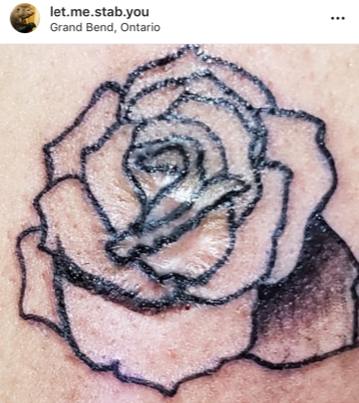
K explained in detail the various layers of skin and complications around tattooing scar tissue in particular. “Many tattoo artists avoid tattooing over scars as they add a literal extra layer of difficulty and possible complications. For example, keloid scars cannot be easily pigmented, sometimes not at all. That can lead to multiple sessions of tattooing to try to build up that layering, or to see how ink will rest in the skin before continuing.” K works around this for now by integrating the raised scar tissue into the design.
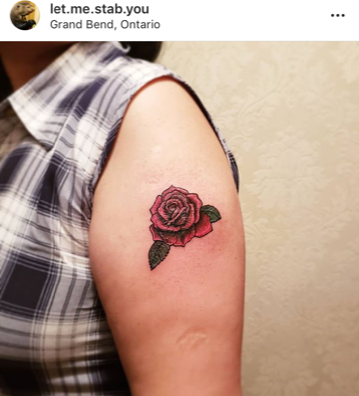
K works mainly with marginalized people, making their work accessible and affordable on a sliding scale, maintaining a PWYC (Pay What You Can) policy. Most often, K works with people who have had intrusive surgeries or injuries that have led to unwanted scars. This includes self harm, accidents, abuse and gender confirmation surgeries. K finds connection with people through stories of scarring:
“I find that there is a direct correlation between scarring and being a marginalized individual. If I were to focus on either, I’d run into the other. For an example of what might go into a simple scar: someone may get top surgery, which is a process that can'take years in terms of registering, having physiological and psychological evaluations, being on a long waiting list (very few trusted surgeons and teams are readily available), working through governmental and medical systems for things like coverage and insurance, and then determining how intrusive of a surgery it is – if it’s a minor fat and tissue reduction or a full mastectomy for instance – and then when it’s all said and done, no matter how great the surgeon is, you will be left with a scar. It may not even be a scar you want covered up, it can be a sign of success and worth itself, but maybe there are related scars, scars from the past that got someone to that point. Scarring is a complicated process with so much beneath it, both physically and metaphorically.”
K offers people a way to gain creative ownership of their bodies and turn a marker of something painful or unwanted into a personalized artwork. Rethink Breast Cancer is one Toronto based advocacy group that shares personal stories of breast cancer survivors, many of which include tattooing as a way to reclaim a sense of empowerment.
“So I’m making a specialized prototype for this tattoo machine for scar tissue, something I first explored in thesis and lab work. There are machines on the market that do this well, but there aren’t ones that do it well at a good price, or they do it well by proxy of being powerful machines. There’s no all-in-one solution in tattooing, especially with variables like the artists themselves, so I’m trying to build a more standardized tool, from the motor to the ergonomics.” K hopes that developing this tool will make scar tattooing more accessible and streamlined, and is confident that this tool will help other tattoo artists and some have already expressed interest in testing the prototypes.

I don’t always get the chance to talk with customers about what they’re working on, but with K I was so glad I asked. It is inspiring to know how our services and staff support people like K, who uses their expertise to help many others. What looked like a small, obscure geometric form turned out to be a prototype that has the power to help transform the way people relate to their skin and their scars.
We welcome everyone to visit one of Toronto Public Library’s Digital Innovation Hubs and pursue their projects or prototypes through 3D printing! If you are new to 3D design or 3D printing, try attending one of our classes, or browse for 3D design files from Thingiverse. Bookings for printers and equipment are available to be scheduled over the phone or in person.
Comments