2012 IST Fall Conference: UX and You
The 2012 Information
Services Team Fall Conference theme is all about evolving reference services,
highlighting the strategic plan initiative of supporting a city of innovators.
One of the
keynote speakers was Amanda Etches, Head of Discovery & Access at the University of Guelph Library, where she spends her time guiding teams and
projects that are all about making the overall library experience better for
users, both in-person and online. The user comes first and understanding user
behaviour and using that understanding to guide the way services, spaces,
systems, and interfaces are designed go a long way in providing good customer service. Her presentation was a conceptual
introduction to the principles of user experience (UX) design as well as some
ideas into ways library staff can incorporate them in their provision of (reference)
services.

Design is
everywhere in the library (furniture, signage, service desks, etc.) and design
decisions should be made with the user in mind, giving what the user wants and
not what you want. Userability is a quality attribute, designing and building
things that work the way our users work as opposed to expecting users to adapt
to them. Amanda Etches outlines 10 specific principles to user experience
design decisions.
You are not your user/know
thy user
For the most part, design decisions
made are convenient for us, representing insider opinions rather than
users’. We should give people what they
want, not what you want.
User is not broken
How something is
consciously designed affects how another experiences it. Any issues can be
fixed by modifying the design, not the user.
Empathy required
Stepping in a
user’s shoes is a good way to find out what a user needs.
Can’t build great
experiences without research
Researching is required to get to the
heart of user’s opinions and what they are thinking or what they want to accomplish. There
are two types of research: attitudinal, the user’s views that are obtained
through surveys, focus groups, and interviews; and behavioural, the user’s
behaviours observed through usability testing.
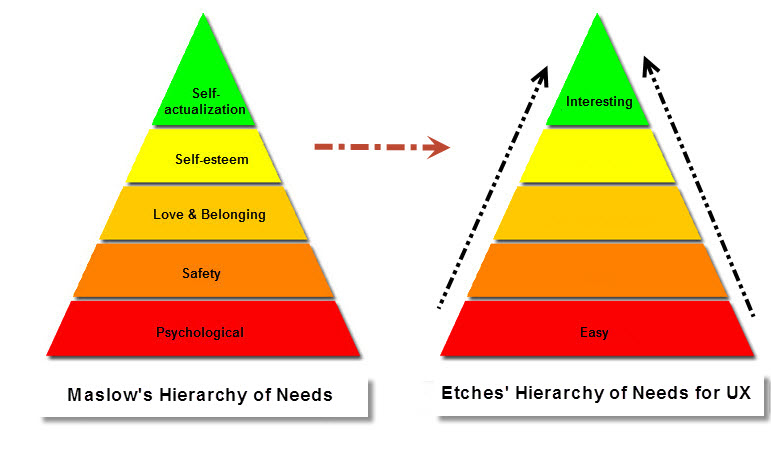
Maslow's hierarchy of needs,
a useful paradigm for design specifics
In order for a design
to be successful, it must meet the basic 'hierarchy of needs' before it can
move ahead to satisfy the higher-level needs. The design must work as it is
intended.
Good/best user experience
(UX) design is to have as little design as possible
People need functionality and less
design that gets in the way.
Good design is universal
Using universal
design techniques (i.e. equitable, flexible, simple & intuitive, perceptible,
tolerant of error, low physical effort, etc.) to guide design decisions will
result in a successful design project that will serve users with a variety of learning styles, abilities, experiences, and cultural backgrounds.
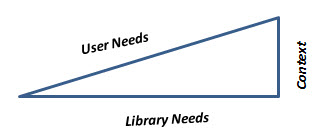
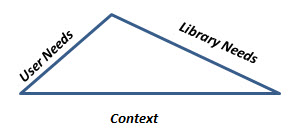
Balance user needs with library needs
User
needs and library needs are illustrated as a triangle joined by the context.
Depending on what is being designed, they can be a shifting and balancing
between the three components.
Good user experience is more than good customer service
People will barely take note of the time, effort and hard work it takes to make their user experience a great one. This is as it should be. It's a measure of the success of UX professionals when the focus is on user's satisfaction.
Good user experience is holistic
Every
element of a design has to work – what the building looks like, the smell,
furniture, lightning, customer service, website, programs & services,
policies (how user friendly), staffing and how empowered they are, rules, hours
of service, signage at all the appropriate places, website, social media
presence, etc.

User experience is basically all about the people.
It’s all about the users and what they really want and need to accomplish and how
we can enable that. Every decision you make affects how people experience the
library.
One thought on “2012 IST Fall Conference: UX and You”
A great overview of Amanda’s presentation at the IST Conference. She had a lot of ideas that really makes one think about how to look at the library experience in a different way.