Job References – Especially for Students and New Canadians
References: A list of people who are able to recommend you or to vouch for your ability to do a job.
Potential employers expect several work references. If you are asked for references, it usually means that they are thinking about offering you a job! Try to find three to five people who will talk positively about your skills, work ethic, accomplishments, performance, etc.
Make sure that you have good references – your reference list is an important tool in your job search.
- Usually you would select your supervisors but you could include
a co-worker, a subordinate or a customer. An interviewer may question
why you have not used your previous employers. - Format your list of references in a business-like way and print it
on the same paper as your resume. Be sure to put your name on the top
of the page. - Always assume references will be checked.
- Select people that who have worked directly with you and can speak well of your job performance.
- Choose your references based on the type of job you are applying
for so that they can give the right kind of feedback on you and your
skills. - Ask your references for their permission to give their names.
- Make sure that your references know about your latest work duties
and achievements and your qualifications. Send them a copy of your
resume. - If you are applying for many jobs, it would be a good idea to
rotate your references so that they don’t get tired of discussing you
with potential employers. - Make sure that your list of references is up-to-date and accurate.
- Let your references know how your job search is coming along. They may even have a tip for you!
Strategies for finding references:
Some job hunters may not have much work experience. Newcomers may find that employers prefer Canadian references. Students may not have any previous work experience.
Academic references are often used by students. These should be a teacher
or instructor who has known you for some time. This type of reference
is able to provide information about you which could reflect how well
you would do on a job.
Character or personal references – Personal non-work related reference may be used if you have no
work-related references. Generally, avoid references that are
associated with political parties or religions.people who can speak about your honesty, reliability and other good qualities. Supervisors from summer or temporary jobs or from volunteer work, people who know you from community service activities, such as soccer coach or Girl Guide leader.
Letters of reference – Although these are not as useful to job hunters with a lot of local experience, newcomers may find that letters from previous employers are useful. Perhaps you know someone outside Canada who could
provide a solid reference in English for your industry or occupation.
Get a written reference from this person with his or her contact
information, if possible. A long-distance phone call or an email may be
good enough for a future employer. Source: Possibilities Project
And if
you just lost your job because your company downsized or closed, you
could include a copy of a letter of recommendation / explanation from them.
Mention any letters of reference in your cover letter and bring them to the interview along with your list of references.
Mentors – Professional newcomers can get a mentor through the Mentoring Partnership. Mentors can act as references as well as give you valuable insight into the Canadian work world. Contact your local partner organization. In Toronto, these are Consortium of Agencies Serving Internationally-trained Professionals (CASIP) and the Centre francophone de Toronto.
Internships / practice firms / work experience programs – Immigrants can get Canadian experience with an unpaid internship – see our post on practice firms.
See this article from CanadianImmigrant.ca about volunteering and interning.
Students can get work experience and gain references through government and community programs.
Part-time or temporary jobs – Part-time work can be a good way to connect with employers and get local current references. See our blog posts: “Temporary, Contract and Part-Time Work and Finding Part-Time Jobs” for some tips.
Should I include my references with my resume or application?
Answer: There are different opinions about this. As a hiring manager, I recommend you do not include references in your resume. It takes up valuable space and may result in more calls to your references than necessary. I don’t need your references unless I’ve already interviewed you and intend to make you a job offer. Checking references is the last thing done before the job offer is extended and there is no reason to give them unless asked. Source: Job Search Steps
This is the usual advice – don’t include references with your resume and cover letter. Most people do not include them and you don’t want potential employers to eliminate you before you have had a chance to see them. You also don’t want your previous employers bothered answering needless questions if there is no job offer.
Bring your reference list to the interview – listed on a separate sheet of paper with their full name, title, company, address of the company and telephone number for each. Some writers suggest that you include their relationship to you – your supervisor, your colleague, etc. Don’t pick family members, even for personal or character references. Be sure to put your name and contact information on the sheet.
If the company requests your references before the interview or with the job application, of course, you should send them.
More information:
Check out the careers section of CanadianImmigrant.ca website for job help information for immigrants to Canada. See “No Canadian Experience: how to get around that bogus barrier to the job market”.
For more information, see our list of links in Career Bookmarks.
For more suggestions on getting job experience, see our blog post “Getting experience: options for graduates and newcomers to Canada”.
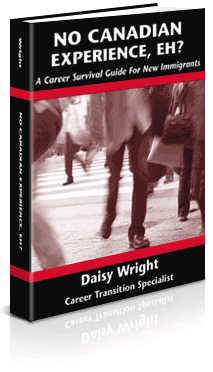
Visit us again at torontopubliclibrary.ca/jobhelp or subscribe to our updates with your favourite RSS reader. Search our blog with our Google search box.
2 thoughts on “Job References – Especially for Students and New Canadians”
Excellent post I have come across.It’s really a very informative post.It would help the students those who are searching for a job.Thanks for sharing the information about the job reference for the students.Keep up your good work.
Great job! Thanks.Some of points from this article are very helpful for me as I haven’t considered them yet.This post will definitely help readers like me.Thanks for sharing such a great article with us.Keep blogging.