So You Want to be a Trial Lawyer, eh?
While we are all concerned with the maintenance of our individual rights and freedoms, we also recognize that they are not absolute, since we live in society with others. In Canada, as in any democracy, our society is governed by the rule of law. This "balance(s) individual rights with our obligations as members of society" by giving us "rules of conduct that protect everyone’s rights" (Canada. Department of Justice. What is the Law? ).
Some are called to play a special role in maintaining our laws. If you are one such person, you may have considered becoming a lawyer, someone that, according to the Canadian Law Dictionary, has "been trained in the law and that has been certified to give legal advice or to represent others in litigation. to This person is also known as a 'barrister & solicitor' or an 'attorney'. Since ancient Greece, there have been those who might be described as "lawyers", but it was not until the Middle Ages that being a lawyer became a "lifelong profession in itself." If you had a chance to see the recent exhibit, Magna Carta Canada, at the new Fort York Visitor Centre, perhaps this inspired you to become a trial lawyer, a lawyer who represents their clients in court.

The court system involves many players, including judges and lawyers, as well as jurors. One of the key principles arising from the Magna Carta (in its various incarnations from 1215 to 1300) is the right to trial by a jury of one's peers. The Canadian Law Dictionary defines a jury as a "group of citizens randomly selected from the general population who decide on the merits of a legal case", or, in other words, who decide on the facts of the case. As an adult Canadian citizen, you may be summoned at some point to serve in this capacity (as a potential juror), if you haven't been already. If you'd like to know more about our country's court system, you might like to read Canada's Court System by the Department of Justice Canada.
The Magna Carta was concerned with establishing a set of rules to settle disputes between barons and the Crown. However, as Queen's University law student Pascal Lévesque argues in his award-winning essay, The Relevance of Magna Carta in Canada in 2015: Upholding the Heritage of Freedom, it grew "to have a life of its own, going beyond its initial scope, becoming a political argument, and generating other initiatives fostering protection of human rights, especially where there are advocates to keep the fire alive".
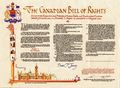 One such initiative relevant to us in Canada is the Canadian Bill of Rights (1960) which concerns "the Recognition and Protection of Human Rights and Fundamental Freedoms", regardless of an individual's "race, national origin, colour, religion or sex". This includes "the right of the individual to life, liberty, security of the person and enjoyment of property, and the right not to be deprived thereof except by due process of law" (article 1.a), as well as "the right of the individual to equality before the law and the protection of the law" (article 1.b). Of even more significance currently is the Canadian Charter of Rights and Freedoms (part of The Constitution Act of 1982).
 A more recent initiative relevant to us in Ontario is the Human Rights Code (1962) which builds on this by recognizing that "the inherent dignity and the equal and inalienable rights of all members of the human family is the foundation of freedom, justice and peace in the world and is in accord with the Universal Declaration of Human Rights as proclaimed by the United Nations."
Library Resources:
Regular Print Books:
You will find other sources of interest in the Career Collection at the Toronto Reference Library .
Also try the following:
eBooks:
Find Your Way…Articles & Online Research
Click on Articles & Online Research from the FIND YOUR WAY section of the library’s homepage, select Databases & Research Tools by Topic and then Business & Careers or Practice Tests. (Or, just enter the title of the database in the main search box of the homepage, or browse using the A – Z List of All Databases).
Suggested Titles:
LawSource (North York or Toronto Reference Libraries only)
See Also
Recommended Websites related to Law.
Programs and Classes:
Law at the Library series
You might also want to consult the websites of The Law Society of Upper Canada, The Ontario Trial Lawyers Association, or The Criminal Lawyers' Association.
2 thoughts on “So You Want to be a Trial Lawyer, eh?”
A few things about this article:
– The “Canadian Law Dictionary” linked in the first paragraph seems to be pretty much entirely plagiarized from the excellent Duhaime’s Law Dictionary at duhaime.org. Duhaime’s is a great free resource and deserves recognition at the very least. Here’s their page on the definition of ‘lawyer’: http://www.duhaime.org/LegalDictionary/L/Lawyer.aspx
– It’s strange that this article notes the Canadian Bill of Rights (1960) and not the Canadian Charter of Rights and Freedoms (1982), the latter of which happens to be a part of the Canadian constitution and is much, much more important in current Canadian law and in shaping Canadian history.
– The Ontario Human Rights Code dates to 1962, not 1990. The year 1990 appears in its legal citation only because that’s the year of the most recent (and perhaps last ever) comprehensive paper consolidation of Ontario public statutes.
– If readers are interested in becoming a lawyer in Canada, they should be wary of texts like “How to Think About Law School” that are written for a US audience. The law school systems and the legal professions themselves are different in meaningful ways between the US and Canada. You’d be better off with Allan Hutchinson’s “The Law School Book” (TPL record 2692802, available at several branches).
– It should also be noted that TPL has a “Law at the Library” series of seminars which may be interesting for would-be lawyers.
Dear FP,
thanks very much for your helpful feedback.
I was recently a potential juror for two first-degree murder trials, and I wanted to write about it in a non-personal way that related to my work in the Business, Science and Technology Department of the Toronto Reference Library, where we have a Career Collection.
I have attempted to incorporate your suggested revisions.