The teenage brain – really?
Having raised three children of my own, I well know the shock that occurs when your precious child morphs into that mysterious being, the teenager. The teenager, that stranger in your house who cannot get enough to eat, uses the floor to store everything (and not in an orderly fashion), sleeps as late as humanly possible, has wild mood swings and is sullen and unresponsive to most queries directed to them. From the paren't's perspective, it is a bewildering time, but it is important to note, your teenager is equally bewildered, confused and puzzled.
 In order to understand the changes that you are seeing in your adolescent you must first have a basic understanding of the brain and how it functions. Paul D. MacLean was the neuroscientist who brought forward the theory that the human brain is in fact three brains in one: the reptilian brain, the limbic brain and the neocortex.
The reptilian brain is in control of our survival mode. It will dictate the instinctive behaviours involved in aggression, dominance, fight or flight and territoriality. It also regulates the body’s vital functions: breathing, heart rate, body temperature and balance.
The limbic brain is responsible for our emotional responses. The main structures in the limbic brain are the hippocampus, the amygdala and the hypothalamus. It is here that value judgements are made.
The neocortex is responsible for the development of human language, abstract thought, imagination and consciousness; it is here that learning takes place. Within the neocortex is the prefrontal cortex, which acts as the CEO of our brain, making executive decisions and is the centre of judgment.
These three parts of the brain operate in conjunction with each other, except in cases where the brain is undergoing major rebuilding – the teenage years.
Until recent times scientists thought that the brain had achieved full growth by the time the teen years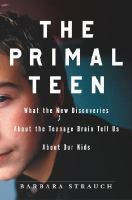 arrived, and that the aberrant behaviour of teens was largely due to hormones. We now know that, in truth, the teenage brain is still under construction and for the most part the reptilian brain (the part that acts mainly on instinct) is largely in control of the decision-making processes of our teens. There is a great book that discusses all of this and helps paren'ts decipher and deal with their teenager. The primal teen: what new discoveries about the teenage brain tell us about our kids is written by Barbara Strauch and provides a scientific explanation of the behaviour of teens. But by far the most significant aspect of this book is the practical strategies offered within the book for dealing with teens.
Another resource worthy of note is the website run by Kathie Nunley. Kathie is both an educator and a brain researcher and her website explores how current research can be applied in the classroom. Although aimed at teachers, I would argue that understanding the current research and how it is being applied in the classroom is important for paren'ts, and can also be adapted for use at home. On her site are articles on the need for sleep and the changing sleep habits of teens, why the adolescent brain challenges the adult brain, the caffeine craze with youth and many more.
Dealing with teens is an age old problem, knowing you are not alone in the battle is comforting. Being armed with new strategies to deal with your teen is beyond valuable. A very experienced teacher once told me, “Arguing with teens is like wrestling with a pig. You just get dirty and the pig loves it.” Knowing that your teen’s brain is a work in progress will help you get through those times when an argument seems like the best route to take.
Comments