Snapshots in History: February 16: Remembering Yonge Street and its Beginnings

On February 16 and beyond, take a moment to remember the beginnings of what would become Yonge Street on February 16, 1796, when Upper Canada’s Deputy Surveyor General Augustus Jones and his work party of Queen’s Rangers, under the direction of John Graves Simcoe, completed the cutting out of a trail from present-day Eglinton Avenue (in what was then York, Upper Canada) to St. Albans (now known as Holland Landing) on Lake Simcoe that began on January 4, 1796. Augustus Jones also surveyed the routes for Dundas Street and supervised its building. Jones developed good relationships with indigenous peoples in the area, including the Mississauga Ojibwa and Mohawk. Augustus Jones also became fluent in many of the indigenous languages and earned the trust of many people, including Joseph Brant, with whom he became friends.
What about the name “Yonge Street” itself? Yonge Street was named at the insistence of Upper Canada’s Lieutenant-Governor John Graves Simcoe for Sir George Yonge (1731-1812), governor of the Cape of Good Hope, and a Member of Parliament of the British House of Commons from 1754-1761 and 1763-1796.
Consider the following titles for borrowing from Toronto Public Library collections:
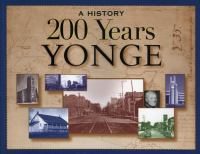
Book – also available as eBook
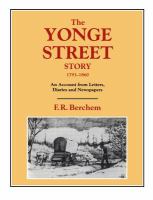
Book – also available as eBook

Book – also available as eBook
For additional titles, please consult the We Recommend Discover Yonge Street book list.
Do you have any experiences and remembrances to share involving Yonge Street? Consider visiting the youryongestreet website to share your memories in textual, visual, audio-visual, and audio formats. Please also visit the library’s Digital Archive to view visual images from Toronto Public Library collections related to Yonge Street.
Comments