During March, take a moment to remember Father of Confederation and Liberal Reformer George Brown (1818-1880) and the newspaper that he founded. The Globe (superseded by today’s Globe and Mail), founded on March 5, 1844, embraced new technologies. Beginning in August 1844, it began publishing on the first cylinder press in Canada West (i.e. Ontario). This resulted in an increased print capacity of 1,250 papers per hour. The Globe, published every other week at first, becoming a weekly in 1849, and subsequently a tri-weekly.
During the 1840s and 50s, the Globe became a popular source of information on anti-slavery movements in the United States, Great Britain and the British North American colonies. This was not a surprising development, as George Brown was one of three people involved in the founding of the Anti-Slavery Society of Canada in Toronto on February 26, 1851. The others were Dr. Alexander Milton Ross, a leading anti-slavery activist in British North America, and Harriet Tubman of “Underground Railroad” fame. Coming from a Scottish Presbyterian background, Brown also used the editorial pages of The Globe to issue anti-Catholic comments. These included support for strident anti-Catholic speeches by ex-monk Alessandro Gavazzi. Gavazzi's speeches fuelled rioting in Montreal on June 9, 1853, resulting in five deaths. The Globe also earned a reputation for providing up-to-date European news during the Crimean War, in the days before the laying of transatlantic telegraph cable. The reputation continued after the laying of the cable on the ocean floor.
George Brown was elected to the Province of Canada’s Legislative Assembly in 1851. While a member of the Assembly, Brown rebuilt the Clear Grit (Liberal) Party in 1857. He supported the annexation of Rupert’s Land and the separation of church and state. He advocated for small government. Most importantly, Brown argued for representation by population, so that all electoral districts would contain approximately the same number of electors. George Brown was a political opponent of Liberal-Conservative leader John A. Macdonald and Parti bleu leader George-Étienne Cartier. However, the three leaders worked together in the Great Coalition government of 1864. This coalition served as the government of the Province of Canada (Canada East and Canada West) right up to Confederation on July 1, 1867. However, Brown himself resigned from the Great Coalition in 1865 over differences of opinion around trade policy with the United States. He supported free trade in opposition to the tariffs proposed by the Coalition. Despite his sometimes strong feelings about French-Canadians, George Brown acknowledged the importance of seeking French-Canadian views towards Confederation during a speech he gave in the Legislative Assembly on February 8, 1865.
As publisher of The Globe, George Brown fought with the Toronto Typographical Union (TTU) as they sought better wages and working conditions for employees. The resulting Toronto Printers’ Strike of 1872 was part of the international Nine-Hour Movement that sought a shorter work to allow more time for family and community life.
On March 25, 1880, a former Globe employee named George Bennett shot George Brown in the leg at The Globe’s offices after Brown had pushed the gun in Bennett’s hand downwards. The wound turned gangrenous, resulting in George Brown’s death on May 9, 1880. George Bennett was subsequently hanged.
The Globe absorbed The Mail and Empire newspaper in 1936 (the Mail and Empire was the result of a 1895 merger of the Toronto Mail and Toronto Empire newspapers, both with small-c conservative bents) to form The Globe and Mail newspaper that exists to this day.
The Globe and Mail celebrated the centenary of The Globe in its March 4, 1944 issue with a cartoon on the editorial page (page 6) under the banner “A Hundred Years of History.” The cartoon depicted George Brown with copies of The Globe and The Globe and Mail newspapers in front of a statue of George Brown.
For its sesquicentennial, The Globe and Mail published an article written by Cameron Smith, “150 years in Canada,” on pages 1 and 3 of its March 5, 1994 issue.
Consider the following titles for borrowing from Toronto Public Library collections:
Books:
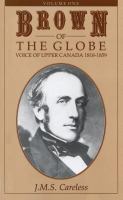
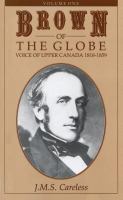
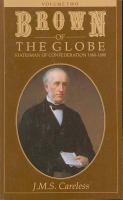
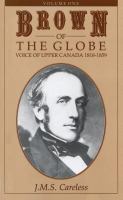
eBooks:

Here are a sample of images that belong to the Baldwin Collection at the Toronto Reference Library:

Globe Building (1895-1938), Yonge Street, south west corner Melinda Street
Hammond, Melvin Ormond (Canadian, 1876-1934), attributed to
Picture, 1900, English. Rights and Licenses: Public Domain. (Credit: Toronto Reference Library, Baldwin Collection, X 65-7).
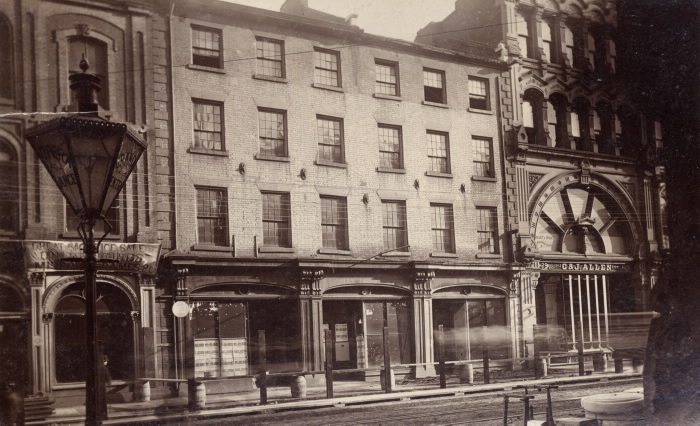
Globe Building (1853-1864), King St. W., s. side, w. of Jordan St.
Unknown
Picture, 1887, English. Rights and Licenses: Public Domain. (Credit: Toronto Reference Library, Baldwin Collection, B11-6a).
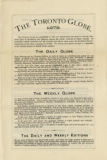
Toronto Globe. Ephemera, 1878, English. Rights and Licenses: Public Domain. Provenance: From the Norman donation. (Credit: Toronto Reference Library, Baldwin Collection, 1878.Globe.vs).
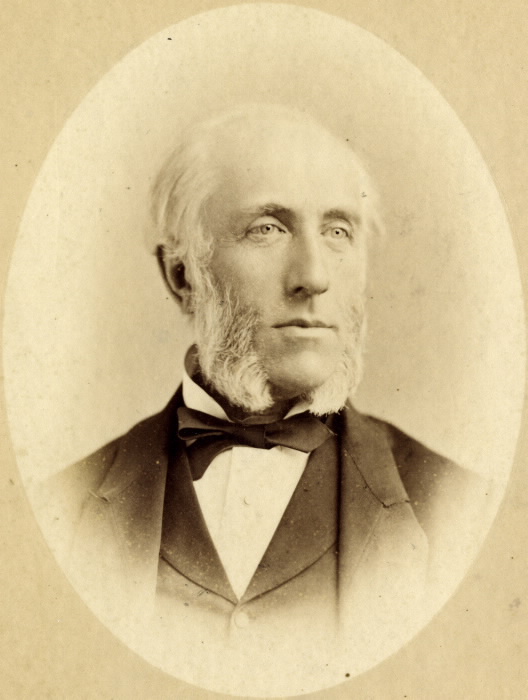
George Brown, 1818-1880
Unknown
Picture, 187-, English. Rights and Licenses: Public Domain. (Credit: Toronto Reference Library, Baldwin Collection, C 2-81a).
Related Post: Remembering the Globe and Mail: November 23: Snapshots in History
One thought on “Remembering The Globe and George Brown: March 5: Snapshots in History”
Just come across this – re anti slavery, although I can’t prove it conclusively I have good reason to believe that George Brown was related through his mother’s family to Priscilla Buxton daughter to Sir Thomas Fowell Buxton, one of the founders of the anti- slavery society.