Best of Luck in the Year of Dog! A Special Journey Away from Home
The Year of Dog is coming! The Dog is the symbol of honesty and loyalty. People whose Chinese zodiac sign is Dog possess a good sense of humour, they are smooth-talking and have a resourceful personality. If you are a dog, remember to wear red underclothes and red socks for the first month, because they are believed to ward off evil. This is an important Chinese tradition to ensure good luck in your own zodiac year.
Chinese Lunar New Year, also called Spring Festival, is a time for family reunion. In China, Spring Festival travel season, officially named Chunyun (春運), creates the biggest movement of people every year; BBC News calls it “the world's largest annual human migration”. During Chunyun, airplanes, trains, buses, ships and highways are continuously packed, bringing and sending people to their loved ones.
Spring Festival is a light, showing children the way home. They go home to see mom, to enjoy mom’s favourite dishes, to see childhood friends, to wear red socks bought by their sisters, to play majong with cousins… there are so many traditions that Spring Festival brings people together to do.
For some families, however, a reunion isn’t always possible. There was one Chinese family in 1979, whose children had no way of going home to celebrate Spring Festival; instead they were busy escaping as documented in items held in our Chinese Canadian Archive at Toronto Reference Library.
Towards the end of Sino-Vietnam war in 1978, many Chinese people in Vietnam were forced to leave the country, including My Vi Vuong and her brother and sisters. The group of seven, including a three-year-old boy, left Saigon (Vietnam) in June 1978 and spent 14 months moving from one place to another. They passed various border inspections, were detained in refugee camps, packed into junk ships, and eventually reached the final destination of Canada in August 1979.
During the 14-month journey, the group mailed numerous letters and photos home, narrating the daily happenings of fleeing. This correspondence is now kept in the Chinese Canadian Archive.
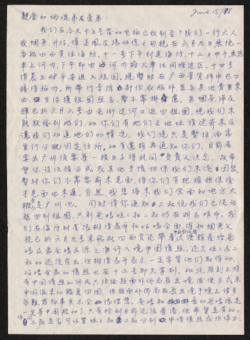
This is the first letter Hien Tong Vuong, My Vi Vuong's brother and the oldest in the fleeing group, wrote one week after they left Saigon on June 9th, 1978.
"We left Saigon via United passenger ship June 9th and arrived the coast border inspection on the afternoon of the 11th. On the 13th we arrived at the City of Hanoi on a bus and then took a train to the border area of Tongdeng. 5 o’clock in the morning of the 14th, we entered China safely.”
The letter continues to detail where the group lived, what living necessities were needed, as well as some foreseeable itineraries; most importantly, Tong expressed the hope of going to Hong Kong.
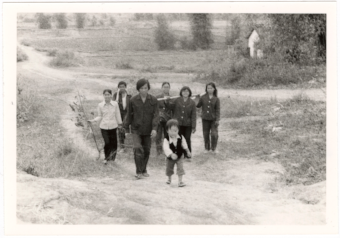 The above photo of the group was taken at Yingde Tea Plantation, Guangdong (China), one of the refugee camps in which they were detained, in November 1978. The precious picture was captured illegally because of the prohibition on photographing in the camp. They lived in the Plantation for a few months before moving on to the next stop.

This photo was taken at Kai Tak Refugee Camp, Kowloon (Hong Kong) in July 1979, by a visitor to the building. The group lived here for six months without the freedom of leaving the residence. They spent Spring Festival of that year being detained, missing home and wandering about the unknown future…
Decades have now passed, memories are fading in people’s minds, but these incredible eye-witness accounts vividly bring stories back to life, narrating this special journey away from home to find a new one.
狗年吉祥!
5 thoughts on “Best of Luck in the Year of Dog! A Special Journey Away from Home”
Awesome, thanks for sharing this Chinese tradition!
Thanks! I remember wearing red socks every Spring Festival as a child, my grandma called it “Step on the evil” (踩小人). Don’t think it works, but still keep doing it.
Good to know. I remember that I could only get new clothes for Spring Festival and Chinese Red Envelopes/Packets (Hongbao)from my grandma when I was young.
Annie’s blog mentions the Chinese Lunar New Year, or Spring Festival. It was a big deal for most kids when they were living in 60s, 70s, and early 80s, as they lived in impoverished life. At that time, every household in Mainland China lived with a ration card (which were eventual abolished in 1986), which means that how much meat, eggs, cooking oil a family can purchase in a giving month. So children were dreaming of the Chinese Lunar New Year, as they would have the luxury of eating delicious foods, wearing new clothing, and even get the red envelope.
Annie also touched the topic of Sino-Vietnam war and the refugees. At time, I was 16 year old and the government’s propaganda machine tried very hard to mobilize the public and we did not have the full picture of the war and its full consequence. As the conflict started, about 300,000 ethnic Chinese living in Vietnam, Cambodia were forced to flee from their homeland and settled in Hainan Province in Mainland China; others fled to South Asian countries, Hong Kong, and North America, In 1986 when I first visit Hong Kong, there were lots of so-called boat-refugees from that region, and their miserable life was the direct result of the unification of Vietnam and the Sino-Vietnam war.
Thanks Guikang! did you mean those Liang Piao (糧票), Bu Piao (布票), Rou Piao (肉票), etc.?you described quite a picture of that period of time in Chinese history. I remember receiving a lot of red envelopes every Spring Festival when I was little and hiding them in my ‘secret’ drawer at home, but never knew what happened to them eventually; I guess ‘hiding red envelopes’was the most important part at that age rather than spending the money.
One of the few things I remember about the Sino-Vietnam War was the song “Blood stained effulgence” (血染的風采), pretty much political propaganda at the time. The War resulted in millions people leaving homeland. I didn’t have a close and clear understanding of boat-people until working with the Vuong family’s archive. Thanks to them leaving so many fascinating written accounts that recorded what truly happened then.