Ontario’s Tuberculosis Sanatoriums, 1897-1960
“It is an appalling reality that, during the first five years of World War II, 36,000 Canadians died of TB, while 38,000 Canadians were killed by enemy action.”
— Saturday Night newspaper, quoted in Katherine McCuaig's The Weariness, the Fever and the Fret
Tuberculosis (TB) used to impact a huge number of Ontarians. It's hard to even imagine today. If you were alive before the life-saving drug streptomycin, you likely knew someone who had the disease.
To help fight tuberculosis, volunteer organizations ran sanatoriums. Sanatoriums were medical establishments based on the idea that fresh air, bed rest and diet were key to curing the disease. They originated in Germany in 1854 with the Goebersdorf sanatorium (the setting for Thomas Mann’s famous novel, The Magic Mountain).
Ontario's First Sanatorium

In 1897, Gravenhurst, Ontario became home to the third tuberculosis sanatorium in the world — the Muskoka Cottage Sanatorium. Its Joss House gazebo (leftmost structure in the above postcard from Digital Archive Ontario) let patients relax and picnic next to Muskoka Bay. The gazebo was recognized by Ontario Heritage Trust as "a proud reminder of the significant role that Gravenhurst played in the fight against Tuberculosis."
In Ontario, sanatoriums were often located outside of major city centres — partly because it was thought that country air helped the patients’ recovery, but also because of “phthisiophobia,” or fear of tuberculosis. Indeed, significant social stigma surrounded these institutions.
Just For the Wealthy?
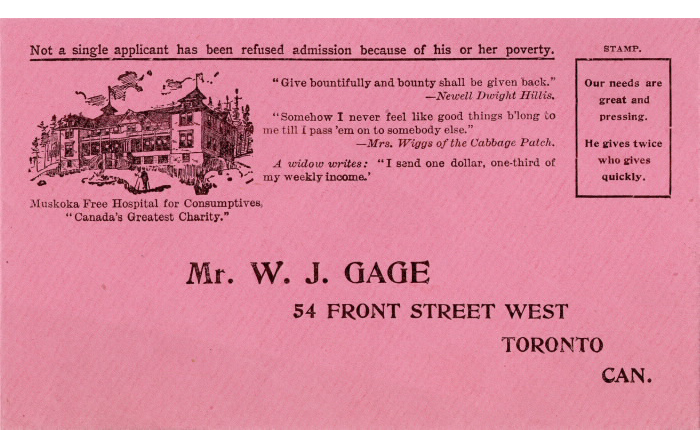
Initially, sanatoriums catered to wealthy patients and were almost indistinguishable from country resort hotels. However, as the medical benefits of this treatment became more widely recognized, efforts were made to support patients who couldn’t pay their own way. (This was before Ontario provided free healthcare.)
Sir William Gage was a key player in establishing free medical care for tuberculosis patients. In 1900, he founded the Ontario-based Canadian Association for the Prevention of Consumption and Other Forms of Tuberculosis (today the Lung Association). In 1918, he was knighted for his dedication to the cause.
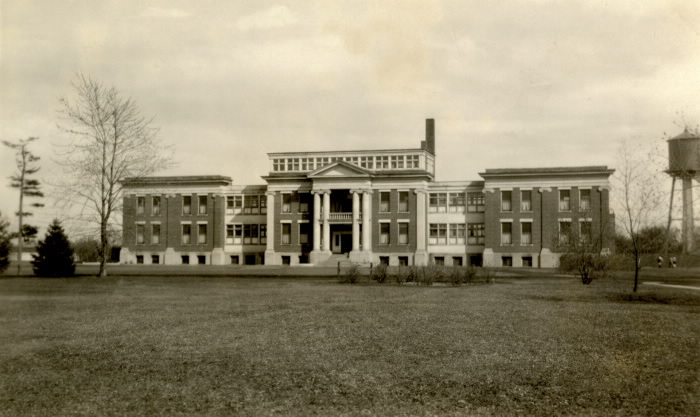
Driven by Gage, the Association established the first free sanatorium in the world: the Muskoka Free Hospital for Consumptives in Gravenhurst, a sister sanatorium to the Muskoka Cottage Sanatorium. Similar institutions followed, such as the Toronto Free Hospital for Consumptives, also known as Weston Sanatorium.
Decline of Sanatoriums
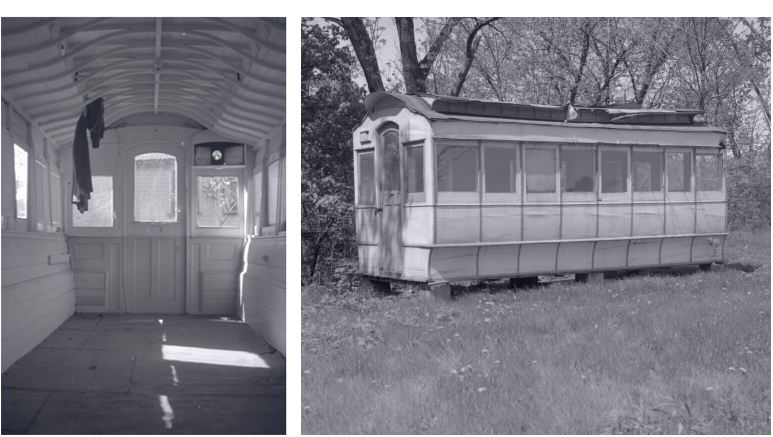
At their peak, sanatoriums in Ontario were serving huge numbers of patients, and their waiting lists were long. To add more beds, sanatoriums like Weston Sanatorium got creative with their space, using out-of-service horse-drawn streetcars as patient pavilions.
After streptomycin was discovered in 1944, use of sanatoriums in Ontario declined. Many were closed. Others were converted for different uses.
The Muskoka Cottage Sanatorium and the Muskoka Free Hospital for Consumptives went through many renovations, fires and name changes. In 1957 the Free Hospital was sold to the province of Ontario, to be used as a training school for firefighters. In 1960 the Muskoka Cottage was sold to the province of Ontario and converted to the Muskoka Centre, which then closed in 1994. Today, the Cottage property is fenced and the buildings left unused, with the Joss House gazebo left overlooking the water — a reminder of the site’s importance to our provincial history.
Edit: Post updated on April 24, 2019.
Related Resources
Books
- The Weariness, the Fever and the Fret: The Campaign Against Tuberculosis in Canada, 1900-1950 by Katherine McCuaig (1999)
- Curing Tuberculosis in Muskoka: Canada’s First Sanatoria by Andrea Baston (2013)
Online exhibits
- Medical Records at the Archives of Ontario by Archives of Ontario
- Fighting for Breath: Stopping the TB Epidemic by Museum of Health Care in Kingston
Videos
- "Her Own Fault," a government-made video demonstrating unhealthy lifestyle, from Library and Archives Canada (1921)
4 thoughts on “Ontario’s Tuberculosis Sanatoriums, 1897-1960”
‘Clara’s Rib’ is the true story about a young girl growing up in the Royal Ottawa Sanatorium…very enlightening. I also had an aunt who spent time at ‘The San’ in Ottawa. Hardly a family that wasn’t touched by TB but I was quite shocked at the number of people who died in the quote at the beginning of this article.
The final paragraph of your post concerning Ontario’s Tuberculosis Sanatoriums is inaccurate. Muskoka Cottage Sanatorium, the first Sanatorium for the treatment of TB in Canada, (and later simply known as Muskoka Hospital) became the Muskoka [Regional] Centre in 1960, a facility for the care of mentally challenged people. By 1994 “the Centre” had closed its doors and has remained closed ever since.
Muskoka Free Hospital, opened in 1902, was sold to the province of Ontario in 1957 to become the Ontario Fire College, a fire officer training facility for the Province of Ontario and the first residential fire officer training facility in Canada. It continues to be a vibrant centre for the training of officers of fire departments throughout Ontario and has provided university and community college courses in Fire Department management to officers from around the world since its inception.
Gravenhurst Archives (a volunteer Archives in operation for 41 years to date), holds significant fonds regarding both Sanatoriums and the Ontario Fire College.
Hi Judy– thanks very much for this information! I’ve double checked my sources and made those changes to the final paragraph.
And thank you for letting us know about the fonds Gravenhurst Archives– that sounds like a fascinating resource.
Thanks so much for your comment, Diane! I’ll have to check out Clara’s Rib. I’m also reading ‘Building Resistance: Children, Tuberculosis and the Toronto Sanatorium’ right now, which you might find interesting.
Here’s the link to the book’s Toronto Public Library catalogue record: https://www.torontopubliclibrary.ca/detail.jsp?Entt=RDM3669425&R=3669425