History of the Music Library at Toronto Public Library (1959–1977)
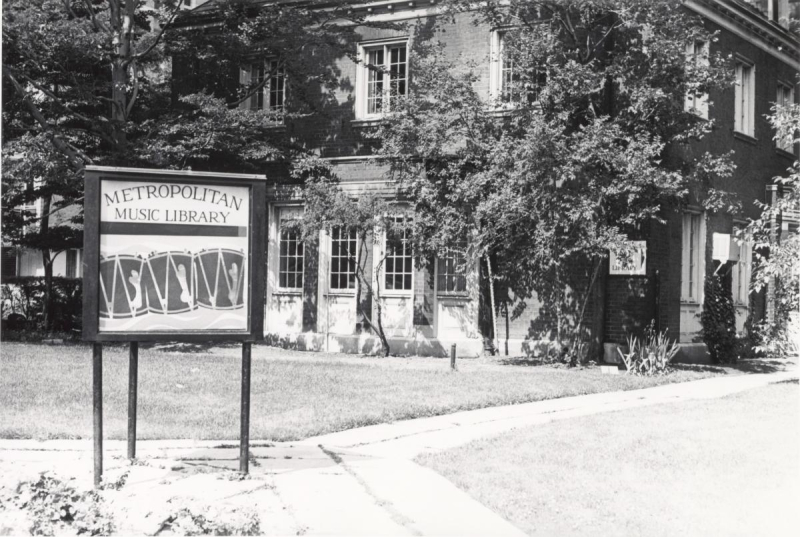
Did you know that we once had a branch devoted just to music? The Music Library opened its doors in 1959 and operated for nearly two decades. It offered thousands of records, books and scores to borrow or use on the spot.
Here's a look back at this largely-forgotten location in Deer Park, featuring images from our Digital Archive. You'll see how public libraries have always been more than just books — and how parts of the Music Library live on at Toronto Public Library.
The building before it was the Music Library
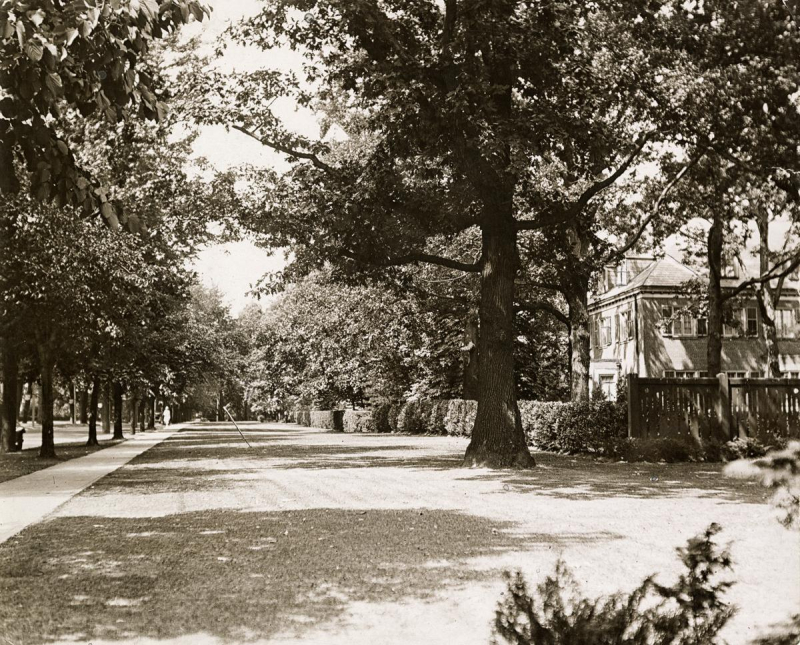
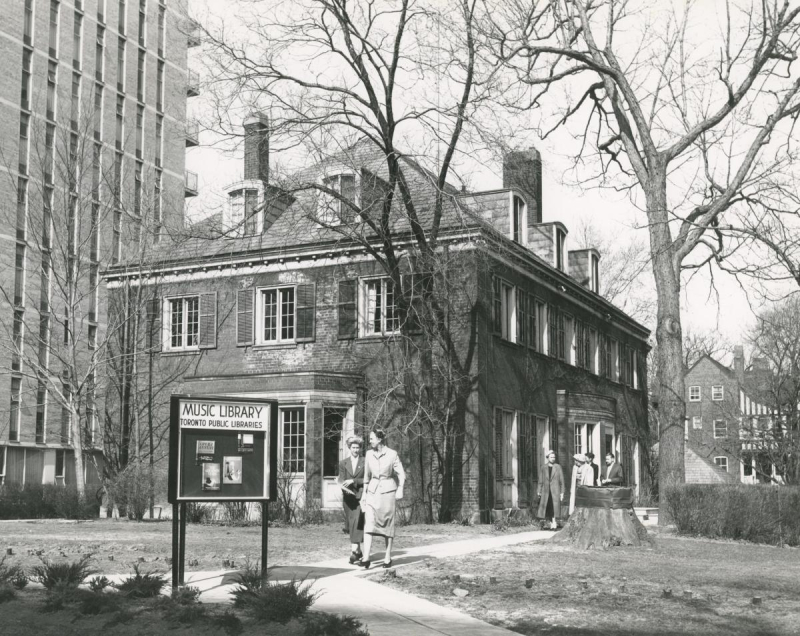
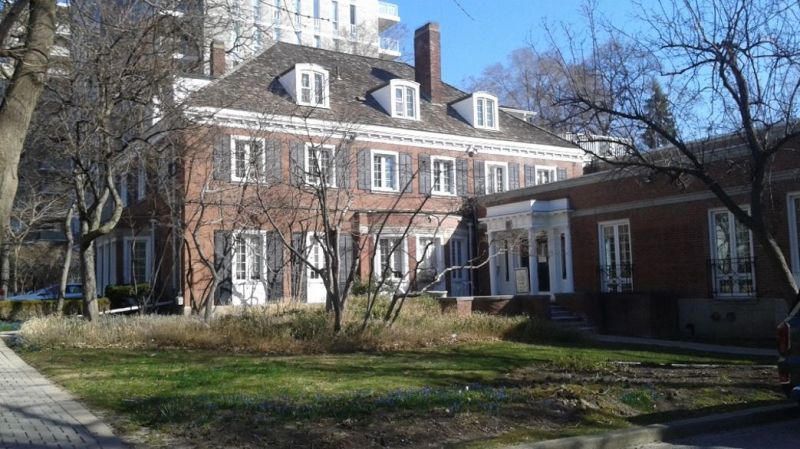
The building that would become the Music Library was built in 1930. It started out life as the home of George Howard Ferguson, premier of Ontario (1923–1930) and High Commissioner to the United Kingdom (1930–1935). The Conservative Party gave the house to Ferguson as a retirement gift.
Situated on the northeast corner of Avenue Road and St. Clair Avenue West, the 100-foot lot had many old trees. Ferguson stipulated that they be preserved. Architects Wright and Noxon drew on a modern interpretation of the Georgian style for the residence. The house had an off-red brick with stone trim and soft green shutters.
A growing music collection at Toronto Public Library
Long before the Music Library would form in the Ferguson House, we had a music section at our Central Library on College Street. As of 1915, it held 828 books of music or related to music. But the collection outgrew the space. When the Music Library opened in 1959, there were 25,000 records, books and pieces of sheet music. (The collection grew to 30,000 books and scores and 6,000 records by the mid-1970s.)
Opening of the Music Library
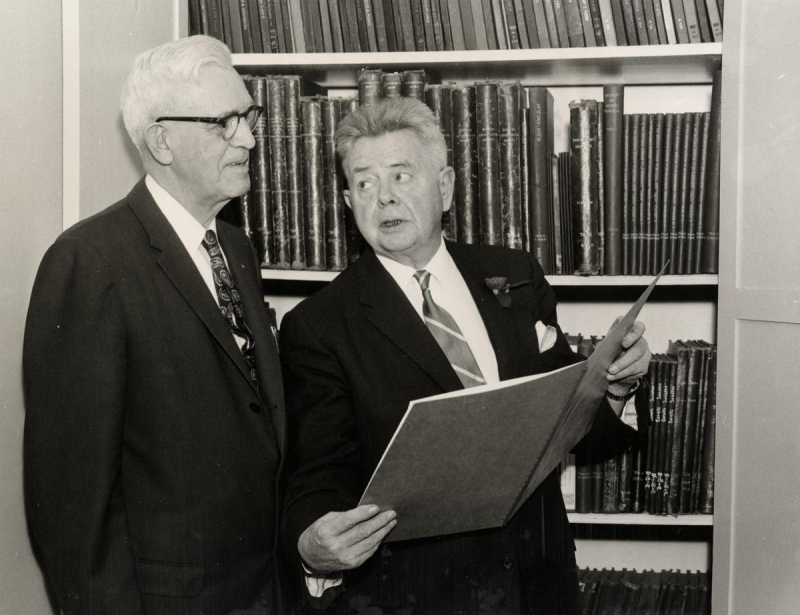
The Music Library opened on April 2, 1959 in the Ferguson House at 559 Avenue Road (the number later changed to 555). It was on the main floor, with the Canadian Centre for Music on the second floor. The official opening was April 18, during Canadian Book Week. Ernest Macmillan, a dominant force in Canadian music, gave a brief address.
Most of the collections came from the Central Library's music section, which closed on March 26, 1959. Donations were also plentiful. Besides books and scores, the Music Library received items such as pictures, pottery and sculptures. Mrs. Albert Nordheimer provided a Toronto-made Nordheimer concert grand piano of Sheraton design for the Rare Music Room.
Services at the Music Library
Customers could visit on Mondays, Tuesdays, Thursdays and Fridays from 12 pm to 8:30 pm and on Saturdays from 9 am to 5 pm. It was closed on Wednesdays and Sundays.
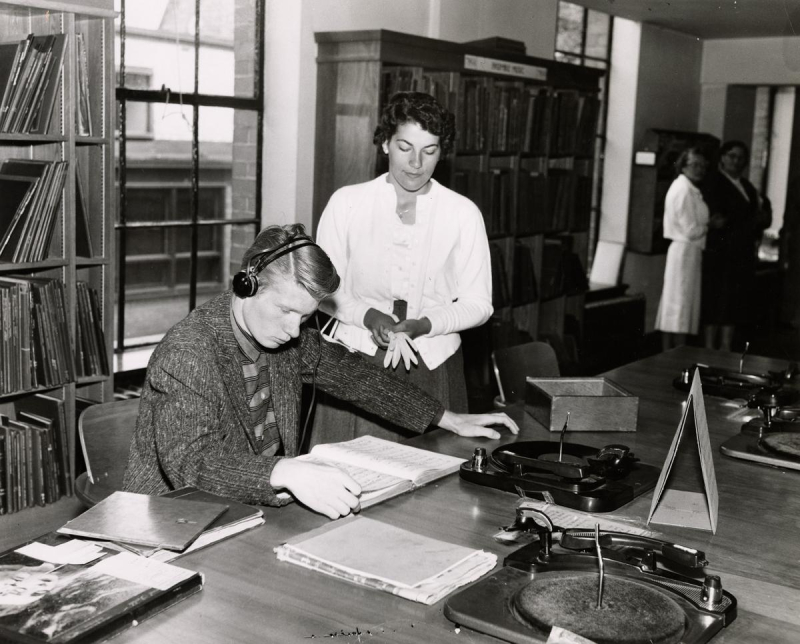
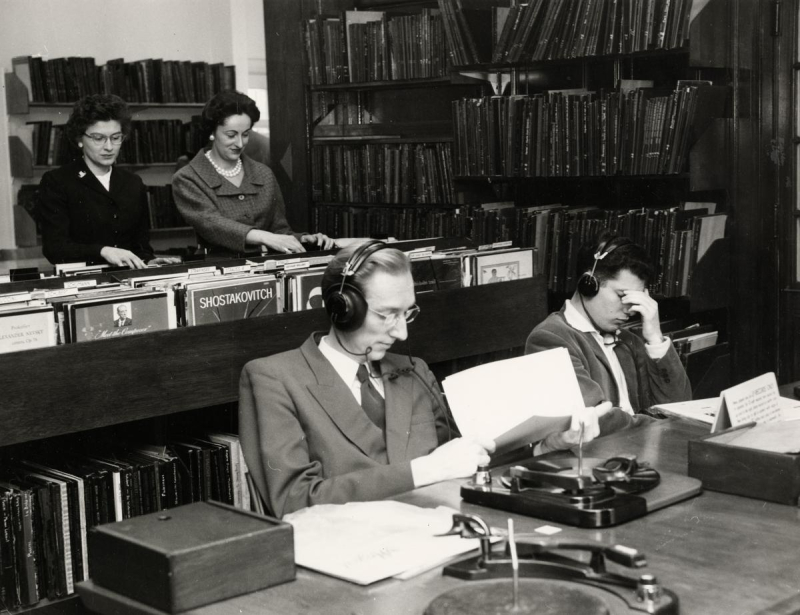
Library card holders were free to borrow books, scores and sheet music. (At the time, a regular library card cost 10 cents.) Circulating books included biography, history and theory. Rare and special books, periodicals and newspaper clippings could also be accessed in the branch. Materials were not organized by the Dewey Decimal System but by a classification scheme from Brookline, Massachusetts.
Long playing records (LPs) were also part of the collection. There were fees to use the records, which fell under a narrow range of genres — a stark contrast to today's more inclusive Toronto Public Library. An annual charge of one dollar was in place for listening privileges and there were rental fees for recordings. In 1960, The Globe and Mail quoted the head of the Music Library as saying that jazz LPs weren't collected as "many jazz fans don't take care of the records" and that "rock ‘n’ roll is not music and we don’t stock it.” Thankfully, the times they were a-changin'.
Addition in 1967
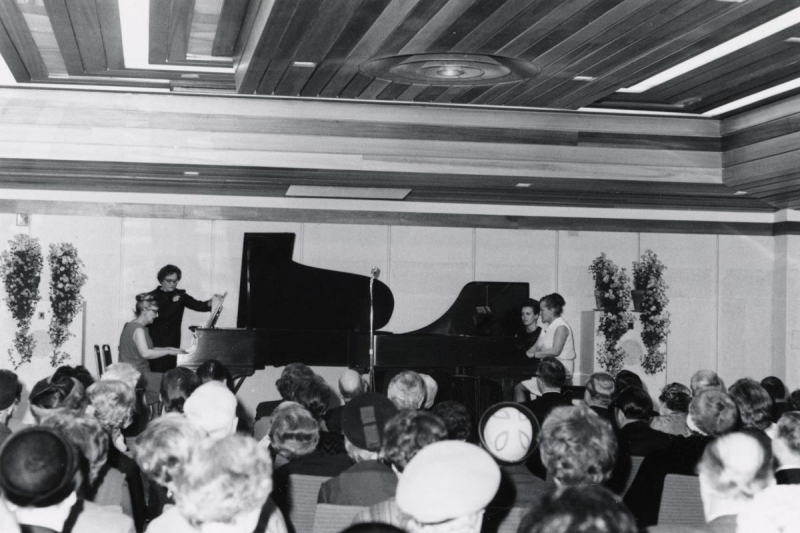
The Music Library's success led to an addition. Architects James A. Murry & Henry Fliess designed a new space for The Music Library Concert Room. W. Kaye Lamb, Canada’s National Librarian, opened the addition on December 9, 1967. The highlight of the opening was a performance of Variations on Opening a Music Library by Shelai Bluether and Liesal Kohlund, staff at the Music Library. The pieces were composed for two pianos — made possible since Mrs. Albert Nordheimer donated a second grand piano, a Steinway.
The new venue seated 160 people and was available to rent for concerts, exhibits and film showings. The library sponsored concerts both live and recorded. Many wonderful performances were sponsored by musician unions. Staff also arranged exhibitions of Canadian Music and Painting, working with organizations like the Canadian Music Centre.
A section in the Music Library opened in 1968 as a film reference centre for materials in the performing arts: Music Library Cinematheque. Other changes to the Music Library included enhanced listening stations that allowed customers to listen to music and easily follow its score.

Farewell to the Music Library
Our new central location, Toronto Reference Library at 789 Yonge Street, officially opened on November 2, 1977. The Music Library was incorporated into this larger location, and the smaller branch was no longer needed. Library staff spent most of that year coordinating the move to the new location from the old Central Library as well as the Music Library (initially relocated to the second floor of Toronto Reference Library).
The Music Library building was listed for sale by the City of Toronto for an asking price of around $300,000. It remained empty until 1980, when the Religious Order of the Cenacle bought it as a retreat house. In 1988, Upper Canada Development purchased it and made extensive renovations. Finally, it became the Consulate General of the Republic of Korea.
In 1976, the building was granted Heritage Status by Toronto City Council (Bylaw 101-87), so the property is protected from any future development.
Legacy and current music services
The most direct legacy of the Music Library is the Arts Department on the 5th floor of Toronto Reference Library. It holds many of the same scores found at the Music Library. It also offers 16,000 CDs to borrow and 5,000 vinyl records, listening stations, and piano practice rooms. Elsewhere on the 5th floor, we also preserve thousands of rare and original Canadian sheet music as part of our Special Collections in the Arts.
Our music collections and services now extend far beyond any one location. We offer CDs and in-person music programs across our system, free music and concerts to stream from home, and cultural passes that provide equitable access to ticketed musical performances in Toronto. Oh, and did we mention our musical instruments lending library and recording studios?
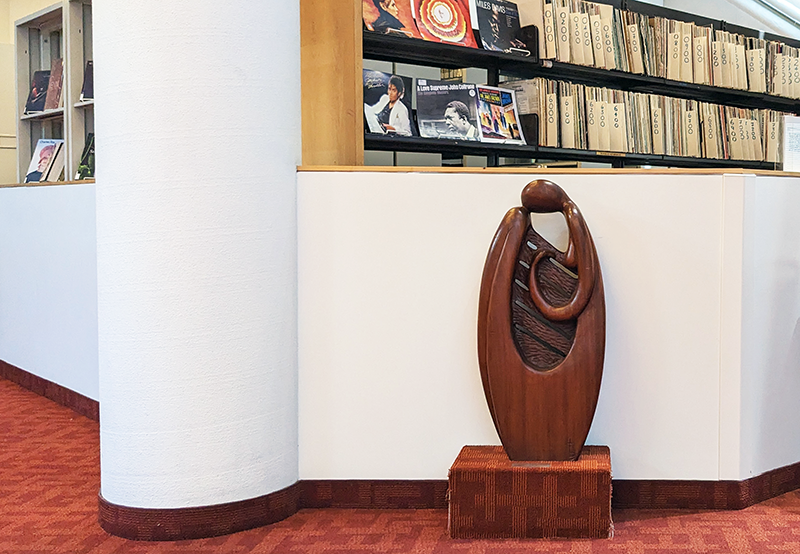
On your next visit, keep an eye out for artifacts from our old music branch. The Steinway piano from the Music Library lives at Northern District branch where it's still played at concerts and piano lessons. Back at Toronto Reference Library, visitors to the 5th floor may spot a sculpture of a harpist that once played its silent song in the old Music Library.
Explore more
Digitized items
Books
- G. Howard Ferguson: Ontario Tory
- A Century of Service: Toronto Public Library 1883-1983
- Sir Ernest MacMillan (1893-1973): Portrait of a Canadian Musician
12 thoughts on “History of the Music Library at Toronto Public Library (1959–1977)”
Thank you so much for your fascinating blog about the Music Library, Pamela! I actually remember it, and so enjoyed learning more about it, as well as The Harpist statue at Toronto Reference Library, which I have admired.
l
Thank you for your comment, Muriel. Toronto Public Library history is always a pleasure to research.
This is a wonderful and informative article, Pam. It’s so easy to forget our history! You brought it all to life again. Do you have any more information on T. Bagnall, the sculptor of The Harpist? I just did a search on several TPL databases and all I found was a brief obituary of a Rev. Thomas Hutchison Bagnall in the Toronto Star, which notes that the Reverend was also a wood sculptor. Is this the same T. Bagnall, and do we know any more about him?
Thanks for the feedback Claire. TPL’s past contains some fascinating stories. Unfortunately we don’t know much about T Bagnall, or The Harpist, only that it came from The Music Library at 559 Avenue Road.
Hi Pamela,
I’m a retired teacher, but my first career was drumming for a local bar band. Despite that career pivot, I’ve never lost my passion for music. My wife and I have donated countless music CDs to TPL over the decades, mostly World Music titles, in addition to many rare books.
Most local rock fans will know that Rush’s Geddy Lee has a much-anticipated memoir coming out this fall. He wrote it with Daniel Richler, Mordecai’s son. But fewer are aware of a brand-new coffee-table book about Rush’s labelmates ‘Max Webster’. That book, ‘High Class in Borrowed Shoes’ was just released. It was written by Hamilton’s Bob Wegner (guitarist in the stage production ‘WE WILL ROCK YOU’).
I am asking you to please consider endorsing the purchase of this fan-tastic new book by TPL. Bob is a self-published rookie writer. The hoops that such authors must jump through for our library system to consider buying their titles can sometimes be onerous.
As for Max Webster, they were incontestably rock’s most under-rated band ever. There are very few duff tracks in their entire discography. In addition, they were a riveting live presence with their frontman Kim Mitchell. Although there is another biography of that band already out there from many years ago, readers and rock fans deserve to read this new above-mentioned title. Its simply better and the photos are spectacular.
Pamela, lets give a Canadian writer some support and convince TPL to buy copies of this oh-so worthy book. Music aficionados will appreciate it. Got any connections in the Purchasing department?
cheers
Gregg LaMarsh Leslieville
retired teacher
former rock drummer
feeder of birds
Thanks so much Gregg for reaching out and for your music donations to the library! I checked with my colleagues and the best way to suggest a title is using our Recommend a Title page (library card required). All the best!”
Hello , I enjoyed to read it, thank you.
Such beautiful place and the building, on heart of downtown Toronro.
so Far I know basement of floor consulate is using for votes of election of Korea. Or painting /photograph exhibition. (Not often, sometimes)
Consulate of General Korea completely open to public,
I visited several times for notary of papers past 15 years and finally became a canadian 3 yeads ago (no more need to go probably?)
Many koreans (visitor, students visa, or work permit ppl) go and visit to consulate for notory of exchange drival license to canadian one G license to exchange basically.
https://allmyexp.tistory.com/m/288
Attaching the blog website of my cousin’s recent made (2022.March) visit to consulate of Korea (former music library)
You could see some of picture of inside consulate of these days.
Enjoy and and its 100% in korean.
Gam sa hab ni da. 감사합니다 ☺️
Thank you! (In korean)
Great article, Pamela! I’m sharing with all my musically-inclined friends!
Thank you for the comment, Kurt. Toronto Public Library has a rich history.
Thanks for this feature Pamela, my first time hearing about the Music Library and enjoyed reading your post! I also wondered about the sculpture too by the Arts Desk.
Thanks for your encouraging comment, Anna.
Missing from this interesting story is the genius behind it all, Ogreta McNeill. As the music librarian she directed the move to St. Clair, and developed the collection. Herself a performer, she made her library into a centre of community musical life and established standards for librarianship in music. Those pieces for two pianos were commissioned from prominent local composers who were her friends. As well as the yearly concert series she developed in the hall, she broadcast recordings in the surrounding grounds during the summer. For a more nuanced view of her attitude towards popular music, please read my article about her published in the Canadian Association of Music Libraries Review. file:///C:/Users/kmcmo/OneDrive/Documents/CAML/The%20Mother%20of%20Us%20All%20(Og)Reta%20McNeill,%20Canada’s%20First%20Professional%20Music%20Librarian%20CAML%20Review%20_%20Revue%20de%20l’ACBM.htm