Snapshots in History: March 11: Remembering Robert Baldwin and Louis-Hippolyte LaFontaine
On March 11 and beyond, take a moment to remember the contributions of Robert Baldwin (Born: May 12, 1804 in York, Upper Canada; Died: December 9, 1858 near Toronto, Canada West) and Louis Hippolyte-La Fontaine (Born: October 4, 1807 at Boucherville, Lower Canada; Died: February 26, 1864 at Montréal, Canada East) who are best known for their contributions to the notion of responsible government as a stepping stone towards the eventual independence of Canada from Great Britain.
In fact, Globe and Mail columnist (and author) Lawrence Martin deftly provided the context for March 11, 1848 when Baldwin and La Fontaine were sworn in to serve as co-prime ministers of a Reform government in the Province of Canada in the aftermath of the 1837-1838 rebellions in Lower and Upper Canada. (In fact, the experiment in the Province of Canada followed slightly behind Joseph Howe’s responsible government initiative in Nova Scotia in February 1848.)
Consider the broader revolutionary context in 1848 in Europe and the counter-revolutionary responses in 1849. Baldwin and La Fontaine were of a similar mind that a democratically elected assembly needed to take precedence over an appointed, colonial executive council to fend off anarchy and revolution. Yes, history reminds us that the parliament buildings in Montréal were burned down on April 25, 1849 as a culminating event of the Montréal Riots by a reactionary, Loyalist mob (encouraged by the political opposition Tories), expressing opposition to the Rebellion Losses Bill passed by the La Fontaine-Baldwin government. Governor-General Lord Elgin endorsed the passage of the Rebellion Losses Bill by a majority vote in the legislative assembly, affirming the principle of responsible government but having to endure the egging and stoning of his carriage by rioters.
The Montréal Riots revealed that ethnic tensions could be brought to the surface as the city at that time was both half-English and half-French speaking, resulting in the capital city of the Province of Canada being moved to Toronto (1849-1852, 1856-1858) in alternation with Quebec City (1852-1856, 1859-1866) while the Parliament Buildings in Ottawa were being built in conjunction with its choice as the permanent capital of the Province of Canada by Queen Victoria – which ultimately became the capital of the Dominion of Canada in 1867.
Consider the following titles for borrowing from Toronto Public Library collections:

It is no accident that academic John Ralston Saul wrote this dual biography of Baldwin and LaFontaine for the Extraordinary Canadians series, given that almost single-handedly, he advocated for public recognition of the 150th anniversary of the advent of responsible government in the Province of Canada on March 11, 1998, resulting in the annual LaFontaine-Baldwin Lectures.
Also available in eBook format and Talking Book (Restricted to Print Disabled Patrons) format.
Aussi disponible en français comme Louis-Hippolyte LaFontaine et Robert Baldwin . Read the review in the Literary Review of Canada.
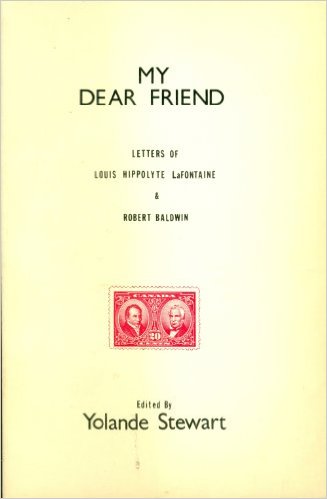
My dear friend: letters of Louis Hippolyte LaFontaine & Robert Baldwin
Read through this collection of primary source material symbolizing the political partnership between Robert Baldwin and Louis-Hippolyte La Fontaine.
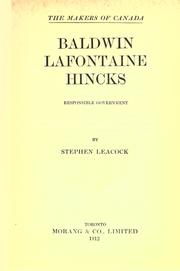
Baldwin, Lafontaine, Hincks: responsible government
Political scientist Stephen Leacock (who is also the humorist) authored this 1907 book on the roles of Baldwin, La Fontaine, and Sir Francis Hincks in the push for responsible government in the Province of Canada prior to Confederation in 1867.
Comments