Wellbeing Toronto: Mapping Toronto’s Wellness
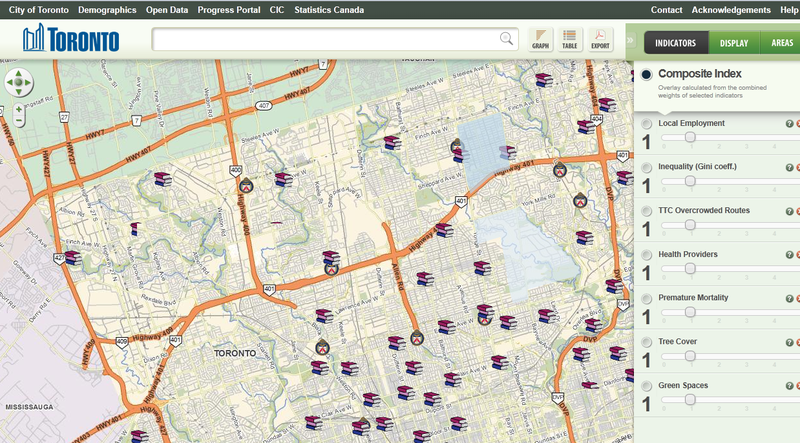
In early July the city of Toronto launched a brand new website/web app Wellbeing Toronto, the website allows users to map out and compare social, economic and civic indicators by neighbourhood – the results then appear on an easy to read table, graph and/or map. This allows Torontonians to measure, map, rank and compare how their neighborhoods are faring. The indicators are divided into ten categories- 148 indicators to be exact, which according to the National Post the city will constantly update:
- Demographics – ethnicity, language, gender, age, etc.
- Civics – voter turnout, city beautification, city grant funding
- Economics – local employment rates, social assistance recipients etc.
- Transportation – TTC stops, road collisions, TTC overcrowded routes etc.
- Education – library activity, library space, catholic school university applicants etc.
- Health – female fertility, health providers, teen pregnancy etc.
- Housing – social housing units, rent bank applicants etc.
- Recreation – sports facilities, community space use, program registrations etc.
- Environment – tree cover, polluting facilities, city green retrofits etc.
- Safety – ambulance calls, sexual assaults, arsons etc.
As a library worker I definitely see the value of a tool like this for qualitative research on Toronto. Just last week a student was doing research on racial profiling in Toronto. At first I suggested a Toronto Public Library database called E-STAT which contains reliable, current and historical data about Canadian people. Then I remembered Toronto Wellbeing and suggested she use it too – we found that she could find crime statistics on: visible minorities, not a visible minority, drug arrests and other crimes. I decided to do a few neighborhood comparisons myself and found some interesting stats. I'll share a few with you:
Income
The average family in the Bridlepath-Sunnybrook-York Mills area earns $678,933/year and the income equality level (measured by a Gini coefficient) is very low -1. Whereas the average family in the Malvern area earns $66,736 and the income inequality level is higher – 44.
Greenery
The Rouge neighborhood in the east end boasts 12,888,043.88 square meters of tree coverage. Whereas the tree coverage in the Kensington-Chinatown neighbourhood is only 186,615.16 square meters.
Employment
The Bay-Corridor has the highest rate of employment -175,515 people, whereas the Lambton Baby neighborhood has the lowest rate – 391.
2 thoughts on “Wellbeing Toronto: Mapping Toronto’s Wellness”
Great blog. It’s good to know where we can locate information like this. Thanks!
Thanks @Grace for the feedback!