How Ants Survive Microwaves
 Ever wonder how it happens? Scientific study and activity is important for finding answers to many questions that cross our minds. Some questions are natural to ask. Other questions are just quirky. And some still don’t have answers. Regardless, the North York Central Library carries a number of books related to how it happens.
Read this and count the F’s:
FINISHED FILES ARE THE RE-
SULT OF YEARS OF SCIENTIF-
IC STUDY COMBINED WITH
THE EXPERIENCE OF YEARS.
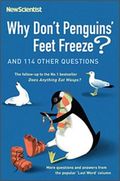
How many did you count? Most people at first only see 3, but if you look closer you’ll see that there are actually 6. The reason behind this odd occurrence can be found in editor Mike O’Hare’s book, Why Don’t Penguins’ Feet Freeze? O’Hare has organized the eccentric questions of curious people and the responses thereafter from academics around the world, into a fun, intriguing book of fascinating science. Find out why nose mucous is green (ew), or how ants survive microwave zapping (yes, it’s true).
I’m sure we’ve all spent some time thinking about pencils. And now we can learn more! Barbara Ann Kipfer in her book, How it Happens: The Extraordinary Processes of Everyday Things, shares with us the exciting details behind pencil formation and use. Graphite particles, china clay, kilns, wax, wood casing and non-toxic lacquer, pencils have quite an architecture. Her work is concise as she lists the steps involved in the development of items ranging from air recirculation in a plane, to model ships in a bottle, all the way to zippers.
I’ve learned that no question is stupid. Ironically, this came about after reading Leland Gregory’s book, Stupid Science. There are tonnes of strange scientists….er….rather, strange research being conducted around the globe, and stranger still are some of the methods used to gather the info. In 1971 a group of Japanese scientists looking to research landslides, visited a hill with fire hoses, intending to water down the hill with torrential-like force. The result was an actual landslide, and without having to get into the specific outcome of the experiment, let’s just say that I will never again go mountain biking, skiing, or do any sort of activity that could lead to slippin’ and slidin’ off a hill. Stupid Science has taught me that roundworms know math better than I do, and that clowns contribute to the success of women who undergo in vitro fertilization. Now, isn’t that funny?
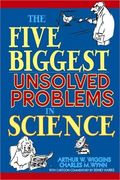
Of course, there are still questions that have yet to be answered. For example, why is the universe expanding faster and faster? That’s one question for which a chapter has been dedicated within Arthur Wiggins and Charles Wynn’s book, The Five Biggest Unsolved Problems in Science. Wiggins and Wynn take subjects that have been baffling us for centuries, and comically explore what we know and what we still have yet to learn.
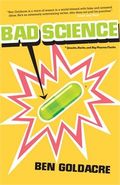
And finally, there is always bad science. I mean literally. Bad Science by Ben Goldacre. This hilarious title of “quacks, hacks and big pharma flacks,” targets scientific scams and misinformation that has us believing silly myths. Does it really stimulate the flow of oxygen to your brain if you form the letter “C” with your thumb and forefinger, rub beneath the collar bone for 20 seconds while simultaneously placing your other hand over your navel? (see page 16). Bad bad bad, but, oh so good, to laugh, learn and know the truth behind all the beeswax.


Read them all and you'll never wonder again!
(Not a guarantee)
One thought on “How Ants Survive Microwaves”
Microwaves are designed for cooking and we can’t deny the fact that we sometimes used them to store our food. There are unexplainable things that happen in our lives and questions that remain unanswered until science will make them clearer. I am not that sure if ants can survive from the heat of a microwave. We will try if they can really survive in the microwave at a maximum level of heat.