From Maypoles to Gasmasks: the curious evolution of a holiday
Cast your imagination back to Chicago, 1886. The date is May 1st, a day previously declared as the beginning of a national standard eight-hour workday. Working people across the country set to strike in support of “Eight hours for work, eight hours for rest, eight hours for what we will.” Between 30 and 40 thousand workers struck for three days of marches and rallies before a bomb incident and police gunfire derailed the movement. The ‘Haymarket Massacre’ would live in Chicago’s history forever.
“May Day” originated sometime before however. “At an earlier time, May Day was a spring fertility festival of May poles, dances, floral wreaths, and general rejoicing. This celebration of spring comes down from the distant past. The Romans paid tribute to the goddess Flora with games that began on the 28th of April and lasted several days. Through the intervening centuries, other nations followed the Roman precedent, choosing May First as a time for great frolic.” Perhaps taking inspiration from those origins, sympathetic artist Walter Crane created the Workers May Pole in London, 1894.
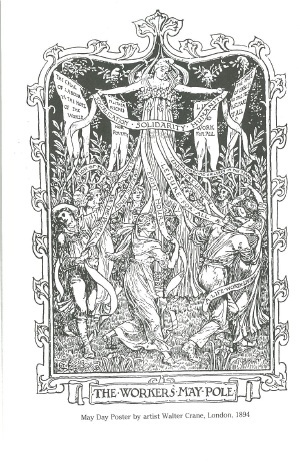
May 1st has enjoyed some notoriety ever since.
 On May 1st, 1896 in Ottawa, Sir Charles Tupper was named Prime Minister of Canada. He would resign after only ten short weeks after losing a general election in spite of winning substantially more votes than the opposition Liberal party. I imagine this guy can understand how he felt. His 68 days as Prime Minister continue to be the shortest stint ever for a Canadian head of government. Along with Kim Campbell and John Turner from more recent times, Sir Tupper’s government never sat in parliamentary session, so he never had the chance to try out the big chair.
 In the early years of the last century, F. Scott Fitzgerald’s May Day immortalized May 1st 1919 in New York City: “There had been a war fought and won and the great city of the conquering people was crossed with triumphal arches and vivid with thrown flowers of white, red, and rose. All through the long spring days the returning soldiers marched up the chief highway behind the strump of drums and the joyous, resonant winds of the brasses, while merchants and clerks left their bickerings and figurings and, crowded in the windows, turned their white-bunched faces gravely upon the passing battalions.” Quoting anymore would ruin the suspense for those itching to put the book on hold.
Moving into my lifetime, and we arrive at May 1st, 1973, when “Moving Day” in Quebec moves from May 1st to July 1st. The tradition began as a humanitarian measure during French colonial rule. Seigneurs, the semi-feudal landlords of New France (the pre-pre-cursor to the province of Quebec), were barred from evicting their tenant farmers before the winter snows had melted. Much later, this had evolved into a requirement that urban leases begin on May 1 and end on April 30. May 1 thus became "Moving Day", the day during which renters changed addresses.
In 1973, the Quebec government decided to move Moving Day to the summer so that students would not have to move during the school year. The new law repealed sections of the Civil code setting fixed terms for leases; however, tradition prevailed and the vast majority of leases are still a year long and begin around July 1. This has proved a boon to moving companies, with movers sometimes booking six months in advance!
Fast forward to the 21st century and May Day returns to its 19th century militancy. May 1st 2001 saw mass protests in London, England for the third May 1st in a row. Reclaimed as a day of protest by tens of thousands around the world, May 1st sees actions in Toronto, Istanbul, Moscow, Jakarta, Beijing, Paris, Seoul, Berlin, Sydney, Warsaw, Seville, and dozens of other cities around the world. Causes and ideology varied widely, but May Day’s pugnacious past was back on the agenda. In more recent years, May 1st has been celebrated with such diverse activities as a Stilton cheese rolling competition (!),dawn choral singing in Oxford, and theatrical meditations on family relationships, among other more ‘traditional’ pursuits.
With such a kaleidoscopic past, one wonders what May 1st, 2012 will bring??
Sources
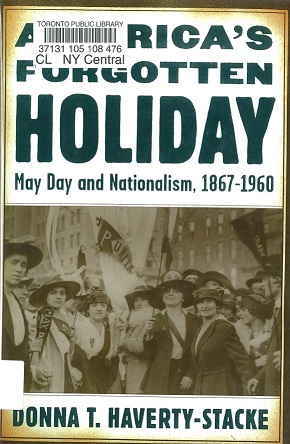
America's forgotten holiday : May Day and nationalism, 1867-1960 (Haverty-Stacke, Donna T., 2009)
394.2627 HAV – 3rd floor Society and Recreation, NYCL
May Day (Fitzgerald, F. Scott, 2009)
FICTION FIT – 2nd floor Languages, Literature & Fine Arts, NYCL
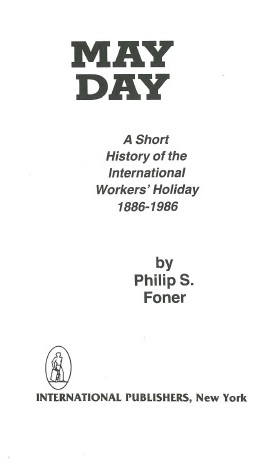
May day : a short history of the international workers' holiday, 1886-1986 (Foner, Philip Sheldon, 1986)
394.2683 FON – 3rd floor Society and Recreation, NYCL
One Day in May, a play in two parts (Light, Greg, 1984)
819.22 L – 6th floor Canadiana, NYCL
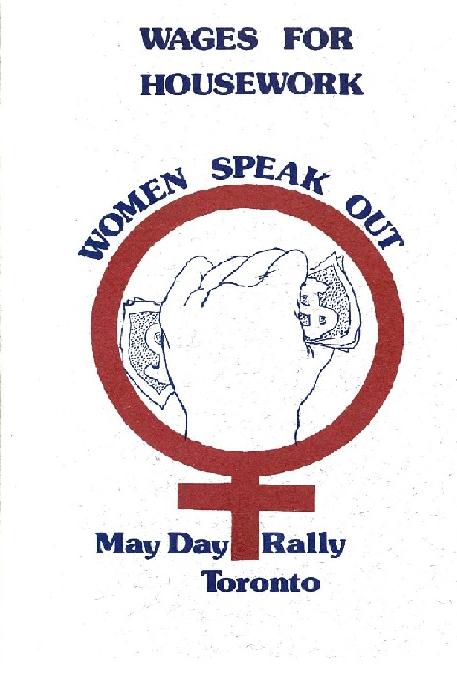
Wages for Housework : Women Speak Out (Ramirez, Judy [contributor], 1975)
331.4 W – 6th floor Canadiana, NYCL
War Horse of Cumberland: the life and times of Sir Charles Tupper (Durant, Vincent, 1985)
971.05 D – 6th floor Canadiana, NYCL
8 thoughts on “From Maypoles to Gasmasks: the curious evolution of a holiday”
Thank you for such a fascinating blog – I particularly like the
Walter Crane illustration.
Thanks Muriel. Check back often, I am going to try to do something similar every few weeks!
Great post! Interesting to see how yesterday’s struggles continue to be relevant today.
I always wondered about moving day in Quebec. Thank you.
Joyeux premier mai! Great post. Thank you.
I knew a bit about the eight hour day history, but the rest of it was all new. Thanks!
I am a high school student. I love it when my teacher would announce a holiday or holidays. When we are in school, we always pray for holidays for us to be free from school works.
Great article. Thank you for this. Really informative.