The ‘Picasso of the north’ and the Woodland School of Art

Shaman and disciplesPlease join us at North York Central Library on Wednesday June 4 at 7:00 pm for a presentation on First Nations artist Norval Morrisseau and The Woodland School of Art. Call 416-395-5639 to register for this free program.
As a child, Norval Morrisseau made drawings in the sand at the lakeshore and watched as the waves erased them. As a man, he made an indelible mark on the world of art by creating a new art form, the pictographic style, and inspiring a group of First Nations artists who became known collectively as The Woodland School of Art.
Norval Morrisseau, sometimes called ‘the Picasso of the north’, was born on a First Nations reserve in northern Ontario in 1932. His grandfather, a sixth-generation shaman, taught him the Anishinaabe stories and legends which inspired him throughout his life as an artist.
When Morrisseau was nineteen, he became very ill. He didn’t respond to conventional treatment, so a medicine woman was called. She performed a renaming ceremony, giving him a name signifying power: Copper Thunderbird. Morrisseau attributed his recovery to his new name. From then on, he signed his works Copper Thunderbird, in Ojibwa syllabics.
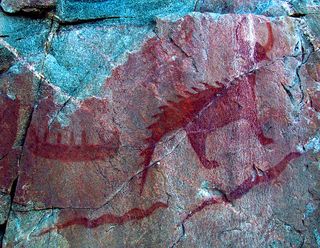
Agawa Rock pictograph – photo: D. G. Robertson His early influences were the pictographs or rock paintings he saw during his travels with his grandfather, and the sacred birchbark scrolls his grandfather made as a shaman. When he was finally exposed to European art as an adult he was left with a general impression of darkness. He resolved to paint with more colour. He believed that the colour in his paintings had healing power: “Many people have told me I cured them of various sicknesses. I told them, I didn’t cure you, it was the colour that cured you.”
Like his grandfather, Morrisseau became a shaman. He painted the visions he saw in dream states, when he travelled along “the inner highways” to what he called “the house of invention”. He broke an Ojibway taboo by portraying the spiritual beliefs of his people and he was criticized for it, but he persisted. “My aim,” he said, “is to reassemble the pieces of a once-proud culture, and to show the dignity and bravery of my people.” Inspired, other First Nations artists followed the trail that Copper Thunderbird blazed.
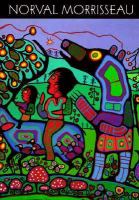
Norval Morrisseau :
travels to the house
of inventionI’ve just finished reading Norval Morrisseau: travels to the house of invention, which has many examples of Morrisseau’s paintings. It almost felt like these images were energetically saturating my retina with their intense colours when I looked at them for awhile. Try going to google images (http://images.google.ca/) and entering the search “Norval Morrisseau paintings” and you’ll see what I mean. The Morrisseau quotes in this post are taken from the book. This is my favourite quote:
“The Department of Indian Affairs once wanted to give me art lessons, but I refused. In my opinion, this would spoil me, for there is no one who can'teach me this kind of painting.”
If you’d like to see a short movie on Morrisseau, reserve a copy of Gifts from the Thunderbird: the life and art of Norval Morrisseau.
Comments