Ode to the Illustrious Typewriter
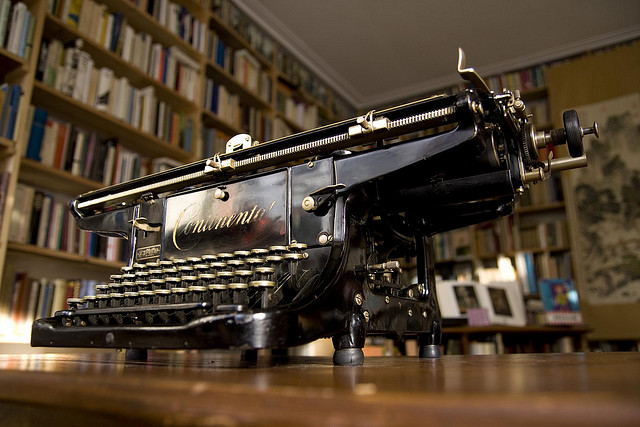 Continental Typewriter (image courtesy of Dr. Shordzi on a creative commons licence)
June 23rd is National Typewriter Day. Those who worked in office settings or used them at home prior to the 1990s will remember these machines well. Whether they are manual (see above), electric, or electronic, typewriters played a major role in processing information.
The main goal of the typewriter was to enable users to fashion ideas, thoughts, and information into type print. The process began from the tapping of fingertips on typewriter keys in short staccato strokes. The keys attached in a basket arrangement of thin metal arms (typelevers) that ended in lettered hammers (typebars). These typebars striked against an inked ribbon to stamp marks onto a sheet of paper clipped to a moving carriage. Each keystroke spurred the carriage merrily along until a bell chimed to indicate the end of that line. This "ding" sound informed the typist to push the carriage lever to the right which also propelled the paper up to a new line.
The process is similar for electric and electronic typewriters. Electric typewriters requires electricity to operate to reduce finger pressure on the type keys. Electronic typewriters contain a computerized circuit board to enable the machine to perform added functions such as automatic underline, erase, superscript, subscript, and italic lettering. The most notable improvement on the basic typewriter design for the electric/electronic typewriter was the addition of the "Enter" key that we see on today's computer keyboards. This new key replaced the manual typewriter carriage and push lever system.
Here is a video to visualize how the manual typewriter operates:
Video courtesy of Cooper-Hewitt National Design Museum on a creative commons license.
These machines assisted in the creation of documents, reports, essays, and manuscripts at a quicker pace over handwriting. Employed typists achieved speeds ranging from 50 to 80 words per minute. At this pace, it would be difficult to transcribe in longhand while still appearing legible.
Most typewriters shared the same Courier font. Howard Kettler, as noted in Typedia, developed this font in 1955. He did not patent his design which was, therefore, quickly shared and adopted by all typewriter makers for its clean and crisp print.
For more information on the history of typewriters, the people who use them, and the cultural influence of these machines, here are some interesting titles to glance over:
 |
 |
 |
 |
 |
 |
 |
 |
While electronic typewriters came on the market during the mid-1980s, their popularity quickly evaporated. Through extensive software development, computers became new and undefeatable rivals. By offering word processing features to enable users to easily type, edit, duplicate and store information in digital form and then transmit this information from one user to another leaving virtually no paper trail, computers pushed aside the typewriters on the market. Even with this swift change, computers adopted the alphanumeric keyboard from their predecessor.
For more information related to technological and social changes over time, have a look at the following titles:
 |
 |
 |
 |
 |
 |
 |
 |
Computer Classes, Digital Innovation Hubs, eBooks, eVideos, and eMagazines
The Toronto Public Library offers computers, Internet access and digital services.
To keep up with the changing times, the Toronto Public Library offers classes for development of computer and library searching skills.
 This image is licensed under the Creative Commons Attribution 2.0 Generic license.
For those who would like to try their skills and learn how to self publish books or create an object on a 3D printer, the Digital Innovation Hubs offer training and hands on experience.
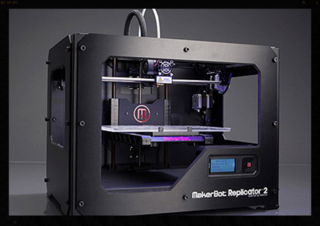
(3D printing at Fort York Branch, photo Toronto Public Library)
How about learning how to download an eBook, eAudiobook, eMagazine, eVideo, or look up a business or computer textbook online? Classes are available.

Even with so many technological innovations that have occurred over the past 20 years, the typewriter still bestows an adorable quaintness worth appreciating and celebrating.
8 thoughts on “Ode to the Illustrious Typewriter”
ah, brings back so many memories! Intimate knowledge of early to mid-century manual typewriters – along with ownership of a dial phone – is what makes a certain generation old school. Even before white out of any kind!
Yes, Marie, I remember it well. Those dial phones/payphones (using dimes), manual typewriters, and TV shows like Columbo with suspenseful music during fight scenes, I do remember them well. It was a time before the Internet and I bought the latest hits on 45 rpm records at Sam’s.
Thank you, Ann, for such an interesting blog. I remember, as a child, typing with my paren’ts’ typewriters from university that were similar to the one in your first photo! I appreciate the nostalgia of the Courier font, which could explain part of the reason why I really enjoy going to a certain chain of coffee shops, rapidly expanding around town, which uses the Courier font in their signage!
You are welcome, Muriel! I enjoy hearing and reading about people and their stories about their typewriters. Mine is a Cadillac blue Commodore manual typewriter in a James Bond style white oval shaped suitcase. I still have it today.
I also feel nostalgia when look upon old documents typed by some typist decades ago who is unknown to the reader except for a pair of initials at the bottom of the page, if any, to indicate ownership.
I would like to visit those coffee shops around my area and park myself down for some good old fashioned hospitality.
Hi again,
I would like to include here two titles that I was unable to mention on my blog because these topics would have diverted away from the main theme–typewriters, technology, and time.
The first title, a co-worker wonderfully suggested, are titles of fiction written by Don Marquis about a typing cockroach who hurled his little buggy body against the typewriter keys. Now that is one impressive and determined bug. The series is called Archy and Mehitabel available at http://www.torontopubliclibrary.ca/search.jsp?N=33156&Ntt=Archy+and+Mehitabel+.
The second title worth mentioning is a (2000) children’s picture book by Doreen Cronin called, “Clack, clack, moo: cows that type.” The children and paren’ts will get a good chuckle from reading this. The link is http://www.torontopubliclibrary.ca/search.jsp?Ntt=clack+clack+moo&view=grid&Erp=20.
Enjoy these two suggestions.
Thank you for these posts!
Dear Angela:
I am delighted with your reply and that you enjoy my posts. The typewriter has inspired me through my childhood years. I believe this miraculous machine deserves an honourable mention.
Here is an article from February 20th from medium.com called, “The Last of the Typewriter Men,” https://medium.com/backchannel/the-last-of-the-typewriter-men-729f150c5083