Unmasking Superfoods, part deux
I almost named this post Science Literacy, but then thought, better not. I don't want to get a jump on the library's Science Literacy Week at the end of this September.
Jennifer Sygo's recent talk on Superfoods provided information on the foods were hyped versus those which had true nutritional benefits, as expected. What I did not expect and thought was perhaps the most valuable part of her presentation was the lesson she gave on science research. She outlined the different types of research from the lowest level, for example, cells growing in a petri dish up to what she termed 'the gold standard'– randomized doubleblind human studies. For example, claims made about some superfoods having anti-cancer properties were based on cell studies, in which the component in the food was sprinkled over cancer cells growing in a petri dish and some cells died. This is a far cry from a longitudinal study in which people eating the superfood are followed over many years; the mortality (death rate) and incidence of cancer of the people are measured, while all other factors are controlled for. For example, any people who had a family history of cancer would not be included in the study.
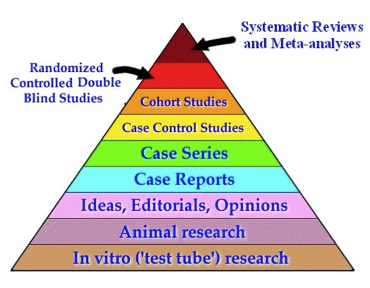 |
Randomized doubleblind studies occur when the people participating in the study are randomly put into either the control group or the treatment group; both the participants and researchers do not which group participants are in. This decreases the chance of confirmation bias in which researchers interpret results to reinforce what they expect.
Systematic reviews or meta-analyses occur when the results of many studies are grouped together to give an overview of the results of a study question.
So, the next time you are reading about the results of the latest research in the news, take a look at what type of study has been done and decide whether the researcher's conclusions are warranted.
Comments