The Right to Read Anything
"…adults should feel embarrassed about reading literature for children."
So wrote Ruth Graham in an article for Slate, which was recently republished in the Toronto Star. The article tries to shame adults who read literature written for young people – not for children, as the quote above indicates, but for teenagers. Graham focuses on realistic teen fiction such as John Green’s The fault in our stars, or Stephen Chbosky's The perks of being a wallflower. These books fall into a category that librarians and publishers refer to as “young adult fiction” or “young adult literature”, often shortened to “YA”. The stone in Graham’s shoe is not YA fiction itself, but the popularity of YA fiction with adult readers. “Fellow grown-ups” she chastises, “at the risk of sounding snobbish and joyless and old, we are better than this.”
Graham has her reasons for maintaining these imaginary intellectual border lines, reasons which I'm not going to address here, other than to say that I disagree with every one of them. Mostly, I disagree with the notion that there are books adults should read – (“literary” fiction) and books adults shouldn’t read (anything marketed to teens) – and if you can’t resist the urge to toddle around in the kiddie pool of fiction, you ought to hang your head in shame. If you must set up rules around your reading, I suggest you consider author Daniel Pennac’s ten point reading manifesto, “The rights of the reader.” Especially number five.
- The right not to read.
- The right to skip.
- The right not to finish a book.
- The right to read it again.
- The right to read anything.
- The right to mistake a book for real life.
- The right to read anywhere.
- The right to dip in.
- The right to read out loud.
- The right to be quiet.
I hereby out myself as a grown-up who reads young adult fiction. Anybody else care to confess? I have read, and enjoyed the aforementioned enormously popular, The fault in our stars and many other YA books.
And I am neither embarrassed or ashamed.
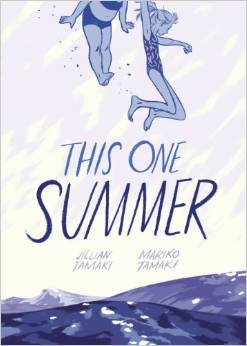 I just finished a poignant young adult graphic novel that captures the feeling of being a girl just stepping into the minefield that is female adolescence. This one summer, written and illustrated by cousins Mariko Tamaki and Jillian Tamaki, takes place in Ontario cottage country. Rose and her friend Windy (named by a hippie mom) are summer friends, who renew their friendship every year when their families go to Awago Beach. Rose has one flip flop clad foot in childhood, and the other is just beginning to test the waters of the vast, mysterious lake of sexuality, gender roles and adult problems.
Underneath the simple summer fun – campfires, swimming, choosing candy and horror movies from the only store around, and finding just the right shaped rock — there are darker undercurrents of teen pregnancy, adult disappointment and loss, the good girl/bad girl dichotomy, and narrow standards of female beauty. Rose’s chubby friend Windy, a year and a half younger than her, dances, bounces and splashes unselfconsciously, often in a state of hyperactive delight. But Rose is already beginning to internalize destructive notions of a female physical ideal. When Windy rolls up her shorts and poses, Rose says, “It makes your thighs look kind of big.” My heart broke for all the young Roses and Windys when I read that line.
This book feels Canadian — Rose’s Dad wears a Toronto Maple Leafs shirt, and extols the virtues of Canadian rock group, Rush. And a trip to Historic Huron Heritage Village might remind readers who grew up in Ontario of school trips to the Huron village in Midland.
 I recommend this young adult graphic novel to my fellow grown-ups. If someone catches you reading This one summer and says you are too old to be reading comics, you could point out that a graphic novel won'the Pulitzer Prize (Maus: a survivor's tale, by Art Spiegelman, in 1992). Or you could tell them that today’s graphic novels aren't your mother’s Archie comics. (Actually, your mother might not recognize the Archie comics of the twenty-first century – an issue of the comic was recently banned in Singapore for depicting a gay wedding.) And if that doesn’t shut them up, tell them you’ll read whatever you please.
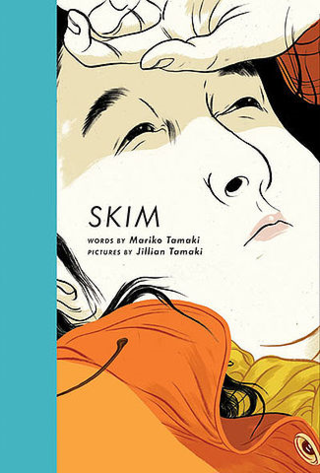
Also by Mariko Tamaki and Jillian Tamaki: Skim, which was nominated for a 2008 Governor General's Literary Award.
"Skim" (Kimberly Keiko Cameron) is a not-slim would-be Wiccan goth who goes to a private girls' school. When her classmate Katie is dumped by her boyfriend, who then kills himself, the entire school goes into mourning overdrive. The popular clique starts a club to boost school spirit, but Skim sinks into an ever-deepening depression."
You can get This one summer and Skim at the library, but if you'd like a peek right now, see this article in The New Yorker:
Eyeball kicks: a teen-age-girl summer
A sidenote to North Yorkers and fans of Rush, who were inducted into the Rock and Roll Hall of Fame in 2013: Rose's Rush loving dad would be happy to know that Geddy Lee and Alex Lifeson, two members of the power trio who grew up in Willowdale, will have a section of Willowdale Park named after them. This summer, Willowdale Councillor John Filion spearheaded an effort to have part of Willowdale Park renamed Lee Lifeson Art Park. What!? Rose's Dad isn't a real person, you say? I refer you to number six, on "The rights of the reader" list above. (#6. "The right to mistake a book for real life.")
10 thoughts on “The Right to Read Anything”
Thanks, Maureen, for such an interesting blog. Daniel Pennac’s rights of the reader are so freeing. I remember an episode of the television show, “As Time Goes By,” with Lionel reading “Winnie-the-Pooh” to Jean
in bed. They were both enjoying the book so much, as do I!
Who doesn’t enjoy Winnie-the-Pooh?
Thanks for your comment Muriel.
This was an awesome blog to read – I personally don’t like a big chunk of YA fiction, but I don’t believe in shaming people for anything, especially not what they choose to read. Shaming people in general for the things they enjoy, simply because we think it’s “inappropriate” or “shallow” or “childish” is, I think, shameful behaviour in and of itself.
Also, I recently read This One Summer as well! I enjoyed it a lot – I’ve always enjoyed the Tamaki style, and it was an interesting and short read that made me think back to my own unsure teenage years, testing out “adult” words and “adult” behaviours for the first time.
Thanks for another entertaining blog 🙂
Yes, shaming people for reading YA fiction is ridiculous. What does it accomplish?
Like you, there’s a lot of YA fiction I’m not tempted to read, but I have found some YA books immensely enjoyable. To name just a few: “Flowers for Algernon”, by Daniel Keyes, “City of Ember”, by Jeanne DuPra, “The curious incident of the dog in the night-time”, by Mark Haddon, “Loser”, by Jerry Spinelli, “The graveyard book” by Neil Gaiman, “Speak”, by Laurie Halse Anderson. I could go on and on…
There was a paragraph in “Speak” that was so beautiful I copied it down, so that when I brought the book back to the library, I’d be able to read it whenever I wanted. It was pure poetry.
I enjoyed “This one summer” so much I am definitely going to reserve a copy of Jillian and Mariko Tamaki’s graphic novel, “Skim.” I look forward to seeing future collaborations by these talented cousins.
Thanks for taking the time to comment, Elaine.
I find the ideology enwrapping Ruth Graham’s article annoying and self-congratulatory. It’s elitist, judgmental and very non-empathetic. It also has a mean-spiritedness about it. like “I got smart, why didn’t you?” For years smart women – especially librarians – lashed out against entrenched societal assumptions and attitudes about “what’s good for you”…and expected behaviours and roles. In public and in private. How quickly people fall into conveniences and forget what previous generations fought to conquer. How dare someone presume to tell anyone else “what’s not appropriate”.. Think of P.E. Trudeau’s “There’s no place for the state in the bedrooms of the nation”. That goes for Ruth Graham and my reading material too..
I know it’s none of my business but that I find it a bit weird that a co-worker who is clearly in her 30s reads teen fiction. Her choices would focus on the same topics and storylines: rich, anglo-saxon, preppy and valley girl. Some days I think she takes on a character and brings them to work. Odd!
Well, there’s much that I objected to in Graham’s article as well. Teen fiction, she writes, “could plausibly be said to be replacing literary fiction in the lives of their adult readers.” This is a sloppy generalization. I like to sample from all the dishes in the banquet that is fiction – regardless of whether that fiction has been marketed to children, teens or adults. And I’m certain I’m not the only one.
And Graham’s statement that “the emotional and moral ambiguity of adult fiction—of the real world—is nowhere in evidence in YA fiction” is another sloppy generalization.
“There’s of course no shame in writing about teenagers; think Shakespeare or the Brontë sisters” Graham writes. So, an adult can write about teenagers, but should be ashamed to read books written by adults about teenagers (which would describe most teen fiction)?! Am I the only one who is confused?
But mostly, I object to Graham’s attempt to heap shame on readers for their choices. I don’t see what it accomplishes.
Thanks for your comment, Marie.
Thoroughly enjoyed.
The idea that only certain kinds of people should read only certain kinds of things is all kinds of wrong. But the idea that I “should feel embarrassed” about reading teen lit is downright infuriating. It’s a snobby critique, to be sure. And it’s also a sexist one. The majority of successful YA authors are women – more than half of the NPR’s 100 best-ever teen novels, for instance – a rarity in the old boys’ club of mainstream publishing. And many of those authors write about young women and their experiences. Suzanne Collins, L.M. Montgomery, Laurie Halse Anderson, Judy Blume, Sandra Cisneros, Madeline L’Engle…they all have something to say about what it means to be a girl in the world. Reading can help us empathize with others and make meaning of our own experiences. What does it say when we reject so many stories written by and for women as being undeserving of our attention?
Thanks for contributing to the conversation, Winona. I didn’t realize that there seems to be a disproportionate amount of YA authors who are women. That adds a whole new, disturbing dimension to Graham’s attempt to shame adults who read YA novels, which I hadn’t considered before.