Season’s Greetings, Glacial Readings
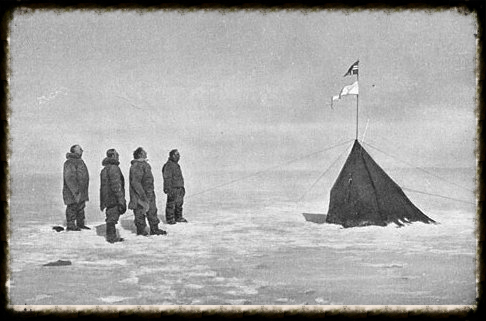
Winter Arrives
Last night at 6:03 pm, the Winter Solstice swept across Toronto to officially jumpstart the winter season. The dwindling daylight endured these past three months will return stronger and stay longer.
This week ramps up with several festive celebrations manifesting in spectacular events across the city. Even with the gladdening news of fun-filled activities and increasing daylight hours ahead, winter holds center stage. The season accompanies face-freezing temperatures, frost-covered roads, incessant sleet, blowing snow, and blazing winds. Past temperatures have easily dipped down to -25 degrees Celsius or lower and this does not include the wind chill factor.
Despite the frosty welcome, this arctic-like weather compares little with the winter temperatures at the bottom of the world. The December 10, 2013 Guardian article, Coldest temperature ever recorded on Earth in Antarctica: -94.7C (-135.8F), provides an eye-opening account of how people sustain themselves in such severe biting conditions.
Canada sits in the northern hemisphere and the Nunavut, Yukon, and Northwest Territories are the land masses nearest to the North Pole. In contrast, the North Magnetic Pole currently lurks near the upper western corner of Nunavut. Both the geographic north and south poles have corresponding north and south magnetic poles that shift in location over time.
For more information on the Earth's magnetic poles, please read Gillian M. Turner's (2011) title, North Pole, South Pole : the epic quest to solve the great mystery of Earth's magnetism:

The Geographic North and South Poles in Early Maps
One could become fascinated with the interpretations of things and events in earlier times. The Toronto Public Library Digital Archive and The Toronto Public Library on Pinterest offer amazing digital artifacts to entertain, enlighten, and enrich our understanding of past accomplishments.
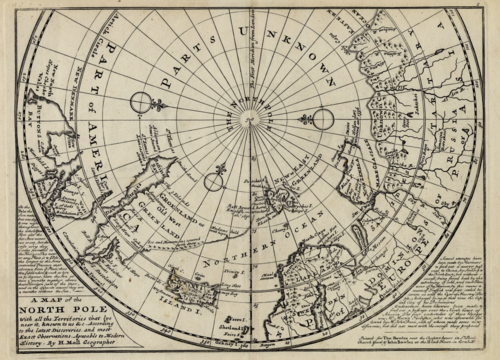
Early maps provide an intriguing view of the world. Featured below is a map of the North Pole in 1732. As you can see, the region where the country of Canada currently resides was, "Part of America," and the area above the Arctic Circle was named, "Parts Unknown." Clearly, little was understood on the various aspects of this northern terrain, but geographers such as Herman Moll provided the North Pole with a definitive point in space.
The map below was printed forty years later and sketched an outline of the South Pole. This depiction seemed as mysterious as its polar counterpart.

There was no indication of any land structure at the South Pole. This visualization is a chilling reminder of the limits of human endurance in early global exploration. The Polar Regions remained shrouded in secrecy for the next century.
Recorded for Posterity
In the nineteenth and early twentieth century, travelers have endeavoured to reach the poles. The need to know was of paramount significance. The unfinished maps of that period in time compelled explorers to fill in the gaps with new knowledge. Other aspects included competition to reach that place first and the challenge to test their own physical, mental, and emotional limits against the harshest conditions imaginable. Even so, some explorers paid the ultimate price for this opportunity. These stories, too, are preserved in the historical body of knowledge as a part of that particular landscape.
In today's world, current technology in the form of satellite imagery digitally maps out these forbidden landscapes. This information is easily accessible through print and online resources. Explorers who want to travel to these regions (particularly the South Pole) will require the latest tech gear to arm themselves against these harsh terrains.
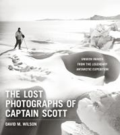
For the rest of us who prefer to reside in warmer climates but want to read up on these fascinating explorations, here are some suggested cool titles:
 |
 |
 |
 |
 |
 |
 |
 |
Enjoy the cheery warmth of the festive season while Old Man Winter pounds the Northern Hemisphere with blistering icy conditions. The early travelers on their polar expeditions will solemnly wait until the reader chooses to pick up and continue along with them on their epic journeys.
Comments