Shiny New Books for Movie Lovers
As the year 2014 recedes into the rear view mirror, what better time to consider some pleasure reading for movie lovers? The Screen Actors Guild Awards have been handed out, and so have the Golden Globes. The Academy Awards will be held on February 22. Here's some reading for the cinephile's bedside table — a selection of books published in 2014 about the world of film.
 |
 |
 |
 |
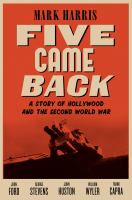
Five came back: a story of Hollywood and the Second World War by Mark Harris.
• eBook
Five Hollywood directors abandoned successful careers to volunteer for military duty in World War II. Frank Capra, William Wyler, John Ford, John Huston, and George Stevens contributed to the war effort by doing what they did best: movie making. They documented the war and created cinematic propaganda. Wyler filmed a combat mission of the Memphis Belle (a B-17 heavy bomber aircraft) over Germany. Ford got hit by shrapnel while filming the Battle of Midway. Stevens captured the landing of the troops in Normandy, the liberation of Paris and the horrors of the concentration camp, Dachau. His work was used as evidence in the Nuremberg trials. Harris shows how these legendary directors were profoundly affected by their experiences during the war.
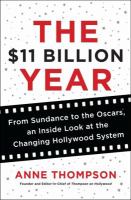
The $11 billion year: from Sundance to the Oscars, an inside look at the changing Hollywood system by Anne Thompson.
• eBook
Thompson focuses on 2012, a watershed year for the movie industry in Hollywood. "From executive firings and hirings to the stories behind films that almost never made it to the screen, Thompson's journalistic flair makes her analysis of the film industry a compelling and page-turning read." Kirkus book review.
 |
 |
 |
 |
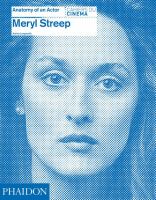
Meryl Streep: anatomy of an actor by Karina Longworth.
This book looks at the brilliant career of three time academy award winner Streep, focusing on ten pivotal performances, including her turns as Margaret Thatcher (The Iron Lady), Julia Child (Julie and Julia) and Sophie Zawistowska (Sophie’s choice), a performance so emotionally devastating I haven’t been able to watch it again. Lavishly illustrated, with lots of interesting biographical details and quotes, such as this one, from 2006, in which Streep modestly sums up a career that's still going full throttle: “My achievement, if you can call it that, is that I’ve basically pretended to be extraordinary people my entire life and now I’m being mistaken for one.” Other actors put under the spot light in the Cahiers du Cinema’s "Anatomy of an Actor" series: Al Pacino, Jack Nicholson, and Marlon Brando.
So anyway by John Cleese.
• eBook
• eAudiobook
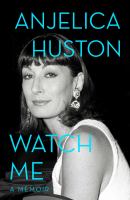
Watch me: a memoir by Anjelica Huston.
• eBook
• eAudiobook
• Audiobook
• CD Talking Book (Restricted to print disabled patrons)
"Picking up where A story lately told leaves off, when Anjelica Huston is 22 years old, Watch Me is a chronicle of her glamorous and eventful Hollywood years. She writes about falling in love with Jack Nicholson and her adventurous, turbulent, high-profile, spirited 17-year relationship with him and his intoxicating circle of friends. She movingly and beautifully writes about the death of her father John Huston and her marriage to sculptor Robert Graham. She is candid, mischievous, warm, passionate, funny, and a fabulous story teller.”
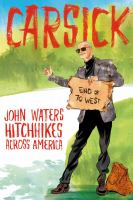
Carsick by John Waters.
• eBook
• eAudiobook
• Audiobook
• CD Talking Book (Restricted to print disabled patrons)
In 2012, cult film director John Waters set out from home carrying homemade signs inscribed with declarations such as “I’m not psycho” and “midlife crisis.” Thus began a nine day hitchhiking adventure from Baltimore to San Francisco. Along the way the director know as “the pope of trash” formed an unlikely friendship with a young republican in a corvette, got picked up by an indie band on tour, and met an assortment of ‘ordinary’ Americans. Library Journal calls Carsick a “rollicking, raunchy romp that delivers big-time laughs.”
 |
 |
 |
 |
World film locations: Toronto.
Have you seen any film crews on the streets our city? You don’t get out much if you answered no to that question. Toronto has been the star of many movies, but just like an actor, it usually isn’t playing itself. In Good Will Hunting Toronto played the role of Boston, and the University of Toronto played the role of Harvard University. In Mean girls, Toronto played the role of Evanston, Illinois. Toronto plays jazz age Chicago in the Academy Award winning 2002 movie musical Chicago. World film locations: Toronto explores the role that the city has played in many films, including Pacific Rim, Cinderella Man, and American Psycho. The author of this book will be giving a talk at North York Central Library on Wednesday September 16 on the history of filmmaking in Toronto.
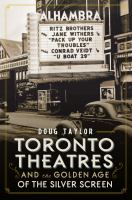
Toronto Theatres and the golden age of the silver screen by Doug Taylor.
• eBook
“Movie houses first started popping up around Toronto in the 1910s and '20s, in an era without television and before radio had permeated every household. A century later the surviving, defunct, and reinvented movie houses of Toronto's past are filled with captivating stories. Explore fifty historic Toronto movie houses and theaters, and discover their roles as repositories of memories for a city that continues to grow its cinema legacy. Features stunning historic photography.” If you are interested in the history of movie theatres in Toronto, you might also like to have a look at The nabes: Toronto’s wonderful neighbourhood movie houses, which provides a visual record of neighborhood theatres of the past.
Werner Herzog: a guide for the perplexed by Paul Cronin.
An updated edition of interviews with director Werner Herzog, whose impressive list of credits includes such diverse projects as the unforgettable documentary Grizzly man, the tragic story of grizzly bear enthusiast Timothy Treadwell, and the cult crime movie Bad Lieutenant: port of call New Orleans. Among the Herzogian gems of wisdom in the book: “There is nothing wrong with spending the night in jail if it means you get the shot you need.” Reviewed in The Independent and The Telegraph.
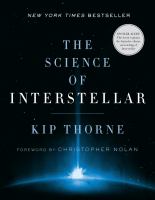
The science of interstellar by Kip S. Thorne.
“Interstellar, from acclaimed filmmaker Christopher Nolan, takes us on a fantastic voyage far beyond our solar system. Kip Thorne, the physicist who assisted Nolan on the scientific aspects of Interstellar, shows us that the movie's jaw-dropping events and stunning, never-before-attempted visuals are grounded in real science. In chapters on wormholes, black holes, interstellar travel, and much more, Thorne's scientific insights–many of them triggered during the actual scripting and shooting of Interstellar–describe the physical laws that govern our universe and the truly astounding phenomena that those laws make possible.”
24 thoughts on “Shiny New Books for Movie Lovers”
Thank you, Maureen, for a thought-provoking blog about the movies. I am looking forward to reading John Cleese’s autobiography!
Glad you liked it, Muriel. Michael Ian Black, who reviewed the book for the New York Times, wrote that reading the book “is a bit like having a long lunch with an amiable, slightly loony uncle.” If you want to read the book review, here’s the link:
http://www.nytimes.com/2014/12/07/books/review/so-anyway-a-memoir-by-john-cleese.html?_r=0
HI MAUREEN
I OWN THE CANADIAN COPYRIGHT OF A BOOK WRITTEN BY THOMAS P. KELLEY AND HERBERT EMERSON WILSON.I AM CURRENTLY IN THE PROCESS OF SELF PUBLISHING THIS BOOK AND HOPE THAT IT WILL BE FOUND TO BE A GREAT READ.THE MOVIE OPTION TO THIS BOOK WAS PURCHASED BY STANLEY KUBRICK IN 1957 AND WILL BECOME A T.V.MINI-SERIES ROUGHLY AROUND THE END OF THIS YEAR,STARRING MICHAEL C.HALL AS HERBERT EMERSON WILSON.
I ALSO AGREE 100% THAT A MOVIE SHOULD BE MADE ABOUT THE DONNELLY TRAGEDY.
Thanks for your comment, John, which is referring to another post I`ve written, called Dear Famous Movie Directors, on the topic of a crime in Ontario history, the murder of several members of the Donnelly family in the late 19th century.
I had to look up Herbert Emerson Wilson after reading your comment. I hadn’t heard of him before. I read that he was a Canadian minister “who eventually became one of the best safecrackers and most successful American bank robbers in the early 20th century.” What a fascinating story! I look forward to the mini-series “God fearing man” starring Michael C. Hall.
I wish you success with publishing the book. When I read Thomas P. Kelley’s “The Black Donnellys” when I was a kid, I had no idea he’d written so many books. According to Wikipedia, he claimed to be “King of Canadian pulp writers.” What an interesting heritage for you – I read in your other comment (on another post) that you’ve inherited the rights to all of Kelley’s works from your mother. Thomas P. Kelley sounds like a really interesting character – I read on Wikipedia that he journeyed with his father’s medicine show, and was a professional boxer for a time, and that he wrote for pulp magazines.
As for a movie about the Donnellys, I’m still waiting, still hoping.
HI MAUREEN
THANK YOU FOR THE WELL WISHES ABOUT THE BOOK.I AM VERY EXCITED TO SEE WHAT THEY ARE GOING TO DO WITH THE MINI-SERIES.HERB AND MR. KELLEY WERE GOOD FRIENDS AND I HAVE SOME LETTERS THAT WERE SENT BETWEEN THEM.THEY WERE WORKING ON PROJECTS TOGETHER UNTIL HERBS DEATH IN 1968.
I AM GOING TO VISIT THE MERRIL COLLECTION AND SEE IF THEY ARE INTERESTED IN SOME OF THE MATERIAL I HAVE FROM MR. KELLEY.I HAVE A BOOK CALLED “TAPESTRY TRIANGLE” THAT APPARENTLY IS VERY HARD TO FIND AND A POCKET BOOK CALLED “THE HOUSE TIME FORGOT” THAT NO ONE HAS HEARD OF.
THE STORY OF MR. KELLEY’S DAD,”THE FABULOUS KELLEY” WOULD MAKE AN EXCELLENT MOVIE.HIS MEDICINE SHOW ENTERTAINED PEOPLE FOR DECADES AND IT MADE MILLIONS OF DOLLARS.
“The Fabulous Kelley” could make a great Canadian story. Maybe you should write the screenplay!
Hi Maureen
“The Fabulous Kelley” would make a great Canadian story.It is Canadiana at it’s best.Bragg Creek Film Productions had a movie option on the story at one time.In 1987 Jim Betts did a musical about the colorful life of Doc Kelley at the Young People’s Theatre.I have an outline for a musical,written by Rod MacIntyre,called,”The Man Within Me”,based on the book,”The Fabulous Kelley”.It’s an amazing story and hard to imagine how these caravans travelled through the back roads of North America,drew the attention,and entertained people for decades.
Thank you for your interest.
Hi Maureen
Just wanted to let you know that my copy of “I Stole $16,000,000” is almost ready for the shelves. A rough copy has been printed, but with some minor changes, the books and electronic version should be completed by the end of September, 2015. I haven’t heard anymore about the T.V. mini-series, “God Fearing Man”, that is based on this book, but I hope it will come out soon. I am really looking forward to seeing it.
I’m looking forward to seeing “God Fearing Man” too. I hope they are still going forward with that project. Congratulations on finishing your book, John. You came up with a very catchy title. I assume it’s about Herbert Emerson Wilson, the bank robber. It must have been such an interesting project to work on, considering the fascinating material you’ve been delving into. Good luck with the fine tuning and publication!
Hello John
I just recently came across this post as well o few of your other ones. Kelley was certainly an intrighing and colourful character. Many of his books, stories and articles are obscure because many were written under pseudonyms. Even some under his own name are little known. No has ever compiled a comprehensive bibliography of his works because he was so prolific and much of his material is hard to identify. I understand you own the copyright to his works. Have you thought of doing it yourself? Have you compiled a list of the material you know of and that you have? It would be interesting. Thanks John
Hello John
Can you tell me the name of your publishing company? From what you wrote it sounds like it is an actual book. As someone who has been working on a detailed list of vintage Canadian paperbound books I was intrigued by the fact you know of some of the more obscure Kelley titles. There are many obscure Canadian books with obscure bylines & I suspect some of them are Kelley’s books.
Hello John
The name of my publishing company is Darling Terrace Publishing. I am exclusively publishing the literary work by Thomas P.Kelley. “I Stole $16,000,000” will be on the shelves in the New Year, followed by “The Black Donnellys”, Vengeance of The Black Donnellys”, The Fabulous Kelley”, Run Indian Run”, Rat River Trapper”, Bad Men of Canada” and an unpublished adventure fantasy, “My Story of The Last Days of The World”. I have a copy of “Tapestry Triangle”, The House Time Forgot”, (which isn’t even catalogued), I Killed Hitler” and Awaken The Dead”. So far I have found 15 of his pseudonyms, but he may have used more than 30.
Thank you.
Hello John
Thanks for the info on your publishing company. I look forward to seeing the book when it comes out. I notice you mentioned that you will be doing “Badmen of Canada”, does this mean you will also be doing the companion volume “Wicked Women of Canada”? I have heard of most of the other stories you mention, like the “Man Who killed Hitler” and “Awaken the Dead” although under the byline ‘Halls Wells’), but as short stories. Were these done by the publisher Frontier as booklets? I haven’t seen any of the booklets Kelley did for them or know any of the titles. “The House Time Forgot” is new to me, what was the name of the publisher? As for “Tapestry Triangle”, I haven’t seen it but of course I’ve heard of it and know what it’s about. Along with my interest in Canadian paperbacks, I also have a modest collection of Canadian pulp and true crime mags and just recently I started to index it. I’ll send you a list of stories that appear under Kelley bylines when I am done, in case you are interested. It would be nice to see a collection of Kelley’s true crime stories that appeared in the pulps & never in book form. Feel free to e-mail me direct at jdm.reb@hotmail.com if you prefer. Thanks again
Hello John
I will be doing “Wicked Women of Canada” as part of the second round, of what I call, the Kelley collection. The short stories I mentioned before, including “The House Time Forgot” are booklets, and were done by Frontier Publishing Company. I would be very interested in seeing the list of stories you find that were done by Kelley. I have quite a few, but I’m sure he wrote hundreds of titles using his alias names. Thanks for the e-mail address, I will contact you.
I am almost done indexing my collection of about 600 plus Canadian pulp mags. E-mail me at the address in the earlier note & I will send you the list of stories I found by Thomas P. Kelley and those under some of the pseudonyms of his that I know about. Best regards. John R.
With regards to your item about “Toronto Theatres and the Golden Age of the Silver Screen”, I would to make some comments.
This book is filled with many errors, and this is going to be a long note because I am going rebut some of the most egregious ones individually.
My reason for doing so is that this book is In Print, and the mistakes herein could very easily be perpetuated by unsuspecting researchers in the future and I cannot stand by and let them go unchallenged. This is a highly specific topic, likely to be of most interest to Torontonians in particular, and movie theatre and history buffs in general, therefore the specificity of the details are bound to be of considerable importance to them.
The first example of an error that could have been very easily researched occurs in the Introduction. In describing a typical Saturday matinee schedule for kids he says:
“….Next they showed a serial, which was a short film that required five or six episodes, one shown each week, before the entire tale was completed. Serials were also referred to as “movie-chapter plays” or “cliff hangers,”…. (page 12)
Serials of the 1930’s, 40’s and 50’s were never that short. They were always between twelve and fifteen episodes
“Each company turned out four to five serials per year, of 12 to 15 episodes each, a pace they all kept up until the end of World War II when, in 1946, Universal dropped its serial unit… Republic and Columbia continued, Republic fixing theirs at 12 chapters each while Columbia fixed at fifteen”.
https://en.wikipedia.org/wiki/Serial_film#Sound_era
The Great Movie Serials; authors; Glut, Harmon. Publisher; Routledge (2013)
On page 33, in talking about the Loews Downtown theatre located at Queen and Yonge he states:
“In 1960, the theatre was converted to “Cinerama,” which required three projectors. To accommodate the expansive curved screen, the opera boxes and the proscenium arch were removed. This greatly diminished the appearance of the theatre ‘s auditorium”.
This is incorrect. There were only two theatres in Toronto that ever converted to three projector Cinerama; The University and The Eglinton.
The University began with “This Is Cinerama” on Oct 24,1957 (not in 1958 as the author states on page 110) and permanently ceased with the Cinerama format on November 25, 1959 with “South Seas Adventure”(to make way for Ben Hur, projected in 70mm).
The Eglinton began three projector screenings on Dec 23,1960 with a rival process called Cinamiracle. The film was called “Windjammer”, but this was the only film ever made in Cinamiracle. The company went bankrupt, and was bought out by Cinerama. The Eglinton then converted to Cinerama, and continued with it until December 15, 1963 with the screening of “How The West Was Won”. This was the last three projector Cinerama film shown in Toronto.
http://www.in70mm.com/library/70mm_in/canada/index.htm
Also in Mr. Taylor’s description of the University Theatre
he says the following:
“In 1962, the film Ben Hur played at the University. Because of the movies I saw in the theatre, in my mind, Charlton Heston was forever the towering hero-Moses or Judah Ben Hur. In 1962, I also saw Lawrence of Arabia, a lengthy film that almost gave me camel sores. Fortunately, the plush maroon theatre seats compensated, as they were soft and comfortable. However, the desert scenes dehydrated me, and at intermission, I gulped two containers of Vernor’s Ginger Ale” (p 110-111)
Well, I know this to be categorically incorrect because in high school I worked every weekend at the University (and fulltime in the summer) from 1962-1964.
Before I started working there, “Ben Hur” played at the University from Dec 23, 1959 to May 5, 1961. It won 11 Academy awards on April 4 1960. It did not play at the University in 1962. Nor did Lawrence of Arabia ever play at the University. That played exclusively at the Carlton Cinema from Jan 31,1963 to July3,1963. The only 70mm roadshow film to play at the University in 1962 was “Mutiny on the Bounty”, followed by “Cleopatra” in 1963.
There are other errors that could have been resolved by more careful proofreading. The author states on page 35 that:
“On the evening the Hippodrome opened, the feature film was “Run for Cover”, starring James Cagney”.
As the Hippodrome, which originated as a Vaudeville house, but was certainly showing films by 1924, this is incorrect, as “Run For Cover” was released in 1955. So (presumably) what the author was indicting is that this was the closing film at the Hippodrome.
On page 77 he quotes Mae West as follows:
“When I’m good I’m good, but when I’m bad I’m really good.”(sic)
The actual quote is:
“When I’m good, I’m very good, but when I’m bad, I’m better. ”
There are more factual errors and debatable premises but I will leave those for now and turn my attention to the author’s style.
The author is prone to superfluous digressions. For example on page 21:
“In the 1940’s,The Ace on Queen Street was owned by Sam Ulster, who also owned The Broadway on Queen St and The Rio on Yonge St. He was also the owner of the Town and Country restaurant on Mutual Street. I remember this eatery very well. It was famous for it’s buffet, which featured roast beef and lobster. Its main rival on the 1940’s was the Savarin Tavern on Bay Street… In the 1940’s, to the west of the theatre was a restaurant named Bowles lunch, the space later occupied by Scott’s Chicken Villa.”
These digressions, and there are others like them, I think are irrelevant in a book about the history of Toronto theatres.
Which brings up the central question about this book. What kind of book is this exactly? Is it a history of Toronto’s Theatres?, or is it a personal memoir? The problem is that it can’t make up its mind and is trying to be both at the same time, and it simply doesn’t work.
That is not to say that there isn’t much interesting and useful information to be found here. On page 15, he talks about the first projected screening in Toronto having taken place August 31, 1896 at the Robinson Musee located at Yonge and Adelaide.
That was new information to me, and how I wish he had listed a reference for that. It took quite a while, but I eventually tracked it down as coming from the Toronto Historical Board.
And that’s the biggest problem with this book. There is no bibliography whatsoever, no index, no source notes, nor any footnotes.
Am I being too hard here? I don’t think so. To date, there is only one other book on the history of Toronto Film Theatres, called “The Nabes” by John Sebert, published in 2001. So “Toronto Theatres in the Golden Age of the Silver Screen” will undoubtedly be consulted as an additional historical reference. There are 19 print copies in the Toronto Public Library (including one at The Reference Library).
I am going to inform the publisher of these errors and hopefully changes can be made in upcoming editions, but this article is a forewarning to anyone who might read this imprint in the meantime.
It is my sincerest wish that these and any other errors in this book can be rectified, and source notes for factual information supplied.
Then it would be a truly useful volume.
A note on pagination: I read this book in an on-line copy borrowed from the Toronto Public Library and it is 154 pages long. The hard copy print version is listed as being 160 pages. So there may be a slight discrepancy with the print version pagination.
Hello Gil,
Thanks for your comments on the book I highlighted in my post. I’m glad that, notwithstanding your criticism, you found worthwhile information in “Toronto Theatres and the Golden Age of the Silver Screen.”
I think it only fair to let the author, local historian Doug Taylor, know about your critique, so that he may respond if he wishes. (I have emailed him.) It’s evident that you were very engaged while reading this book, and I appreciate that.
Doug Taylor emailed me his response to Gil’s comments above, and wanted his comments to be available to readers of this blog post, therefore I have included them below.
“Gil asked the question whether my book is a history or a personal memoire. I clearly stated in the Forward of the book that my main purpose was to preserve the memories of having attended these wonderful old theatres, and because any surviving information is sparse and often contradictory, I cautioned readers about the possibilities of errors.
As a result, I believed that it was clear that my theatre book is not an academic reference source, but is mainly a collection of anecdotes gleaned from the experiences of my youth and others whom I interviewed. However, similar to any set of stories, it contains factual information
When writing other books about Toronto’s past, I often consult Henry Scadding’s book, “Toronto of Old.” It was written as a history, but is clearly Scadding’s memoires of Toronto as he remembered it in the 19th century. The book contains many errors, as he did not have access to the dairies, wills, personal papers etc. that future scholars were able to access. He wrote his book employing the information that was available to him at the time. I did the same.
However, despite the errors in Scadding’s book, I would never suggest that it not be employed as a reference source by scholars today. Researchers understand that it is necessary to consult other sources as well. My modest book is not in the same category at Scadding’s, but similar to him, there were no other sources to check.
Prior to “Toronto’s Theatres in the Golden Age of the Silver Screen” being published, the information contained in it was verified as much as was possible. As I explained in the Forward of the book, writing it was very difficult. The only book specifically written about Toronto’s movie theatres was “The Nabs” by John Sebert, an excellent book, but it contained mainly photos with very little information. However, I was grateful for the data that Sebert provided.
I spent more than a year researching in the Toronto Reference Library, and the Toronto and Ontario Archives. Several web sites were very helpful, but they were limited as there were over 200 theatres in the city in the era when they were in their prime.
I begged on the internet for people to contact me if they had information about the topic or possessed photos. I did not receive a single response. It finally occurred to me that many of the people whom I wished to reach were not on the internet. However, I knew that they purchased books.
Deciding to publish a book under these circumstances was not easy, since it involved an element of risk. The only other option was not to tackle the book at all as some of the data might be incorrect. Perhaps this explains why there are no other books about Toronto’s old movie houses.
Despite the difficulties, I decided to write the book anyway, as it allowed me to open the topic to readers who might offer corrections, expand ideas, and provide suggestions. I felt that this was important as it might be the last chance to retrieve information from people who personally remember these great old theatres.
In the Forward to the book, I encouraged readers to contact me to share information or offer corrections. In this respect I was very successful. I am very grateful for those who took the time to contact me via email or send letters to the publisher, who then forwarded them to me to add their own stories and to correct any errors.
Gil suggested that my book required a bibliography. This was an excellent suggestion, but it was not practical since there were no publications to list (except Sebert’s). My research was obtained directly from the archives or from interviews. Gil also suggested employing footnotes. Another great idea, but not appropriate for a book that is mainly anecdotal in style. Any explanations that I felt readers might require were thus included in the text.
Due to the success of the book on theatres, a more extensive book on the topic will be available in May 2016. Writing the second book has been rewarding, as I am no longer working in isolation, thanks to readers with whom I now have direct contact.
I sincerely hope that any other readers who have information or corrections to offer after reading “Toronto’s Theatres in the Golden Age of the Silver Screen” will respond via email on tayloronhistory@gmail.com.
Gil obviously has much information on Toronto’s old movie theatres. I would strongly encourage him to publish a book on the subject, so that the information he has acquired is not lost to future generations.
Most of Gil’s corrections are already known to me. However, he mentioned a couple that were new. Thanks Gil.
In reply to Gil’s specific comments:
1. Gil states that serials possessed 12-15 episodes. I have found this was not always true, but there were certainly many that were 12-15 episodes in length.
2. Gil is correct that Cinerama never was installed in Loew’s Downtown. However, I discovered a large file in the archives about the renovations to the theatre to accommodate it, and it even provided an opening date. Another reader informed me that the plans were later cancelled, and this was verified by a former employee of the University Theatre.
3. Gil provided much additional information that was not in my book, such as about Cinamiracle. I enjoyed reading this material. However, in a single book it is not possible to include everything. The publisher limited me to a set number of words. Gil appears not to have approved of my choices (see comment #4 below).
4. Gil felt that there were too many “superfluous digressions.” What is superfluous to one reader is a delight to another. This is a personal issue and is different for every reader. Judging by the numerous comments I have received, for most people, the “digressions” added to their enjoyment of the book. In Gil’s case, he obviously wishes that I had included more historical data and less personal information. As stated, this was not my purpose in writing the book.
5. The dates for the screening of Ben Hur have already been noted and corrected, thanks to a previous reader.
6. The dates for the photo for Shea’s Hippodrome and the film “Run for Cover” have also been noted. The dates in the archives were incorrect and it is my fault that I did not see the error prior to publication as it was an obvious error.
7. I have discovered several versions of May West’s famous line. It has been quoted so many times that it seems to have changed throughout the years. I believe that any version portrays her intent and the outrage it created.
8. The dates for opening of Cinerama at the University have been previously sent to me.
9. Gil stated that “Lawrence of Arabia” never played at the University. He may well be correct as he stated that he worked at the Odeon Carlton. I was certain that I attended it at the University. Memory does sometimes play tricks. When I return to Toronto (I am away for two months), I will recheck this fact from the movie ads of the Toronto Star. Internet connections in Mexico are not the best, so I will wait until I return to Toronto.
I want all the information about the city’s old movie houses to be as correct as possible. However, my main purpose was to allow future generations to understand a little of the joy that people experienced when they attended these wonderful theatres of yesteryear.
Doug Taylor”
Dear Doug,
Thank you for the reply to my comments. I just want to clarify a few things in your response, to avert any misunderstandings.
Please understand that I have absolutely no objections to the portions of the book about the theatres that constitute your memoirs. They are yours alone and as such are valuable to both you and the public.
The problem for me is that there is no clear delineation between the writing that constitutes your reminiscences and the material that you are presenting as the result of your research. The first is subjective observation, and the second is objective factual reporting that is not based on your personal experience.
You mention that you spent a year researching your material in the Reference library and The Toronto and Ontario Archives. This is most commendable. My only concern is that the mistakes that have crept in here in both areas will be perpetuated. Once something is in print, it’s impossible to get it out unless there is a second edition. And this is where the quandary lies.
“Gil also suggested employing footnotes. Another great idea, but not appropriate for a book that is mainly anecdotal in style”.
If I may, I would suggest to you Doug that your book may be mainly anecdotal in style but it is not primarily anecdotal in content because much of it is based on hard research on topics of which you were previously personally unaware (or had obtained from an interview with a third party). For example, the highly specific details of theatres constructed and demolished before you were born, or of an age to attend them, or had never attended. As you mentioned you spent a year researching the topic in libraries and archives. I do hope you kept accurate notes of where you obtained your specific facts.
Now I know that Arcadia/The History Press of South Carolina has over 12,000 books in their list and publishes close to 700-800 new titles a year. And I know that they have very specific guidelines for their publications, regarding such things as the explicit format, a limit on the number of pages, etc… They publish largely local and regionally oriented books. So I do understand that they may not require footnotes or source notes.
But your upcoming book in May 2016 is to be published by Dundurn Press, a highly respected Toronto based publisher. So my reason for writing all this has been in the hope that the new book will incorporate footnotes and/or source notes based on your extensive factual based research. Then it will become a truly useful volume for researchers, i.e., wherein there is a demarcation between the memoir aspects and your researched non-subjective factual information.
In reply to some of your specific comments:
1. Gil states that serials possessed 12-15 episodes. I have found this was not always true, but there were certainly many that were 12-15 episodes in length.
Here is an example Doug, where I wish you had provided a source for the statement you make above “I have found this was not always true”
This is your original quote about Saturday afternoon matinees as you knew them in the late mid/late 1940’s to early 50’s.
“….Next they showed a serial, which was a short film that required five or six episodes, one shown each week, before the entire tale was completed.
Out of the 166 Serials produced by studios in the sound era, fully 165 of the 166 were between 12-15 chapters. (There was only one solitary exception, and that was Universal’s 1931 “Finger Prints”, which was 10 chapters).
There is not a single example of a serial produced in the sound era of 5 or 6 chapters in length that I have been able to discover. If I have missed something, I am hoping you will provide a source reference.
3) In reference to Cinerama and Cinemiracle, I was by no means suggesting that anything I wrote should have been included in your book. I described the processes used in Toronto in such extensive detail only because there is so much confusion about the term Cinerama.
7) Regarding Mae West’s famous line, I’m afraid I have never come across the version you quoted. The actual quote is from 1933’s “I’m No Angel” which you can google and access on you tube at:
https://www.youtube.com/watch?v=cxF_V90s9g8
9) Gil stated that “Lawrence of Arabia” never played at the University. He may well be correct as he stated that he worked at the Odeon Carlton. I was certain that I attended it at the University. Memory does sometimes play tricks.
Doug, I am afraid you have misread my original comment. As I mentioned in it, I worked at the University Theatre from 1962-1964 (not at The Odeon Carlton)
Finally, re #4)
4) Gil felt that there were too many “superfluous digressions.” What is superfluous to one reader is a delight to another. This is a personal issue and is different for every reader.
You are absolutely right about this. At the end of my original post, I did identify that I was switching from correcting specific errors to commenting on your style, and these comments are most certainly subjective on my part.
And they only referred to digressions that I felt were not pertinent nor informative about Toronto Theatres
So it is my personal opinion, that, if you had for example described what you enjoyed in Mr. Ulster’s Rio Theatre on Yonge St., (red vs. black Twizzlers, popcorn or candy bars), I would have been amused and entertained and considered it relevant. But the fact that his buffet at The Town and Country on Mutual St was well known for it’s lobster and roast beef, and that its main competition was the Savarin Restaurant, and the fact that Bowle’s Lunch eventually became a Scott’s Chicken Villa? Fine in a book about Toronto’s restaurants. But in a book about Toronto Theatres in which the publisher has specifically limited the number of words you can use? Not so much.
Gil
Hi Gil,
Thanks for taking the time to reply. You make some excellent points and I respect your view point, although I do not share some of them. I too have concerns about the information being correct and this is why I have encouraged readers to contact me. The errors are reported to the publisher to allow future editions to be corrected. When dealing with a subject of this type,where sources are few or non-existant, much relies on personal memories.In this respect,this book is not typical of most publication.
I still welcome comments on the book and appreciate it when errors are reported.
Gil, I would again encourage you to write a book to share with others your personal memories and information about Toronto’s old theatres.
Sincerely,
Doug Taylor
Hello John
Has your book come out yet? I forgot to ask you where it would be sold so I can Pick up a copy. Also, in case you missed my previous note, I went through my pulp mags and I have the list of stories I found by Kelley. If you would still like to see the list e-mail me direct at jdm.reb@hotmail.com and I will send it to you. Best regards John R.
Dear fans of the Donnelly story, I have recently published ‘The Black Donnellys’ eBook by Thomas P. Kelley. Book #2 of the series, ‘Vengeance of The Black Donnellys’ is available in hard copy from http://www.darlingterracepublishing.com and will be available as an eBook soon. I am still waiting to hear if any networks or Hollywood producers have shown an interest in producing ‘The Black Donnellys’ of Biddulph TV series.
I am looking forward to reading ‘The Boy on the Bicycle’ by Nate Hendley. There is a very informative podcast titled Get Published Episode 52-Nate Hendley-journalist, author, editor.
The interview is much like his book ‘Motivate to Create’ with a few more very wise tips about writing. Mr. Hendley talks about the importance of researching, fact checking and editing the vast amount of material necessary to write an accurate book.
Mr. Hendley talked about the tons of books he read when he was doing research for his book ‘American Gangsters’. He explained that, while reading many of the books he used for research, he started to notice that some of the authors hadn’t really done a lot of original research, and it was pretty obvious that they read somebody else’s account of something and then paraphrased it a bit and put their own version down, with no direct quotes to back it up, or newspaper accounts or anything.
Mr. Hendley, also the author of ‘The Black Donnellys’, The Outrageous Tale of Canada’s Deadliest Feud says Tsk,Tsk, to using other peoples work in this manner, and so does the publisher of Thomas P. Kelley’s ‘The Black Donnellys’ The True Story of Canada’s Most Barbaric Feud. Hmm?
“I’ve read this material in a previously published famous book”
Following the release of ‘The Black Donnellys’ in 1954 by Thomas P. Kelley, an interest was sparked in a case that had gone cold for more than 60 years. Gathering and using material from old newspapers, police and court records, as well as taking creative license with details and plot elements where the truth about certain aspects or events were not known, Mr. Kelley’s sensationalized account of the Donnelly tragedy was soon under the microscope. Although being the most popular and the most famous book ever written about the Donnelly massacre, it was heavily scrutinized and criticized for not being historically accurate.
An example of Mr. Kelley’s work, is the scene where James Donnelly and three of his sons get their fortunes read by Grandma Bell, with the predictions of their violent deaths. In the books ‘The Black Donnellys’ ‘The True Story of Canada’s Most Barbaric Feud’ by Thomas P. Kelley and ‘The Black Donnellys’ ‘The Outrageous Tale of Canada’s Deadliest Feud’ by Nate Hendley, both describe this encounter with Grandma Bell, however the encounter first appeared in Kelley’s book in 1954. This account according to both authors happened in November, 1879 and is described very much in the same way in about two and one half pages, right down to the tossing of the coin/coins onto Grandma Bell’s table for payment of the reading. According to historical records, Grandma Bell died in 1878. This scene invented by Kelley never happened at all, but Kelley’s writing of it puts him at his pulp fiction best.
Mr. Hendley is a non-fiction, true crime/biography author, and wrote for Altitude Publishing that specialized in short punchy Canadian non-fiction, primarily of a historical nature.
Mr. Hendley’s book released in 2004, and surprisingly also titled ‘The Black Donnellys’, (the title coined by Mr. Kelley in 1954 and continuously borrowed because of it’s notoriety) contains many of the elements from Kelley’s book where Kelley took creative license with details and plot elements using fiction, invention and imagination where the truth about certain aspects or events were not known. Intentionally or not, using inaccuracies by not researching all of the elements believed to be factual from Kelley’s book affects the truthfulness of Hendley’s biography. Research is key, all sources must be verified.
I also find that Mr. Hendley’s true crime/biography has us guessing what is fact and what is fiction because there is no delineation between his sometimes colorful and melodramatic writing and the material he is presenting as a result of his research, which I believe to be non existent!
Because of the amount of fiction, invention and imagination appropriated from Mr. Kelley’s book, it is my opinion that Mr. Hendley’s, ‘The Black Donnellys’ is not a work of non-fiction, and is a flawed representation of the true crime/biography genre. It would also be logical to assume that if Mr. Kelley’s book can be criticized for not being historically accurate, so can Mr Hendley’s.