Tutankhamun’s Uncommon Encounters
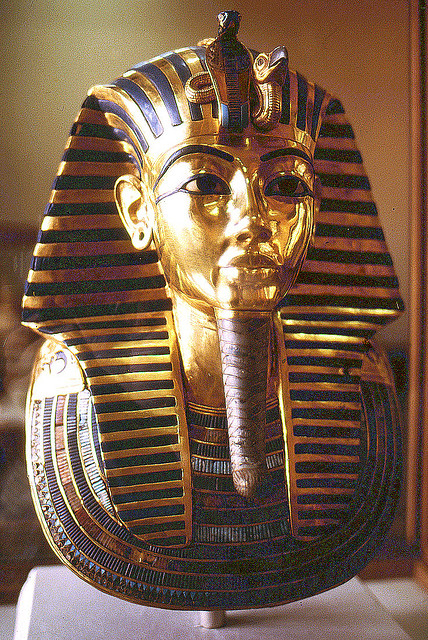
This year Ontario celebrates Family Day on Monday February 16. It is a great day for people to share time with family and friends. For those who like to spend their time immersed in ancient history, February 16 celebrates the 92nd anniversary of the discovery of King Tut (aka King Tutankhamen). This day in 1923, Howard Carter discovered the inner burial chamber and gave rise to a social phenomenon rich in scientific research and folklore.
Tutankhamun endured some (mis)adventures in life and in the thereafter. These include physical injuries that hastened his untimely death, possible spontaneous combustion of his mummified remains during entombment, and the recent unfortunate breaking and hasty reattachment of the beard on his death mask.
Other intriguing issues related to King Tut can be shelved under folklore. These include the ever popular "mummy's curse" upon the opening of King Tut's sarcophagus and the successful plot to murder the young king. In the late 1960s, scientists examined King Tut's remains using X-ray photography. The initial images showed a crack in the lower back area of the mummy's skull. This evidence suggested that King Tut may have been bludgeoned to death. Ay(e), a middle-aged close relative and counselor to the king, was the prime suspect in the young king's demise. Ay(e) had a great deal to gain in murdering the child king and marrying the equally young queen, Ankhesenamun.
Further scientific analysis debunks this initial theory. Recent CT scans discount Ay(e) as the Tutankhamen's murderer. The crack in the skull most likely occurred in the mummification process. King Tut may have died due to an infection resulting from a serious fracture to his left leg. The scientists did report two unusual occurrences while they performed a CT scan on Tut's remains. They jokingly suggested that the sudden shutdown of power to the CT scanner and illness to one of the scientists may be caused by the mummy's curse for performing this "penetrating" procedure.
The library has a good assortment of titles that would interest readers fascinated with topics on Tutankhamen and the history of Ancient Egypt:
 |
 |
 |
 |
 |
 |
 |
 |
For those readers who would like to find out more on the possible murder plot on the young king, here are some gripping suggestions:
 |
 |
 |
As new innovations in scientific research develop, the analysis of King Tut's artifacts and remains will continue to reveal a better understanding of how people in Ancient Egypt perceived life and death. Perhaps not everything about King Tut will be answered–speculation and folklore will attempt to fill in those gaps.
Whether it be murder, archaeology, science, or Egyptology, you will find something intriguing in the titles and the online articles suggested here. Come visit the Society and Recreation Department at the North York Central Library to browse our Ancient Egypt collection. And please visit the Toronto Public Library Pinterest site for more amazing images on all things Tutankhamen.
2 thoughts on “Tutankhamun’s Uncommon Encounters”
Thanks, Ann, for such an interesting post. King Tut will always fascinate, especially since Ancient Egyptian art and artifacts are so beautiful. I also find it interesting that Lord Carnarvon was the financial backer of Howard Carter. Lord Carnvaron lived at Highclere Castle, which today stars as the fictitious Downton Abbey!
Hi Muriel!
This is a fascinating connection to Highclere Castle and Downton Abbey. I am enjoying history more and more every minute! Thank you for that information.