Henry Hudson and His River


As schools begin their first full week of studies, this post will briefly examine the history, travel, and trials of Henry Hudson.
Some Internet sources claim that September 12, 1575 was Henry Hudson's birthday which would make him 441 years old, but his actual birthday was probably near that date. September 12th is better spent commemorating his travel through the river that will eventually be named after him.
Henry Hudson traveled on four voyages on three different ships to try to locate a trade route through the Northeast and Northwest Passage to the Orient, but he never made it to this final destination. Instead, Henry Hudson located trade routes through Canada and the United States. On his third voyage on September 12th in 1609, he sailed down a river which will later be called the Hudson River.
Hudson's voyages across the seas from England to North America have not been smooth. His crew have endured limited food rations, changing temperatures and dangerous weather conditions. These conditions inevitably helped lower the crew's morale and they have threatened to mutiny on a few occasions.
The crew's frustrations culminated on June 22, 1611. With only a 14-day supply of food rations remaining, the crew refused to travel any farther in the freezing ice-filled waters of (what is now) James Bay. Henry Hudson, his son, and a few fellow sailors too weak and sick to defend themselves were cast off the ship by the angry mutineers. The abandoned crew were placed in a small wooden boat to fend for themselves. The National Film Board presents Richard Gilbert's (1964) film, The Last Voyage of Henry Hudson.
Artist John Collier recreated that fateful moment below of the abandoned crew as they floated among the frozen icebergs.
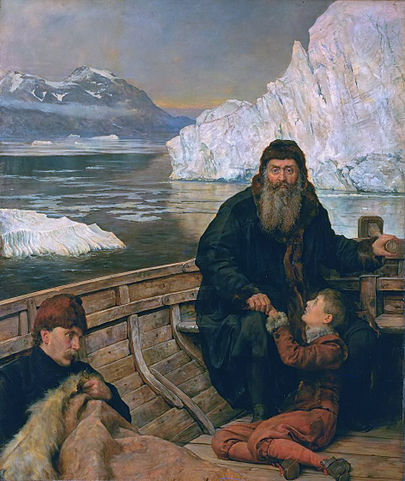

The artist's portrayal shows a resigned look on Hudson's face as well as a sick crewman while John Hudson, his son, clutches Henry's hand for hope to survive this situation. Sadly, the abandoned crew were never found again and presumed dead at sea. Only through Hudson's discovered journal entries and the actual return of the mutineers to England to confess their crime was Henry's tragedy recognized.
To read more of Henry Hudson's travels and the history of the Hudson river, please refer to the following titles:
 |
 |
 |
 |
 |
 |
For more information on the Hudson River from past to present, the following titles offer a textual and virtual field trip through the waterway:
 |
 |
|
 |
 |
 |
In Canada, Hudson's Bay and the Hudson's Bay Company (HBC) are also named after Henry Hudson. Here are some books on this longstanding company to enjoy:
 |
 |
The voyages of this brave man have greatly influence trade, culture, and history in Canada and the United States. Sadly, his efforts left him in a boat adrift on the freezing waters of James Bay and not rejoining his friends and family back in England. Still, North America has honoured and remembered him by name and by his historical achievements.
Comments