Q+A With Sam Weller: Ray Bradbury’s Official Biographer
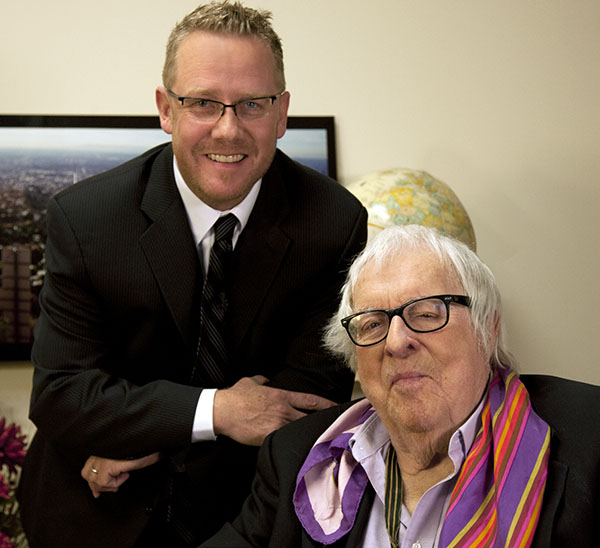
When Ray Bradbury passed away in June 2012, he left behind a tremendous legacy. His work sparked our imagination and was a huge influence on pop culture. But what was Bradbury – whose "Fahrenheit 451" is being celebrated as our One Book this April – really like as a person?
As Bradbury's authorized biographer, Sam Weller got up close and personal with the late author, writing about his life in "The Bradbury Chronicles: The Life of Ray Bradbury" and "Listen to the Echoes: The Ray Bradbury Interviews" (see companion website). Weller also co-edited the 2012 anthology "Shadow Show: All-New Stories in Celebration of Ray Bradbury." He is currently a
professor in the Fiction Writing Department at Columbia College in Chicago and is a frequent lecturer on Bradbury's life and legacy.
What
was Ray Bradbury like as a person?
Sam Weller: Ray was enthusiastic, in love with life, and a non-stop fount of ideas,
opinions, and philosophies. He was always inspiring to be around. He was
grateful for his days and smelled the proverbial roses at each opportunity.
I
described him in my first Bradbury-related book, "The Bradbury Chronicles: The Life of Ray Bradbury" as a “great, jolly blurt of a
man,” and that is exactly what he was. He was funny, loved good food and good
wine, loved old movies, and loved to talk ideas, small and big. He was this
dichotomous mix of great intellect and knowledge, fused with a joyful,
irascible inner-child. I miss him terribly.
In writing about Bradbury’s life, what details and stories surprised you the
most?
SW: I teach the only college-level course in the country dedicated completely
to his work and it continues to surprise me just how many of his stories – even
tales of imaginative fantasy and the far-flung future – somehow connect to his
own experinces.
He often wrote “autobiographical fantasy,” stories culled
from his own life that he examined through the prism of the fantastic. And I
believe this is why his work resonates. It has an emotional truth to it, because
it very often was created from truth.
Beyond this, there were other surprises. He moved to Hollywood in April 1934
at the age of 13. It amazes me how many of the great stars of the golden era of
Hollywood he encountered as this sort of roller skating street vagabond. He
collected autographs and took photos with many of them. He met Clark Gable,
George Burns, Jean Harlow, Judy Garland, Marlene Dietrich and dozens and dozens
of others. Until the very end of his life, he kept his 1930s autograph books
near his side.
How much access did you get into Bradbury’s life? Were there any parts of
his life that were off limits?
SW: I had complete and total access. The poor man, he let me look at his tax
records, rifle through his sock drawer, go through all of his files, and
interview his family, friends, and associates. Not once did he ask to see
what I was writing. He had too much respect for my creative process to make me
feel self-conscious, so he left me alone.
He had some tough moments in his
life, and I describe them in my books at length. Even those were fair game.
What are your favourite memories/stories of the time that you got to spend
with Bradbury?
SW: There are so many! I spent 12 wonderful years working with Ray Bradbury as his
authorized biographer. We probably spent close to 1,000 hours in conversation.
Personally, my favorite moments were late at night at his Los Angeles home,
sitting together in his den drinking wine and talking. We laughed a lot.
There
was one very magical day where I drove him around Los Angeles and he showed my every
place he had every lived, all the prominent locations from his life. It was a
tour through his memories. When we were done, he turned to me and asked if I
would like to go visit his “star” on the “Hollywood Walk of Fame.” Immediately
after asking me this, he laughed and said, “My God, that sounded so
egotistical!” We had a lot of fun together.
Of course, most summers we went down
to San Diego to attend Comic Con and I would interview him on stage in front a
thousand people. I conducted the last two public interviews he did.
Fahrenheit 451 celebrates its 60th anniversary this year. Why does this
novel continue to resonate with readers?
SW: He nailed it, didn’t he? The rising influence – cultural obsession, really, with
technology and mass media? Our smart phones and tablets and the television have
all pushed book reading to the sidelines for many young readers. It takes a
conscientious paren't and dedicated teachers to realize that books utilize
imaginative skills that screens cannot. "Fahrenheit 451" is an amazingly relevant
cautionary tale of what happens to a society when it stops reading books.
Out of all of Bradbury’s works, which one is your favourite?
SW: My favorite Bradbury book changes often. Right now it is "The Stories of Ray Bradbury."
Bradbury did it all, screenplays,
theatrical plays, television writing, radio, comics, novels, poems, essays and
more. But his greatest strength as an artist, I believe, came through in his
short stories. He was truly a master of the form.
The Library is celebrating Bradbury’s legacy during Keep Toronto Reading
this April. In your opinion, what will ultimately be Bradbury’s legacy?
SW: I think he will be looked back upon as having one of the greatest imaginations
of the 20th century.
(Photo: Zen Sekiwava, Courtesy: Sam Weller)
Comments