Curious about Mars?
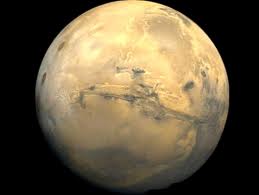
As the rover Curiosity rambles over Mars looking for signs of life, you might be interested in some background information about the planet and previous exploratory missions.
Olivier de Goursac is a science writer and space imaging specialist and his book Visions of Mars is spectacular, not just because of the photos, but because the author makes us feel right at home on Mars.
While marvelling at features such as the Valles Marineris canyon which is 5000km long and up to 11 km deep, we learn about how Mars has contributed to our understanding of geology due its exposed layers of rock, its huge volcanoes and its craters.
Four billion years ago Mars was covered in a sea 400 feet deep. When the acidic water evaporated it left behind salt minerals. Life could have evolved in this environment, but now the planet is cold with an average temperature of -63 degrees Celsius. Water is frozen in the soil, and on the surface it takes the form of water ice and dry ice.
Making Mars habitable would involve heating the dry ice of the South Pole in order to release carbon dioxide. Greenhouse gases could be used for this (although not CFCs). It would take hundreds of years for the atmospheric pressure to rise, and then hundreds more, before enough plants are producing sufficient oxygen to support human life.
But lets wait and see what Curiosity finds. In the meantime come in and do some research at the Toronto Reference Library, Business, Science and Technology Department.
One thought on “Curious about Mars?”
So we remain optimistic that one time Mars will surpot life,that’s very interesting.