Decoding Sherlock Holmes
Arthur Conan Doyle's 60 stories about
Sherlock Holmes are so full of ingenious plots and clever devices that many have
had occasion to wonder how he came up with his ideas. A new item in the Arthur
Conan Doyle Collection sheds light on Arthur Conan Doyle's creative process,
particularly in relation to his Holmes story "The Adventure of the Dancing Men."
Sherlock Holmes are so full of ingenious plots and clever devices that many have
had occasion to wonder how he came up with his ideas. A new item in the Arthur
Conan Doyle Collection sheds light on Arthur Conan Doyle's creative process,
particularly in relation to his Holmes story "The Adventure of the Dancing Men."

Conan Doyles' Dancing Men code
The villain in this story communicates
via a code of little stick figures (the "dancing men" of the title), and the
case is only solved when Holmes's client Hilton Cubitt hires him to crack the
code. Arthur Conan Doyle is said to have gotten the idea for this inventive code
after seeing some stick-figure letters drawn by a young boy in an autograph
book. That same autograph book is now the newest addition to the Toronto Public
Library's holdings related to Arthur Conan Doyle and his works.
via a code of little stick figures (the "dancing men" of the title), and the
case is only solved when Holmes's client Hilton Cubitt hires him to crack the
code. Arthur Conan Doyle is said to have gotten the idea for this inventive code
after seeing some stick-figure letters drawn by a young boy in an autograph
book. That same autograph book is now the newest addition to the Toronto Public
Library's holdings related to Arthur Conan Doyle and his works.
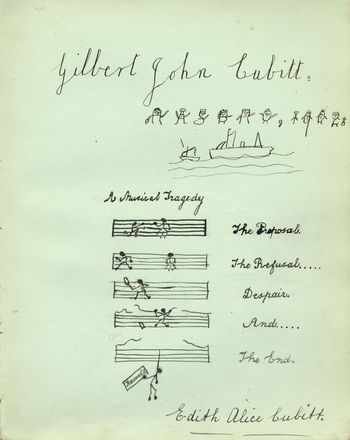
Autograph book entries by Gilbert John Cubitt and Edith Alice Cubitt
The case for the autograph book as
inspiration is compelling. The name Cubitt appears throughout the book, and
judging from the many sketches and paintings within, they were an artistically
inclined family. The little figures drawn by young Gilbert John Cubitt are
really ornamented letters and numbers rather than a code per se, but it is easy
to see how the drawings, along with Edith Alice Cubitt's stick-figure musical
notes would have suggested the Dancing Men code to Conan Doyle. If you look
closely enough at Gilbert's entry to break the "code", you will see that he
signed it in 1902. Therefore, we know the page was already in the book when
Arthur Conan Doyle signed it in May, 1903. "The Adventure of the Dancing Men"
appeared in the Strand Magazine in December, 1903.
inspiration is compelling. The name Cubitt appears throughout the book, and
judging from the many sketches and paintings within, they were an artistically
inclined family. The little figures drawn by young Gilbert John Cubitt are
really ornamented letters and numbers rather than a code per se, but it is easy
to see how the drawings, along with Edith Alice Cubitt's stick-figure musical
notes would have suggested the Dancing Men code to Conan Doyle. If you look
closely enough at Gilbert's entry to break the "code", you will see that he
signed it in 1902. Therefore, we know the page was already in the book when
Arthur Conan Doyle signed it in May, 1903. "The Adventure of the Dancing Men"
appeared in the Strand Magazine in December, 1903.
Coincidence? We think
not.
not.
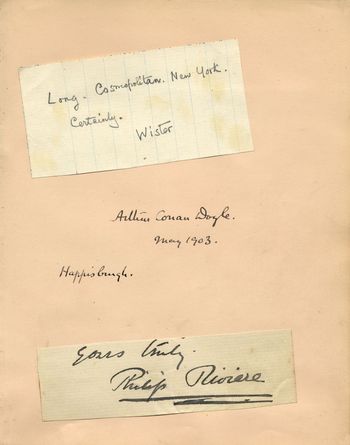 Conan Doyle's autograph, May 1903
6 thoughts on “Decoding Sherlock Holmes”
This is SO cool. I’m curious to know: how did this item land in the library’s donation? Was it bought at auction? Donated? And is it freely available to use by the public? Tell me more!
And by “the library’s donation” I meant “the library’s collection” – whoops!
Hi Mary,
This item was purchased from someone who found it at a flea market in England. A real “Antique Roadshow” story, don’t you think?
As soon as the autograph book is processed and catalogued, it will definitely available for use by the public in the Baldwin Room at the Toronto Reference Library. You can also contact the Special Collections department for further details about accessing the item.
Excellent news! I’m delighted to know that the book is now in a great public collection.
Thanks for a fascinating post – Herbert & Kate Cubitt ( paren’ts) are buried in Brockley cemetery in SE London ( England) & this link to SH/ACD will no doubt be sourced in future guided walks in cemetery?
Herbert Cubitt was a distant cousins of the Happisburgh Cubitts. Rather confusingly, he and wife Kate also had a daughter named Edith Alice but they were not the same person. Edith Cubitt born in London became a distinguished artist.