Brother Jellyfish: Rich and Strange Art from the Sea
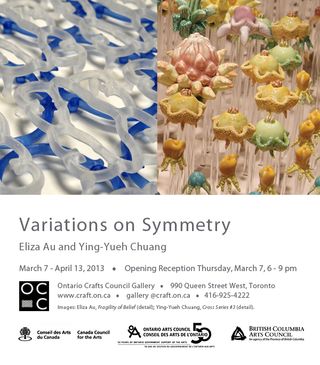
The Ontario Crafts Council on 990 Queen Street West has been showing some of the most exciting work in the city. Now until April 13th the gallery is hosting Variations on Symmetry with the work of Eliza Au and Ying-Yueh Chuang.
Both artists are able to draw extraordinary patterns from a wide variety of materials. Ying-Yeuh’s ceramics were particularly striking because what my weak eyes first thought were marzipan cake decorations turned out to be ceramic sculptures ….of SEA CREATURES.
Ying-Yeuh’s work is featured alongside other contemporary ceramic artists in these books:
500 Cups : Ceramic Explorations of Utility & Grace
Contributors: Tourtillott, Suzanne J. E.
Year/Format: 2004, Book, 408 p. :
The Penland Book of Ceramics: Master Classes in Ceramic Techniques.
Contributors: Morgenthal, Deborah, 1950- ; Tourtillott, Suzanne J. E.
Year/Format: 2003, Book, 208 p. :
Contemporary Ceramics
by Cooper, Emmanuel.
Year/Format: 2009, Book, 303 p.
I
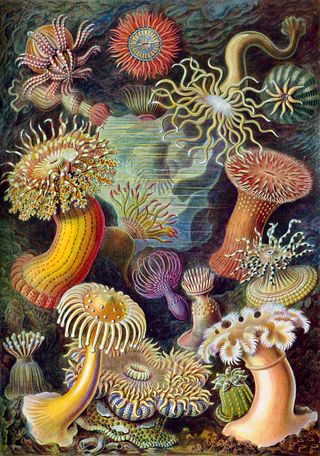
Ying-Yeuh’s work first reminded me of the pioneering work of German zoologist Ernst Haeckel. His illustrations of marine life, while often fascinatingly beautiful, can also appear strangely alien.
You can learn more about his work here:
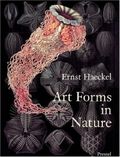
Art Forms in Nature : the Prints of Ernst Haeckel
by Haeckel, Ernst Heinrich Philipp August, 1834-1919.
Year/Format: 1998, Book, 139 p. :
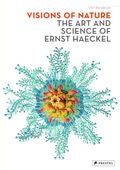
Visions of Nature : the Art and Science of Ernst Haeckel
by Breidbach, Olaf.
Year/Format: 2006, Book, 299 p. :
David Rothenberg uses Haeckel to make the controversial argument that animals have an innate appreciation of beauty:
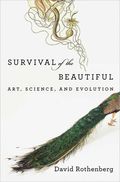
Survival of the Beautiful : Art, Science, and Evolution
by Rothenberg, David, 1962-
Year/Format: 2011, Book, viii, 311, [16] p. of plates
The title is also available as a downloadable ebook:
Haeckel is most famous however for his assertion that ontogeny (The origin and development of an individual organism from embryo to adult) repeated phylogeny (the successive evolutionary ancestors of a species). In other words the development of an embryo to adult partially mimics the evolutionary history of the whole species.
Although this widely held belief has now been largely discredited, it may help explain why marine animals are so fascinating and yet so uncanny. Look at them one way and they resemble fantastic flowers. Look at them the other and they resemble internal organs.
![ErnstHaeckel1[1]](https://blogs.tpl.ca/wp-content/uploads/2025/08/6a00e5509ea6a18834017ee9c99072970d-320wi.jpg "ErnstHaeckel1[1]")
II
This paradox is fully exploited by underground cartoonist Jim Woodring.
His graphic novels feature “Frank” a cute anthropomorphic figure—that looks somewhere between a woodchuck and a cat— who has humorous adventures in a black and white, vaguely art deco, landscape. In a lot of ways they look like early Disney cartoons.
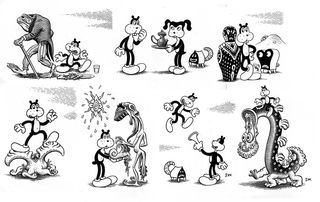
But sooner or later, along the way, the hero becomes menaced by something horrible and psychedelic right out of a David Lynch movie. And that menacing “something” usually owes more than a little to marine biology.
In 2007 some Japanese animators produced a collaborative video “Visions of Frank” with their versions of some of the classic comics. Here are three of the stories which are VERY SCAREY AND ABSOLUTELY NOT INTENDED FOR CHILDREN:
And if you enjoyed those be sure to check out the books which are also VERY SCAREY AND ABSOLUTELY NOT INTENDED FOR CHILDREN:
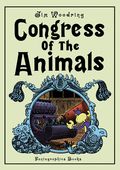
Congress of the animals
by Woodring, Jim.

Weathercraft 1st Fantagraphics Books ed.
by Woodring, Jim.
Year/Format: 2010,
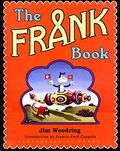
The Frank book 1st Fantagraphics Books ed.
by Woodring, Jim
Year/Format: 2003,
And be sure to visit Eliza Au and Ying-Yueh Chuang’s show at the Ontario Crafts Council.
It’s just out and out gorgeous.
One thought on “Brother Jellyfish: Rich and Strange Art from the Sea”
stunning!