Lusitania is Lost: 7 May 1915
In a year that marks the hundredth anniversary of the first use of poison gas in warfare, the battle for Gallipoli and the first air attack on Britain, there are many bloody centennials of World War I to observe in 2015. But there’s something particularly chilling about a shipwreck.

London Illustrated News, Sinking of the Lusitania, Wikicommons
The Lusitania was not the only ship, not even the only passenger ship, destroyed in war that year. Yet its name probably stands after Titanic as a legendary marine loss. Maybe it was the presence of neutral American citizens on this British ship which left New York bound for Liverpool. Maybe it was the death of so many so quickly—a single torpedo shot, and the ship sank within 18 minutes, taking 1,191 lives. Maybe it was the presence of so many children, most of whom died. Maybe it is the endless conspiracy theories that have played out since that day, as the Allies and the Axis powers both sought to justify their actions, and historians continue the debate.
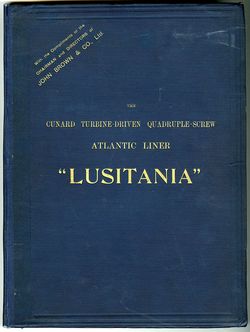 One of the marvels of the Toronto Reference Library are the books and other materials that have been here since history was a current event. Not just copies of the Globe and Mail from May 8, 1915 with the headline: Lusitania is Lost: Many Drown Torpedoed without Warning. You’ll also find the large format book produced by the Messrs. John Brown and Co. Ltd., Sheffield and Clydebank, Constructors and Engineers. Published in 1907, a few months after the launch of the great ship, it reproduces engineering drawings and dozens of photographs showing the creation of this luxurious and ultra-modern ship. They bragged it could achieve “an average speed of 24 ½ knots” between Liverpool and New York. You can hold that book in your hands any time you visit us on the second floor.
But present day always becomes history, and so you’ll also find the many works, from contemporary accounts to those produced for this centenary year, that chronicle the Lusitania and the fallout from her destruction.
Dead Wake: the last crossing of the Lusitania by Erik Larsen. Also in eBook, Audiobook, eAudiobook, Large Print
Exploring the Lusitania: probing the mysteries of the sinking that changed history by Robert D. Ballard
A Higher Form of Killing: six weeks in spring 1915 that changed the nature of warfare forever by Diana Preston
Lusitania: an epic tragedy by Diana Preston

Comments